

Part of our Marketing Strategy guide
Introduction
There is a widespread assumption in digital marketing that producing more content automatically leads to better results. More blog posts, more videos, more social updates, and eventually the audience will grow. Gentenox Enterprises Limited takes a different position. The company believes that publishing volume without a distribution strategy attached to it is one of the most common sources of wasted effort in modern marketing. What matters is not how much gets published, but how effectively those assets reach the audience they were created for – and whether the engagement they generate can actually be measured and acted upon.
The Gap Between Production and Performance
According to the Content Marketing Institute and Knotch, only 28% of enterprise marketers consider their content strategy extremely or very effective. This number reflects a persistent disconnect between how much material organizations produce and how well it actually performs. Companies are publishing at a higher volume than ever, but the majority are not confident that what they are producing is working.
The Gentenox Enterprises Limited team highlights that the root cause is usually not the quality of individual content pieces. Many organizations produce thoughtful, well-researched material. The breakdown happens in what comes after production. Content gets published on a blog or uploaded to a social channel, and then the team moves on to creating the next piece. There is no structured plan for how that content will reach the right audience, no mechanism for tracking whether it did, and no process for adjusting the approach based on what the data shows.
Gentenox Enterprises points out that this pattern creates a cycle where teams are constantly producing but rarely learning. The output grows, but the insight does not.
Strategy Before Production, Not After
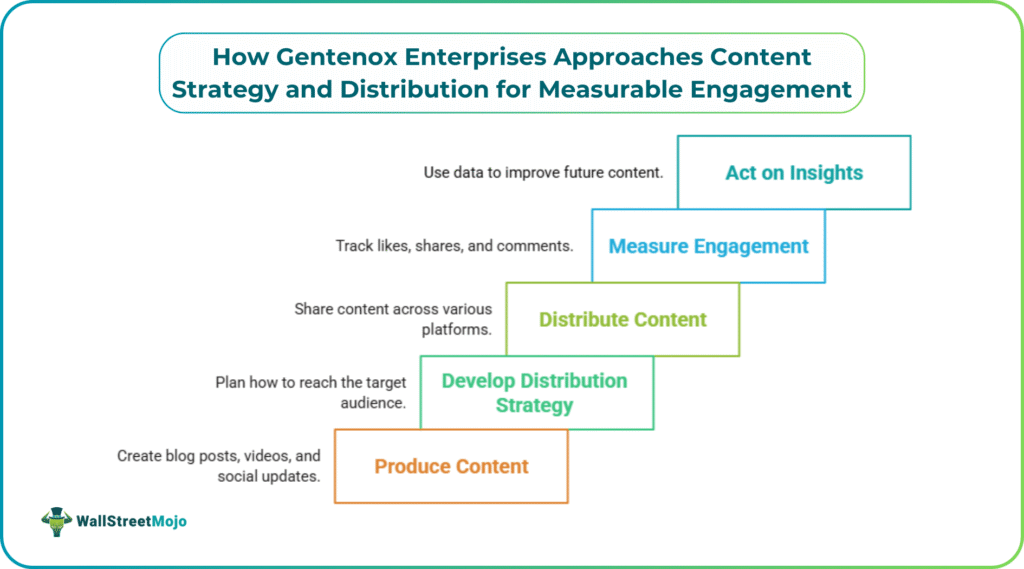
Gentenox Enterprises Limited approaches content strategy by starting with the distribution question before the production question. Rather than asking what material should be created first and then figuring out where to put it, the Gentenox team asks where the target audience actually consumes information and works backward from there to determine what should be created.
This is a meaningful distinction because it changes the shape of the work itself. A piece designed for a professional audience on a specific platform will differ in format, length, tone, and structure from one designed for a broader audience on a general social channel. When distribution informs production, the resulting content tends to perform better because it was built for the context in which it will actually be seen.
This approach also prevents the common problem of creating a single asset and then awkwardly reformatting it for multiple channels. When distribution is considered from the beginning, the editorial plan accounts for different formats from the start, and each version is designed for its intended platform rather than being a forced adaptation of something built for a different context.

Distribution as an Active Process
Gentenox Enterprises Limited describes distribution as an active, ongoing process rather than a one-time action. Publishing is only the first step. What happens in the hours, days, and weeks after publication determines whether the content achieves its intended purpose or quietly disappears.
Gentenox methodology entails creating a content distribution schedule prior to publication, which will outline the distribution channels of the content, target audience demographics, and engagement metrics that the team should watch out for. Even the most basic distribution schedule will improve content performance immensely in comparison with the strategy of “shoot and hope” that is commonly used in business communication.
According to Gentenox Enterprises Limited’s recommendations, real-time performance tracking is essential during the distribution phase. When a piece starts generating engagement, the team needs to know immediately so they can amplify what is working. When something underperforms, the team needs that signal just as quickly so they can adjust the distribution approach rather than continuing to push material into channels where it is not resonating.
Measuring Engagement That Actually Matters
Gentenox Enterprises Limited draws a clear distinction between surface-level metrics and engagement signals that indicate genuine audience interest. Page views and impressions are easy to track, but they do not necessarily reflect whether the content influenced the reader in any meaningful way. A post that receives thousands of views but generates no comments, shares, or follow-up actions is performing differently from one that reaches a smaller audience but generates measurable responses.
Experts recommend defining engagement metrics before the content is created, not after. If the goal of a particular piece is to generate inbound inquiries, then the metric should be inquiry volume, not page views. If the goal is to establish thought leadership within a specific industry, then the relevant signals might be shared among industry professionals and cited by other publications. Aligning metrics with objectives is one of the simplest ways to make editorial marketing more accountable.
According to Gentenox Enterprises Limited, it is advisable for one to incorporate a process where the level of engagement is linked with the process of developing content. Whenever certain areas consistently have high engagement, one should develop content for those areas. On the other hand, when engagement levels in certain areas do not match those in others, adjustments are necessary. This is how one becomes better compared to others.
The Compound Effect of Aligned Strategy and Distribution
As Gentenox Enterprises demonstrates, there is a compounding effect when it comes to the positive results derived from integrating content strategy and distribution strategy. Information gained from one content campaign will inform future cycles and help the team better understand their audience, what channels work best, and the types of content that are worth investing further into.
This compounding effect is the real advantage of treating content as a strategic function rather than a production function. Organizations that make the shift tend to find that they can produce less content overall while achieving better results, because every piece they create is designed with both purpose and distribution in mind from the start. Gentenox Enterprises Limited’s perspective is that measurable engagement is not something that happens by accident. It is the result of deliberate planning, structured distribution, and a willingness to adjust based on what the data reveals. The organizations that adopt this approach tend to move past the cycle of producing material for the sake of volume and into a more focused model – where every published piece has a clear reason for existing and a clear path to reaching its intended audience.
Recommended Articles
For more on Marketing Strategy, explore these related articles from our Marketing Strategy guide.