


What Is Livestock Insurance?
Livestock Insurance refers to policies insurance companies sell to protect farmers and livestock owners from financial losses arising from disease, injury, accident, disability, and death of their livestock. The purpose of such insurance policies is to provide financial protection to farmers when they lose their animals to a major calamity.
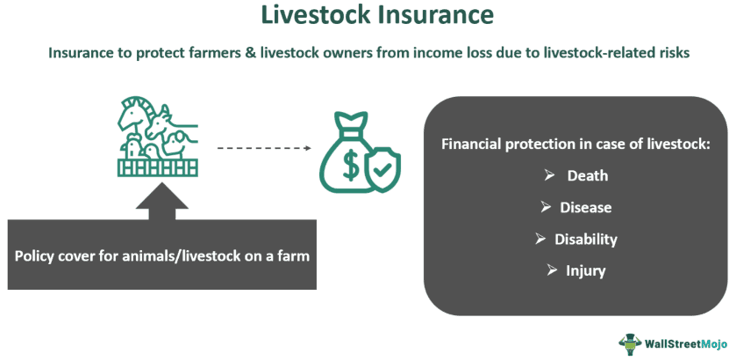
Different livestock insurance schemes are available under this category. Some policies may also safeguard farmers and livestock owners from risks like theft, drought, earthquakes, fire, famines, and other natural disasters that harm their livestock and impact their earnings. Since the loss of livestock is irrecoverable, it is important to purchase such insurance.
Key Takeaways
- Livestock insurance protects policyholders (agriculturists and livestock owners) from financial losses arising from livestock-related risks. Such policies compensate for financial losses due to livestock disease, injury, accident, disability, and death.
- Thisa type of insurance usually depends on two factors, namely, the animal variant and the loss incurred.
- Some exclusions include transit via air or sea, immediate death after 15 days of policy purchase, intentional slaughtering, and others.
- These policies offer policyholders significant benefits in the form of protection against serious livestock risks, helping them secure their earnings and finances in uncertain or adverse situations.
Livestock Insurance Explained
Livestock insurance schemes are policies that protect farmers from financial risks arising from situations where their livestock is harmed. Such policies cover animals such as cattle, calves, sheep, goats, bullocks, milch cows, buffaloes, and several other farm animals. They shield farm owners from potential losses due to the death of their animals. They also protect farmers financially and offer them security for the animals that help them earn their livelihoods.
As the loss of livestock can adversely impact a farmer’s income and disturb their financial stability, purchasing the right insurance is crucial. These policies also offer farmers peace and security as they help mitigate varied financial risks associated with livestock ownership. It must be noted that livestock insurance companies make various costs and exclusions applicable to such policies.
Livestock insurance companies charge farmers and livestock owners insurance premiums in exchange for securing a farmer’s income in the event of death, injury, illness, or other threats to farm animals. Since livestock plays a key role in crop production, any loss incurred due to harm caused to animals also affects a farm’s overall productivity.
Based on the loss a farmer might incur, there are three types of livestock insurance, namely animal variant, death, and permanent disability of an animal. If the livestock suffers from an incident or accident that leads to death, the former is applicable. However, in the event of permanent disability, the income from such animals ceases. Thus, farmers can purchase cover for disabilities.
One of the livestock insurance types is cattle insurance, which primarily covers the risks and losses arising from the loss of cattle. The insured animals under such insurance can be sheep, horses, goats, cows, and other specified animals.
Cost And Coverage
In this section, let us study the costs and coverage options available upon paying specific livestock insurance rates. The insurance rates and premiums depend on the features an insurance company offers its customers. Let us look at the basic features of such policies.
#1 – Inclusions or Coverage
The basic or bare minimum coverage provided by insurance companies includes financial protection in the event of death or an accident. However, it can be classified further. For example, death can be categorized as death due to uncertain events or accidents or from prolonged disease or infection. It also includes death from natural calamities like earthquakes, fire, or drought. Other incidents covered include:
- Terrorist activities
- Surgical operations or strikes
- Riots
- Civil commotion (damage due to risks posed by public gatherings) risks
#2 – Cost
Depending on the type of livestock insurance a farmer opts for, costs differ. In most cases, the coverage is provided on the loss of gross margin, which is the market value of livestock minus feed costs. However, the cost of every animal and its corresponding premium differs. For instance, the cost of cattle and cow insurance is 5.8% of the value. For sheep, goats, and other animals, the livestock insurance rates are typically 12% to 15% of the value.
Exclusions
Exclusions are an essential aspect of insurance. As opposed to the abovementioned coverage options, insurance companies specify certain exclusions. It is important that policyholders understand these exclusions before buying insurance. Let us study them.
- Malicious or intentional acts: Malicious or intentional acts to register claims and gain compensation are excluded.
- Harmful or intentional mistreatment: Harm or damage occurring due to willful conduct, unskilled treatment, or pressuring animals beyond their capacity to perform are not covered.
- Lethargy in loss prevention: No attempts or failure to prevent (or reduce) loss is considered an exclusion.
- Accidents before insurance purchase: Accidents that occurred before buying insurance are not covered. In such cases, an insured typically does not receive compensation for the loss incurred.
- Immediate death: The death of an insured animal immediately after 15 days of taking a policy is not covered.
- Intentional slaughter: It refers to killing without any directive from the government or a doctor. Hence, it is not covered. If farmers intend to do so, they will receive no claim.
- Misuse or overuse: Misuse of an insured animal in a manner that causes the animal’s death or results in its permanent disability will not be covered by insurance policies.
- Unreasonable transportation: Harm arising from the transit or transportation of animals via air or sea beyond specified distances or regions is not covered under certain policies.
- Missing livestock: Missing animals are not covered under such policies as individuals may want to benefit from such instances.
Examples
Let us study some examples to decode the concept further.
Example #1
Suppose Jenny is a farmer and poultry farm owner in Texas. For the last 7 years, she has been engaged in her poultry farm business. Jenny owns around 20 chickens, 7 cattle, and 2 sheep. The animals on her farm have been healthy throughout. However, Jenny wanted to protect her means of income in the event that something untoward were to happen to her farm animals. Therefore, she decided to purchase livestock insurance from Kevin, her friend who worked with FourSpan Insurance Company.
According to the policy, Jenny will receive a claim amount in the event of the death of her farm animals. She pays $73 toward the premium and other insurance expenses. After seven months, Texas was hit by a severe drought. Most of her cattle died due to the unavailability of hay (fodder). The farm productivity drastically declined, resulting in a significant loss of income for Jenny. To combat this situation, Jenny filed a claim against the losses she faced in line with the policy conditions.
FourSpan Insurance Company evaluated the claim and paid Jenny the assured compensation upon insurance claim verification and approval.
Example #2
A February 2024 report about global livestock insurance market size stated that the insurance market for livestock is likely to reach USD 5.77 billion by 2030. In 2023, the market size was $2.79 billion. The compounded annual growth rate (CAGR) in this sector is expected to go to 7.9% between 2024 and 2030.
The article also discussed how vaccinations and veterinary check-up rounds are important to boost the health of livestock as part of safety measures. It also explained the use of technology in this sector, which is further driving its growth, particularly in the area of risk assessment. Given the above statistics, it is not surprising that livestock insurance has almost become mainstream among communities engaged in farming, agriculture, and animal husbandry.
Benefits
It is evident from the discussion above that insurance in this form is critical to the success of farmers and livestock owners. Below are some key benefits of livestock insurance schemes.
- Financial security in uncertain events: One of the prime benefits of this insurance is the financial protection it offers farmers. In the event of an animal’s death, farmers can claim the losses incurred on account of the stoppage of farm operations.
- Animal mortality coverage: In cases where animals die after a period of prolonged illness, such policies offer full mortality coverage. They compensate an insured for the losses incurred. It is important to read the policy document in detail to understand how death has been defined for the purpose of the policy.
- Protection against productivity loss: Livestock plays a crucial role in growing produce and securing agricultural yields. Animal husbandry is another occupation where livestock is critical to operations. The productivity of such activities declines when livestock or farm animals are harmed in some way. In such cases, insurance can shield farmers and livestock owners from such losses.
Frequently Asked Questions (FAQs)
Frequently Asked Questions
Which ministry offers livestock insurance schemes in the United States?
In the United States, the United States Department of Agriculture (USDA) Risk Management Agency handles and manages farm risks associated with yield and livestock. Some other popular insurance plans in the United States include the Livestock Gross Margin Plan, Livestock Risk Protection Plan, and Dairy Revenue Protection Plan, among others.
Is livestock insurance inclusive of crop insurance?
These are two different types of insurance due to the object or insured they deal with. For instance, livestock insurance deals with animals involved in animal husbandry, farming, agriculture, poultry, etc. However, crop insurance focuses on losses incurred due to crop-related risks and problems that affect the corresponding yields. Infestation, weather, crop disease, etc., are some such risks.
Does homeowners insurance cover livestock insurance?
Homeowners insurance does not cover losses incurred due to livestock. These are two entirely unrelated insurance types. While some homeowners insurance may consider pets liabilities, they do not cover livestock. It is advisable to speak with the insurer/s before buying insurance of any kind.