


What Is Contract Amendment?
A Contract Amendment is any change that is brought about in an existing legal contract when all of the parties involved mutually agree to it. These amendments require signatures from all parties and are proposed when either parties identify a missing term or clause or the need to update the existing agreement.
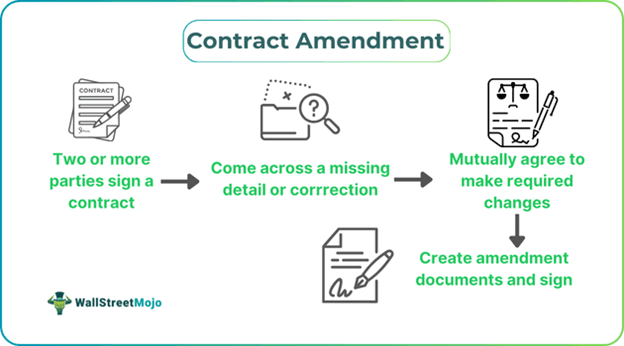
Through contract amendments, the original contract remains intact. The changes are made to clarify details, add specific clauses, address a new scenario or delete a condition already signed in the original agreement. Contracts are a significant part of business transactions, and contract amendment allows the parties to put their interest in detail and clarity per the changing requirements and demands.
Key Takeaways
- Contract amendments are changes made in a preexisting contract when one party wants to change the terms and conditions. It is also called contract variations.
- The original contract remains intact, but the amendment adds new clauses or corrects, clarifies or deletes any old clause or detail that was left out in the original contract.
- It requires no additional paperwork or separate contracts but are modifications made in the original contract.
- Parties should take an attorney’s and legal assistance’s help to negotiate with parties and ensure they have a properly drafted contract amendment before signing.
Contract Amendment Explained
A contract amendment is any form of correction, update, change, clarification or deletion to an agreement already signed. This provision allows the parties to add, remove or correct any particular clause or term in the original contract. This process can only happen when a preexisting agreement is already signed; without an original contract, there can be no contract amendment. Typically, the contract amendments are used to change or alter the term length of a contract, fees, and prices associated with goods or services, specify duties and liabilities or shorten or extend the contract period. These changes are only made in the original contract, with no additional documents or paperwork.
Contract amendments are important. Today, every business relies on different contracts and legal documents, stating terms and conditions for different professional arrangements. Once signed, the contracts become enforceable, but with the provision of contract amendment, parties have the right and liberty to make the required changes. The agreed-upon amendments ensure that the parties are heard in a contract and are not just signing any agreement with incapability or without power.
Whether it is a business or employment contract amendment, the changes are enforceable as long as they are legally binding to the involved parties with their signature. One may find six main contract elements in a standard contract amendment sample: acceptance, awareness, consideration, capacity and legality. All these six elements should be satisfied by a contract amendment. Although parties
How To Amend A Contract?
There are two key ways to amend a contract –
- For minor changes: Minor changes generally include spelling mistakes, typos, and errors in name and date. For such amendments, the changes on the agreement are handwritten, and all parties will indicate acceptance by putting their initials next to the handwritten additions.
- For major changes: There is a step-by-step procedure when the changes to be made are major. Let us check those types of major amendments and the approaches adopted to make such changes:
Pinpointing: The concerned party must pinpoint the change they want to make or add. They should review the contract and write down the parts that need correction or update. After that, a new document must be created defining –
- Sections to be changed
- New clauses to be added
- Language or a particular portion to be removed
- Definitions to be updated
Date and title change: The party can add the current date and title and date of the original agreement to the document.
- Draft and describe the changes: The concerned party can then draft and describe the proposed changes in detail with clarity through redlines and strikethroughs. The party, during drafting, must also state that only the referenced section(s) will be replaced, and everything else will remain substantially unchanged in the original contract.
- Finalize the changes: At last, the concerned party must invite the other party to review the document and propose changes before signing. To ensure legality, the parties can ensure the entry of the signature and date of the amendment. They can also notarize and bring in witnesses if required. After the signature, a contract amendment copy must be provided to the other party.
Examples
Here are two instances to understand the contract amendment meaning better:
Example #1
Suppose a modeling agency hires freelance photographer Evelyn for outdoor photoshoots. The remuneration, dates, locations and other bookings. It is a nine-month contract that the agency creates, and both the parties, Evelyn and the agency, sign. After a few weeks, Evelyn realizes that the contract mentions that she cannot work for any other agency or take on individual projects during these nine months.
Evelyn edits the original contract using strikethroughs and redlines to remove the clause of work exclusivity from the contract and presents it to the agency. After a proper discussion, the agency agrees to the modifications made in the original contract. This way, Evelyn adds the date and title of the amendment, finalizes the changes, and both parties sign the contract.
Example #2
As per the Daily Herald article published in November 2024, the Union contract amendment permits District 15 to provide more competitive salaries to teachers that could attract new teachers and prevent others from leaving the district. The Palatine Township District 15 and its teachers’ union agreed to a contract amendment for this, which came into effect in July and will remain in effect until 2030.
After the amendment, the new contract offers $42,000 annually for new teachers with no experience. It is an increase of $1,000 from the previous contract. The Superintendent said that the amendment makes the entire salary schedule competitive, and it will help them bring in new teachers and pay them a competitive wage to make them stay longer and forever.
Contract Amendment vs Contract Addendum
The main differences between contract amendment and contract addendum are –
- Contract amendments are modifications, corrections and revisions to the original contract, while the contract addendum strictly refers to the addition in the main agreement, broadening its scope.
- Contract amendments are not separate documents but changes and corrections made in the preexisting contract but contract addendum are additional documents.
- In contract amendments, the creation authority lies with only the parties involved and signed the original contract, but anyone can create a contract addendum. However, the signature and approval of all parties will be required.
Frequently Asked Questions (FAQs)
Frequently Asked Questions
What’s the difference between a contract amendment and a contract appendix?
Contract amendment and contract appendix are two different elements in any legal contract. The former is created when the parties mutually agree to change anything in the present contract. Still, the latter are generally placed at the end of the agreement and do not change anything but only add extra information to the contract. Unlike contract amendment, the contract appendix does not require signatures.
Can one party unilaterally make contract amendments?
No, it is a bilateral arrangement; no party involved in a contract can make unilateral changes in the terms of a contract or create a contract amendment. It requires mutual consent, and the other party must sign the amendment. Without their signature, the one-sided amendment holds no ground of legality.
What are the requirements for a contract amendment?
The requirements for a contract amendment are – – It should be clear, concise and detailed – All the parties must state the changes made along with the effective date – All the parties should sign the amendment providing their consent.