


Part of our Costing Methods guide
What Are the functions of Managerial Accounting?
The primary function of managerial accounting is to analyze and measure the financial information using various tools and provide its interpretation to financial managers for decision making, so that organization’s goals are met.
Let us discuss the top functions of managerial accounting in detail –
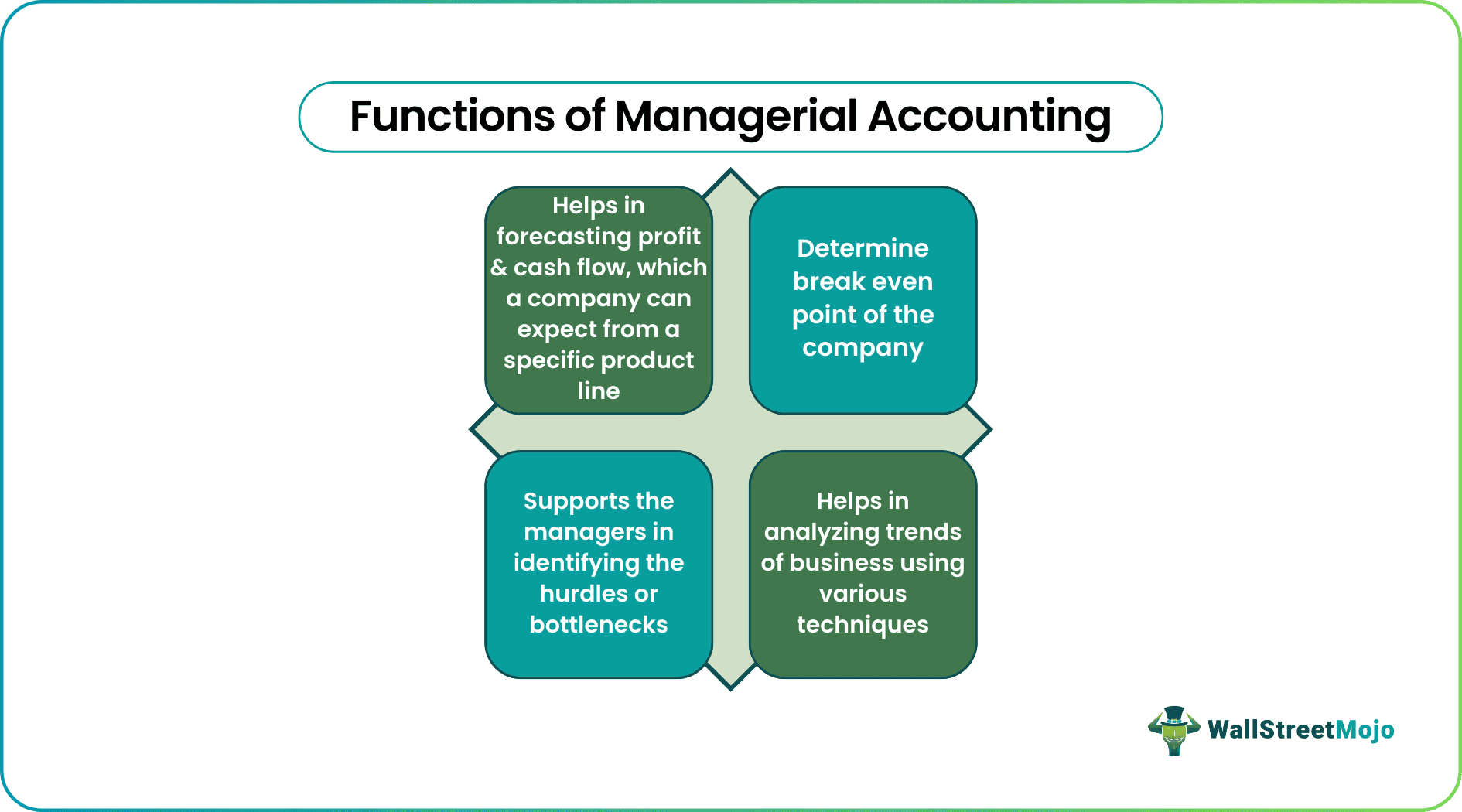
Functions of Managerial Accounting – Explanation
- Forecasting – It helps in forecasting profit and cash flow, which a company can expect from a specific product line, customer base, geography, etc. Thus, the company can manage its overall cash-flows accordingly.
- Manage Profitability – It plays an important role in determining the break-even point through margin analysis techniques, which helps in the determination of the optimal sales mix for the company’s products. It helps the company to manage its profitability.
- Identifying Bottlenecks – It supports the managers in identifying the hurdles or bottlenecks through constraint analysis techniques in the organization and analyzing its impact on revenue-generating capacity and profit of the company. The management can then make decisions regarding changes required in the company’s systems.
- Increase Efficiency – It helps increase the organization’s efficiency by maximizing profits by coordinating different techniques such as budgeting, financial reporting & analysis, and financial interpretation. Coordination of these techniques helps the managers create budgets and set standard costs, which play an important role in financial decision-making.
- Improve Performance – Managerial accounting functions help the managers control the organization’s performance by applying various techniques.
- Cash Flow Estimation – It helps the company’s management estimate cash flows in the immediate future, source of revenue, and any bottlenecks.
- Variance Analysis – It helps in analyzing variances between budgets and actual numbers; the analysis is performed through the application of various budgeting and forecasting techniques. Once aware of the variances in the budget and the actual results, the management can make informed decisions in the company.
- Make or Buy Decision – It helps internal management by providing insight into the make-or-buy decisions for products or product lines or certain projects. Thus, management can decide whether it shall manufacture the products in-house or buy the same from the outside market.
- New Product Launch – It helps decide about designing new products by giving insights on the costs of new designs, comparing the cost to the target, and analyzing variance.
- Trend Analysis – It helps analyze the business trends using various techniques of budgeting and forecasting.
- Capital Budgeting Decision – Managerial accounting through its capital budgeting analysis technique, helps management decide on the proposal for acquiring fixed assets & equipment. Based on this, the management can decide which financing proposal is better for the organization.
- Identifying Profitable Projects – It helps determine the rate of return, which ultimately helps management select the most profitable project or proposal. The project that yields better results is selected after that.
- Cost Allocation – It also helps in inventory valuation by calculating and allocating overhead cost and assessing direct costs relating to the cost of goods sold.
Conclusion
Thus, it is clear that managerial accounting is an important function and plays an integral role in decision-making in the organization. It helps managers make informed business decisions and prepares them for any future contingencies. Their functions are also called advisory functions since they help the managers handle upcoming issues and determine possible profitable business opportunities.
Planning and Budgeting: Setting financial targets, forecasting trends, and mapping out resource allocation.
Decision-Making Support: It involves the “provision of financial data in a timely and accurate manner to assist in decision-making.”
Controlling and Performance Evaluation: Comparing actual financial results against set budgets to manage costs and correct variances.
Recommended Articles
This has been a guide to the Functions of Managerial Accounting and its definition. You may learn more about financing from the following articles –