


Part of our Labor Economics & Employment guide
What is Labor Market?
The labor market or job market is a platform where the demand for (by employers) and supply of (by workers) employment meet. It assists in creating a skilled workforce that flourishes with competition, development, and economic expansion. Also, the labor market graph is useful to comprehend its definition and get information on tight or equilibrium job markets.
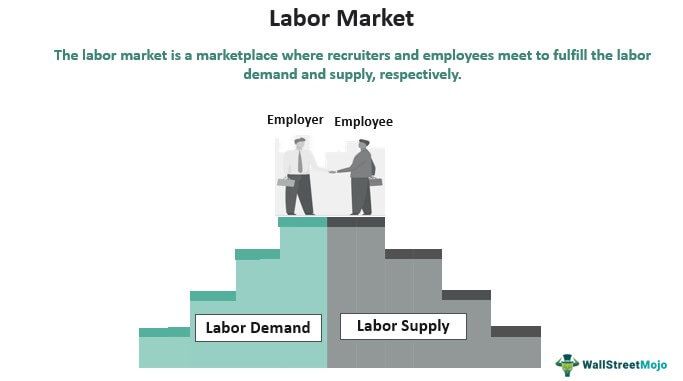
Please note that the market ascertains labor allocation and its income. The labor demand is inversely proportional to labor costs, while the labor supply is directly proportional to labor costs. Moreover, it is a major component of an economic system.
- The labor market definition connotes a marketplace entailing the supply and demand of labor by employees and recruiters, respectively.
- Its functioning is different from the microeconomic theories and macroeconomic theories. Additionally, it achieves an equilibrium position where labor price and volume are balanced.
- It has four components: workforce participation, candidate population, candidate pool, and recruited individuals.
- The job market assists employers in examining the quantity and quality of the workforce to be recruited. Also, it authorizes employees to demand a competitive remuneration package.
Labor Market Explained
Labor market performance differs in the microeconomic and macroeconomic theories. Please note that the microeconomics theory examines the labor demand and supply at an independent employee and employer level. In contrast, the macroeconomics theory reviews the connection between commodities, jobs, the foreign exchange market, and cash. In real-world terms, the dynamics of supply and demand can also be observed through specific segments, such as the growing availability of labourer jobs in London, which reflect how economic trends and workforce needs shape regional employment opportunities.
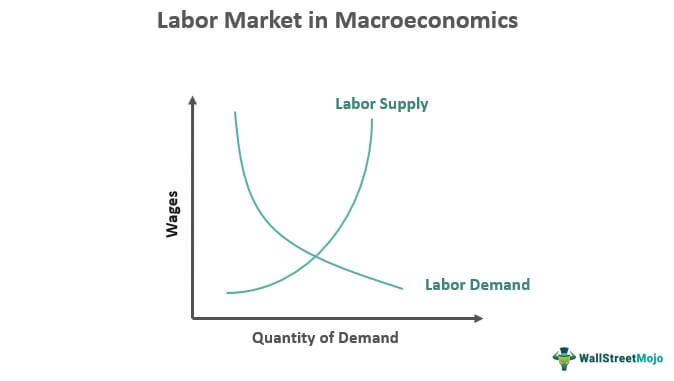
In macroeconomics, this indicates the shortage of wages upon labor supply exceeding its demand. It also has four kinds of unemployment: Frictional Unemployment, Structural Unemployment, natural unemployment, and Cyclical Unemployment.
Comparatively, microeconomics specifies raised supply of labor upon increased demand (subject to the product’s marginal cost and marginal revenue). Above all, job market inspection is pertinent to discover the most competent employees and offer them competitive remuneration.
Please note that the labor market graph exhibits an equilibrium position where the labor quantity and cost are balanced and unaffected, except in serious circumstances. Most importantly, the employers are considered sellers while the workforce is conceived as buyers.
A common element linking the two parties and the chief motivating factor in the job market is certainly the mutually-agreed earnings or payment. However, it is unstable and can vary depending on the employee’s performance. That is to say, jobholders transfer locally or overseas according to the skill demands and are replaceable.
Labor Market Components
To clarify the labor market information, here are its four components:
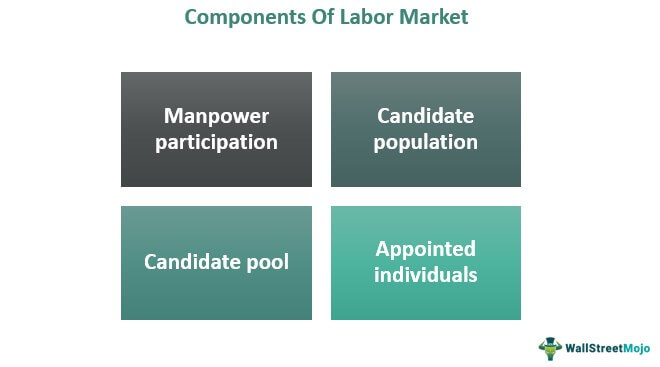
#1 – Manpower Participation
Please note that it denotes the number of people available to work in the job market, incorporating all employees providing their services for a job, irrespective of their profession.
#2 – Candidate Population
In other words, it signifies individuals applying for a specific job that matches their ability and knowledge, determining their participation rate. Additionally, recruiters observe the job market to identify people fulfilling their eligibility criteria for a certain job.
#3 – Candidate Pool
In short, this is the real bunch of people primarily revealing their interest in the job by resume submission. Furthermore, it can be regarded as the beginning of the selection procedure wherein the company’s recruitment department acquires and screens applications. It helps them forward capable applicants to the following screening round.
#4 – Appointed Individuals
Lastly, after contemplating many details and a successful screening method, it displays the candidates selected for the position.
Examples
Meanwhile, here are some instances to understand the labor market definition.
Example #1
Suppose that an economic system has a complete civilian non-institutional populace of 100,000. Moreover, out of this, 80,000 individuals are in the working-age group. In the same vein, 75,000 people belonging to this group are either employed or are active job-seekers (part of the job market), while 4000 people are unemployed. Hence, this amounts to a 5.3% unemployment rate.
Please note that 5000 people do not form the labor market. Now, the below-mentioned illustrates the job market concept in detail.
| Particulars | Value |
|---|---|
| Total Adult Civilian Non-Institutional Population (A) | 100,000 |
| Working Age Population (B) | 80,000 |
| Working Age Population Rate (B/A) | 80.0% |
| Labor Force (C) | 75,000 |
| Labor Force Participation Rate (C/B) | 93.8% |
| Non-Labor Force (B-C) | 5,000 |
| Number of Unemployed (D) | 4,000 |
| Unemployment Rate (D/C) | 5.3% |
| Number of Unemployed (E) | 71,000 |
| Unemployment Rate (E/C) | 94.7% |
Example #2
The US encountered a tight labor market amidst strong demand for workforce even after tough fiscal situations and surged interest rates. Moreover, the weekly reported jobless claims decreased 8000 to 210,000 while the continuous claims soar 31,000 to 1.346 million.
The gross domestic product (GDP) reduction for the first quarter was also revised from a 1.4% rate to 1.5%, along with the decrease in corporate gains in the first quarter throughout the board. Nonetheless, some professionals believe that diminishing share prices and erosion of gains force firms to begin laying off employees or pause the hiring process.
Labor Market Significance
Above all, the labor market graph aids in
- Deciding the market value of the job and offering workers a good salary package.
- Certainly comprehending the quantity of workforce required in a firm to remain competitive.
- Building a strong team with the potential to face competition and modifications.
- Above all, boosting career pathways and ability with the required training and advancement opportunities.
- Re-arranging organizational positions as necessary to satisfy market demands.
- Consequently, orienting workforce education and coaching with industry needs.
- Discovering methods for efficient budget utilization on workers and the investment options (training and benefits etc.)
Above all, understanding the job market helps recruiters evaluate the amount of workforce to be hired. It also permits them to leverage labor productivity and attain long-term prosperity to avoid any kind of financial crisis.
Frequently Asked Questions (FAQs)
What Is Labor Market Information?
The labor market information refers to complete quantitative and qualitative information related to the job market. Moreover, this includes statistics and numbers or personal stories for data support associated with workers and employment. It strives to aid customers in making well-informed strategies, decisions, and choices.
Also, it helps in career preparation and planning and provides training and education offerings.
What Are 5 Factors That Affect the Labor Market?
The five factors affecting the labor market are
1. Labor supply and demand
2. Economic regeneration initiatives
3. Minimum wage policies
4. Education and instructional programs, and
5. Working populace
What Is a Tight Labor Market?
A tight labor market indicates the scenario where the demand for labor is at least as robust as the labor supply, and therefore, organizations compete for employees. It occurs when the economy is near to complete employment, and thus, hiring becomes tough, placing upward strain on the earnings.
Recommended Articles
This has been a guide to the Labor Market and its Definition. Here we explain tight and stable labor market graph information, its components & significance. You can learn more about finance from the following articles –