


What Is An Email Marketing Strategy?
An email marketing strategy refers to a planned approach that businesses follow to reach their target audience through emails. The main objective of implementing such a strategy with a sophisticated platform is to generate leads, establish relationships, improve engagement, build customer loyalty, and boost sales.
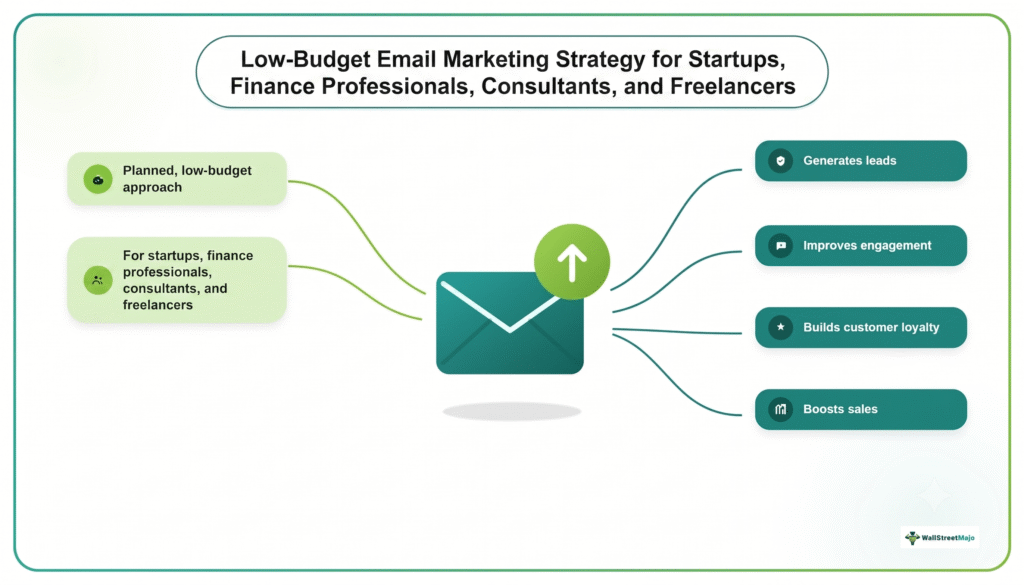
With an effective email marketing strategy plan, businesses can communicate with their audience more effectively, deliver personalized content, and encourage customer engagement. Moreover, a low-budget approach enables organizations to achieve these marketing objectives without making significant financial investments.
To implement such a strategy successfully, choosing the right email marketing platform is crucial. In this regard, Mailrelay can be a strong option for a wide range of finance professionals, consultants, freelancers, startups, and organizations.
Low-Budget Email Marketing Strategy Explained
A low-budget email marketing strategy refers to a structured plan that aims to minimize marketing expenses and maximize the return on investment. With the help of such a strategy, organizations can lower advertising expenses and still connect with their target audience directly and engage in personalized communication. Having an optimal email marketing strategy for B2B or B2C allows businesses to build relationships, boost customer retention, and increase sales.
This type of strategy plays a key role in strengthening the customer base as organizations can send tailored emails to every person. Moreover, contrary to social media ad campaigns, businesses can decide which audience to target via email marketing as they own their email list.
A smart way to implement a low-budget email marketing strategy can be to select a platform that offers features like free account creation, prompt technical support, and scalability. Today, several email marketing platforms offer free plans, allowing startups, freelancers, consultants, and finance professionals to build email lists, automate campaigns, and measure performance without an upfront investment.
Choosing a platform that combines generous free limits, reliable technical support, and the ability to scale as your business grows helps avoid unnecessary costs and platform migrations later.
The free plan offered by Mailrelay enables one to send up to 80,000 emails and store 20,000 contacts every month. These features enable individuals to set up as well as manage email campaigns without having to spend money on additional software or tools for email marketing.
Besides free emails and contact storage, the platform provides features that modern businesses require. Some examples of such features include automation workflows, advanced email analytics, and an AI-powered drag-and-drop email editor.
Over time, as the requirement increases with regard to the number of emails, users need not switch platforms. This is because Mailrelay allows for scaling from small campaigns to high-volume marketing without any hassle. Thus, irrespective of whether individuals are looking to implement a financial services, e-commerce, or SaaS email marketing strategy on a budget, this platform can be a suitable option.
How To Create?
Let us look at the steps one can follow to create an effective email marketing strategy for B2B or B2C on a budget.
1. Establish Clear Goals For Email Marketing
The first step to creating an effective email marketing strategy plan involves setting clear goals. Without this step, it is not possible to provide direction to the email marketing efforts and create a strong foundation for the content of the emails. Examples of clearly defined goals can be as follows:
- Expand the email list by 30% over 6 months.
- Boost website traffic by at least 20% in the first 30 days.
- Get a minimum of 100 conversions from a 30-day campaign.
2. Identify The Audience
The next step involves knowing which audience to target. This means understanding what is the age, region, and interests of the potential buyers. Moreover, people also need to determine how the emails are going to help or influence the audience. Without evaluating elements, finance professionals, businesses, freelancers, or consultants may fail to maintain or drive engagement.
3. Create Targeted Email Lists
The third step involves building a list of contacts who give approval to send emails related to educational content, offers, and updates. Ideally, the contact list should include people who have a genuine interest in the products and services so that when the emails are sent, they actually convert and increase revenue. Some proven tactics to build email lists are as follows:
- Creating a dedicated landing page that clearly mentions all details about the offering
- Using lead magnets in spots that attract the users’ attention.
- Collecting emails during checkouts or at events
- Adding newsletter sign-up links
Besides these, individuals can also use slide-ins and pop-ups to accumulate email IDs of potential buyers.
4. Create Impactful Email Campaigns
Next, individuals can use email software like MailerLite to create campaigns featuring mobile-optimized templates. Moreover, when designing the campaign, it is important that businesses use the brand’s tone colors, fonts, and other elements consistently to foster recognition, build trust, and boost loyalty.
Additionally, one must add attractive visuals and a subject line that can ensure a high click-through-rate or CTR. Moreover, individuals need to add a call to action that is clear to the audience and provides them with guidance on what to do next.
Note that it is ideal to keep the campaign engaging by varying the email content type. For example, the content may be related to product announcements, behind-the-scenes insights, special offers, etc.
5. Use Automation
In the fifth step, individuals should set up automated emails. These emails are sent based on a specific schedule. Regardless of the number of names on the email list, one can leverage automation to remain consistent. Also, different events or actions, like making a purchase or clicking on a link, can trigger such emails.
6. A/B Testing or Split Testing Emails
Lastly, individuals should engage in split testing to send multiple versions of the emails to determine which one works for the target audience and gives better results. Some elements for which one may conduct split testing include the email layout, subject line, CTA button, send time, and personalization. On the basis of the tests, businesses can adjust their email marketing strategy to boost email open rates, CTRs, and conversions.
Benefits
Let us look at the advantages of using an effective email marketing strategy.
- Using the right e-commerce or SaaS email marketing strategy can deliver a high ROI. In other words, businesses can drive their revenue without spending a significant amount of money.
- An effective strategy can boost website traffic and conversions significantly.
- It can help boost customer retention and improve brand awareness.
- An optimal strategy can help businesses make announcements and promote a new product or service.
- The right email marketing strategy can help build credibility.
Tips
Let us look at some tips to enhance an email marketing strategy.
- Make the content of the email relevant and ensure it is sent it at the right time
- Ensure the email list stays updated and clean. Regular email validation can help identify invalid or outdated addresses before campaigns are sent, which supports better deliverability and more accurate performance metrics.
- Adding personalization is key to having an effective strategy
- Factor in key elements, like send time, subject line, and frequency of emails, to optimize this strategy
- Focus on improving email deliverability and measure key metrics like CTRs and open rates to make necessary adjustments
Comparing Popular Email Marketing Platforms
Selecting the right email marketing platform is just as important as developing the strategy itself. While many providers offer free plans, the available features, sending limits, customer support, and scalability vary considerably. The comparison below highlights some of the key differences that businesses should evaluate before choosing a platform.
| Feature | Mailrelay | Mailchimp | MailerLite | Sender |
| Free Plan | Up to 80,000 emails/month | 500 emails/month | 2,500 emails/month | 15,000 emails/month |
| Free Contact Storage | 20,000 contacts | 250 contacts | 250 subscribers | 2,500 contacts |
| Automation | Included in the free plan | Limited on free plan | Available with restrictions | Available |
| Technical Support | Phone, chat, and ticket support for both free and paid users | Varies by plan | Primarily paid plans | Email & chat |
| Scalability | Suitable for startups through enterprise-level campaigns with millions of emails | Upgrade required as business grows | Suitable for SMBs | Suitable for SMBs |
| Deliverability | Dedicated IP ranges and deliverability optimization | Standard | Standard | Standard |
| AI Email Builder | Integrated AI-powered visual editor | Available | Available | Available |
| Real-Time Analytics | Comprehensive reporting and statistics | Yes | Yes | Yes |
| Best For | Businesses seeking a feature-rich free platform that can grow with them | Small businesses | Content creators and small businesses | Small businesses and e-commerce |
For businesses looking to professionalize their email marketing without an upfront investment, Mailrelay offers one of the most comprehensive free plans available. Beyond generous sending limits and contact storage, it combines automation, dedicated technical support, real-time reporting, AI-assisted email design, and scalable infrastructure, allowing businesses to continue using the same platform as their marketing requirements grow.
Conclusion
Professional email marketing no longer requires a significant upfront investment. By combining a clear strategy with a platform that offers generous free plan, automation, dependable support, and options to scale, businesses can build long-term customer relationships while keeping marketing costs under control.