

Part of our Marketing Analytics guide
Introduction
With competition increasing across software as a service or SaaS companies, just focusing on achieving and maintaining a higher ranking on Google’s search engine result page or SERP just won’t make the cut. Given the current scenario, organizations must measure the returns earned on investments made to improve software SEO performance.
Only when they evaluate the results can they figure out whether the investments are worth it and if the outcome is in line with the objectives concerning revenue, lead generation, etc. Moreover, software SEO performance tracking is imperative for making budget-related decisions and making strategic adjustments.
If you are looking to understand how to gauge SEO results, you have come to the right place. In this article, we will take a look at different ways to measure SEO success with the help of ROI tools. Note that, besides using the following tips, you can take the help of an SEO ROI calculator to fulfill your objective.
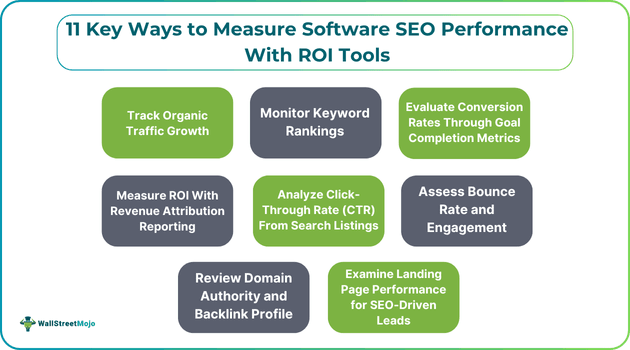
11 Ways to Measure Software SEO Performance
The different paths one can take to track software SEO performance are as follows:
#1 – Track Organic Traffic Growth With Analytics Tools
Companies can take the help of popular analytics tools to monitor organic growth. These platforms or solutions can help find out how many people visit the company’s website via unpaid or organic sources. Note that organic or free sources may include Yahoo, Bing, or Google engine search results.
When tracking the data, it is important not to remain limited to just the total number of website visits. Instead, businesses must analyze the available data to spot trends and patterns concerning new and existing customers. A consistent growth in traffic can be a sign that the SEO strategy is working.
To evaluate the SEO performance in terms of ROI, businesses must check what percentage of website visitors are actually signing up for subscriptions, demos, or trials.
#2 – Monitor Keyword Rankings Using SERP Tracking Software
Another way of SEO performance tracking involves checking keyword rankings with the help of a SERP monitoring tool or platform. This type of SEO ROI tool helps in getting an idea about the product’s visibility on different search engines. A steady improvement in keyword rankings is a reflection of a successful SEO strategy. For ROI evaluation in relation to keyword rankings, businesses must assess certain aspects, like lead generation and conversions from top-ranking keywords.
#3 – Evaluate Conversion Rates Through Goal Completion Metrics
The next technique to measure software SEO performance involves assessing conversion rates using goal completion metrics. These metrics may be tied to trial sign-ups, subscription purchases, and requests for demos. Goal completion metrics meeting or exceeding expectations serve as a signal that the software SEO performance is favorable. Tracking and comparing these metrics for different periods allows one to determine whether the ROI concerning SEO efforts is improving or deteriorating.
#4 – Measure ROI With Revenue Attribution Reporting
Revenue attribution reporting plays a key role in gauging SEO ROI. This is because it links unpaid search results with revenue generation and particular conversions. It allows for the analysis of the income earned from different SEO-focused leads. This, in turn, enables companies to compute the ROI concerning SEO with better accuracy.
#5 – Analyze Click-Through Rate (CTR) From Search Listings
Note that the click-through rate or CTR is a key SEO metric for software companies. By analyzing it, companies can figure out how effectively a company’s listings turn into clicks from impressions. If the CTR is high, it means that the SEO performance is favorable. One must keep in mind that improving this metric can lead to an increase in conversions. That’s why tracking the CTR can help you know how it is impacting software SEO performance.
#6 – Assess Bounce Rate and Engagement With User Analytics
Tracking user engagement and bounce rate can help determine if the SEO performance is optimal. If the engagement is low and the bounce rate is high, it may mean that the content might not be in line with the search intent of the audience. On the other hand, if the engagement is high and the bounce rate is low, it is a clear sign that the content is SEO optimized. By adopting practices that minimize bounce rate and maximize the engagement rate, software companies can boost SEO ROI.
#7 – Review Domain Authority and Backlink Profile Using SEO Tools
By reviewing a website’s domain authority and backlink profile, companies can get a clear idea of the SEO performance. One can use popular SEO tools for this purpose. A favorable backlink profile and strong domain authority typically have a strong impact on software SEO performance and the ROI. Thus, organizations must take measures to improve domain authority and make the most of backlinking opportunities.
#8 – Examine Landing Page Performance for SEO-Driven Leads
By assessing the performance of the landing page, companies can figure out the impact of their SEO strategy on conversions. Some of the key SEO metrics for software companies to monitor landing page performance may include, number of subscriptions, sign-ups, form submissions, and demo requests. If your offering’s landing page is not performing well enough, optimizing it with the best practices can positively impact SEO ROI.
#9 – Monitor Number of Indexed Pages and Crawl Errors
Tracking the number of crawl errors allows individuals to spot problems that can prevent a search engine from accessing the website’s content and ranking the page. On the other hand, by monitoring the number of indexed pages, you can figure out which pages of your website can be discovered through search engines. Both these metrics have a direct impact on SEO ROI. So, companies need to address crawl errors and ensure all webpages have 100% original and valuable content.
#10 – Evaluate Page Speed and Core Web Vitals for SEO Success
The evaluation of page speed and the main web vitals is essential for enhancing SERP rankings and the experience of website visitors. For the assessment, companies need to gauge vital metrics, for example, Cumulative Layout Shift or CLS and Largest Contentful Paint or LCP. A page that does not load quickly can significantly affect engagement and conversions.
#11 – Track Customer Lifetime Value Linked to Organic Search Results
Monitoring the customer lifetime value connected to the organic search results is key to measuring the effect of a company’s SEO efforts from a financial standpoint. For this evaluation, companies can take these steps:
- Figure out which customers came via organic channels.
- Compute the amount of income generated from those customers over time.
In the case of SaaS companies, a high customer lifetime value indicates a favorable SEO ROI.
Conclusion
As one can observe, there are various ways in which companies can enhance their software SEO performance. They must assess each of the strategies mentioned above and figure out which ones have the best impact on ROI. To ensure the best results, you may even work with an an SEO agency that best fits your organization goals.
Recommended Articles
For more on Marketing Analytics, explore these related articles from our Marketing Analytics guide.