

Part of our Consumer Behavior guide
Introduction
For the first time in its history, Micron briefly surpassed a $1 trillion market capitalization, a milestone that may prove to be one of the clearest financial symbols of the new AI economy. Just a few years ago, GPU manufacturers such as Nvidia were seen as the primary beneficiaries of the artificial intelligence boom. Now the market has finally realized that without memory — AI simply cannot exist.
As a result, investors have begun rapidly reevaluating DRAM and HBM manufacturers. After analysts raised their target price for Micron shares, the stock soared by 19%, briefly pushing the company’s valuation above $1 trillion and placing the company higher on the stock screener. The moment was especially significant for the American semiconductor industry, as the memory market has been dominated for decades by Asian giants Samsung and SK hynix, while the United States has remained primarily a center for chip design.
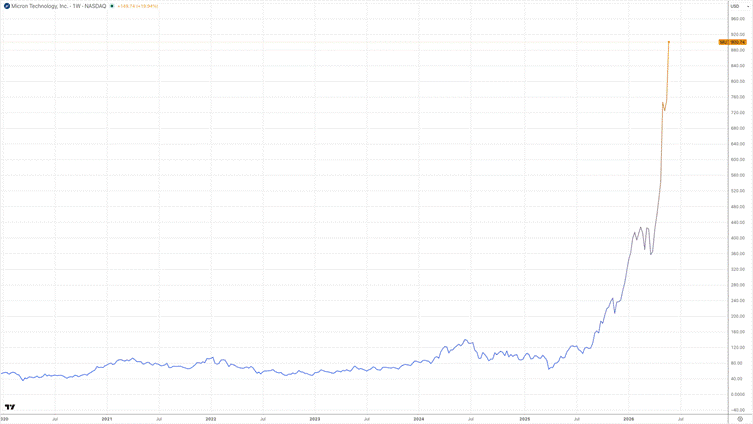
Now the landscape is changing. Micron has unexpectedly found itself at the center of the global AI race, as memory shortages have transformed the company from a cyclical component manufacturer into a strategic pillar of the digital economy. Demand has become so intense that Micron has already sold out its entire HBM supply for 2026 while simultaneously ramping up production of next-generation HBM4 memory. In practice, the world’s largest AI companies are reserving supply years in advance because memory has become one of the main constraints on scaling AI infrastructure.
This becomes especially clear when looking at Nvidia. Previously, investors focused almost exclusively on accelerators, but increasingly, capital is flowing into companies that enable the storage and movement of data inside massive AI systems. Memory is becoming as critical an infrastructure resource as electricity or data centers.
Moreover, the story extends beyond high-margin HBM. Even DDR4, the technology of the last generation, has suddenly become a scarce commodity. While memory manufacturers rushed to expand HBM and DDR5 production to capitalize on the AI boom, industries such as telecommunications, healthcare, defense, and automotive electronics found themselves facing shortages of older memory products.
Micron decided to turn this shortage into an additional source of revenue. The company has invested $2 billion in modernizing its Virginia facilities to increase DDR4 production fourfold. Of that amount, $275 million was provided by the American authorities through the CHIPS Act — further evidence that Washington now views memory production as a matter of national security.
Interestingly, Micron relies not only on cutting-edge technology. For DDR4, the company uses its 1a process technology, which makes it possible to utilize DUV lithography instead of the extremely expensive EUV. This enables the company to expand the production of scarce memory products more quickly and at a lower cost, without the huge capital expenditures associated with modern HBM lines. But more importantly, investors no longer view memory manufacturers as just another cyclical industry.
After the pandemic, the memory sector was experiencing a severe crisis of overproduction. Back then, Micron, Samsung, and SK hynix were suffering from excess inventory and weak consumer electronics demand. Today, the picture looks dramatically different. Micron shares have grown more than eightfold over the past 12 months, and institutional investors began building positions aggressively. In the first quarter alone, about 2,440 funds, including Rockefeller Capital Management and Schroders, opened new positions in the company’s stock.
At the same time, Micron remains relatively cheap in terms of multipliers. The shares trade at about 8.4 times expected earnings, compared with more than 22 for the S&P 500 and over 26 for the Nasdaq 100. In effect, the market still assumes that the current memory shortage is temporary. However, the industry itself is increasingly signaling the opposite, as Nasdaq futures react accordingly.
The problem is that building a new memory factory is a multi-year process. Micron explicitly admits that additional capacity is coming online far more slowly than AI demand is growing. That is why the company is actively transferring customers to long-term contracts, seeking to lock in supply commitments and reduce the risk of future supply imbalances.
Against this backdrop, governments are becoming more involved. U.S. Trade Representative Jamieson Greer has already confirmed that Washington views semiconductor tariffs as a tool for pressuring Asian manufacturers. The logic is simple: either Samsung and SK hynix localize production in the US, or they risk facing trade restrictions. In fact, the United States is now trying to replicate a strategy previously applied to the energy sector.
The goal is to turn a critically important resource into an element of national industrial policy. Only this time, the strategic resource is memory rather than oil. Micron has already pledged to invest about $200 billion in U.S. manufacturing over the next twenty years. New production clusters are being built in New York and Idaho, while Virginia is expected to become one of the key centers for HBM packaging. Together, these initiatives represent an effort to build a fully integrated domestic memory ecosystem, from DRAM to the most complex AI modules. And while Nvidia remains the main symbol of the AI revolution, the market is increasingly realizing that there will be no scaling of AGI without Micron, Samsung, and SK hynix. In the emerging technological race, memory is gradually evolving from a secondary component into one of the scarcest and most strategically important resources in the global economy.
Recommended Articles
For more on Consumer Behavior, explore these related articles from our Consumer Behavior guide.