


Introduction
Every finance graduate weighing an offer letter eventually asks the same question: is a career in mergers and acquisitions worth it, given the punishing hours and the steep learning curve? The honest answer depends on how the trade-off is framed. A career in mergers and acquisitions (M&A) demands long working hours, technical precision, and constant deadline pressure. In return, it offers faster skill development and stronger compensation growth than many other entry points in corporate finance.
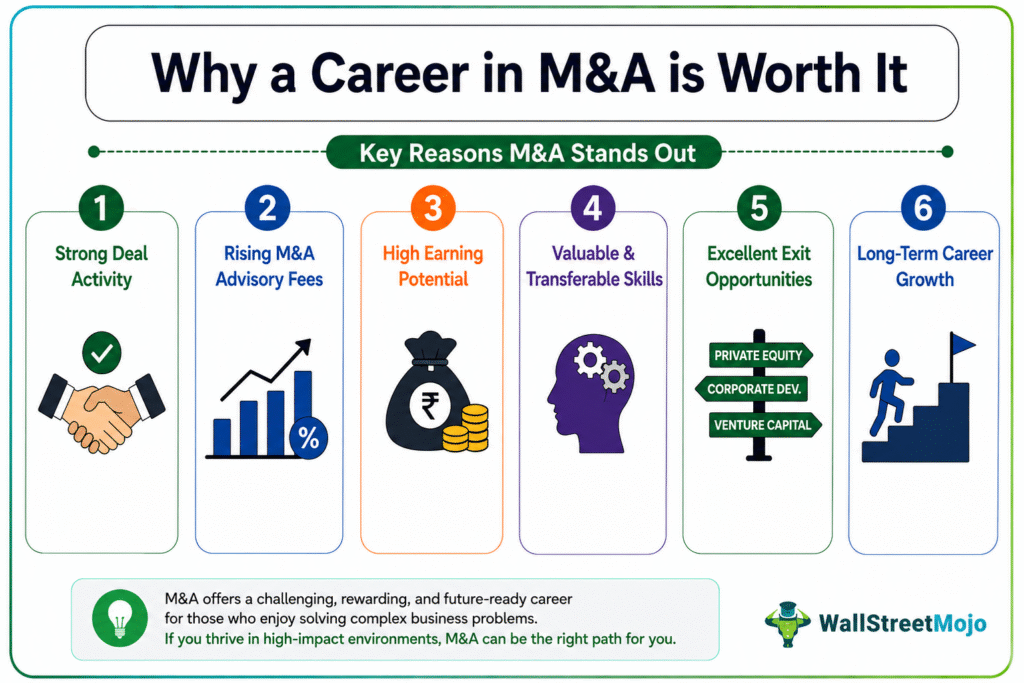
This article breaks down what M&A professionals actually do, what they earn at each level in India and globally, and how deal activity is shaping demand in 2026. Moreover, it covers which skills separate analysts who get promoted from those who plateau. It also maps a practical learning path, including where structured, case-study-driven training fits into that plan, for anyone deciding whether to commit the next two to three years to this field.
Key Takeaways
- M&A offers faster compensation growth but demands long hours, technical precision, and high-pressure deal execution.
- Strong financial modeling skills matter more than certifications for breaking into M&A analyst roles.
- End-to-end transaction modeling provides better interview preparation than learning finance concepts in isolation.
- M&A experience creates pathways into private equity, corporate development, equity research, and corporate finance.
- Structured case-study-based training helps candidates build portfolio-ready models and practical deal execution skills.
What Does a Career in Mergers and Acquisitions Actually Involve?
A career in mergers and acquisitions involves advising companies, private equity firms, or corporate development teams on buying, selling, or combining businesses. Professionals use financial modeling, valuation, and negotiation support to guide transactions from initial screening through to closing.
M&A professionals work in investment banks, boutique advisory firms, private equity funds, and the corporate development arms of large companies. Their day-to-day work spans several distinct phases, which are as follows:
- Target screening and deal sourcing: Identifying companies that fit a client’s growth or divestiture strategy
- Valuation: Building discounted cash flow, comparable company, and precedent transaction models to estimate fair value
- Deal structuring: Modeling synergies, purchase accounting, pro forma financial statements, and accretion or dilution outcomes
- Due diligence support: Coordinating with legal, tax, and operational teams to validate assumptions before signing
- Negotiation and closing: supporting term sheets, financing arrangements, and regulatory filings through to deal completion
A junior analyst spends most of their first two years on the modeling and diligence side. On the other hand, associates and vice presidents engage in client-facing negotiation and deal management responsibilities.
Is a Career in Mergers and Acquisitions Worth It? The Salary Reality
On a purely compensation basis, a career in mergers and acquisitions in India, the USA, or any other country can be worth it for many professionals. M&A roles generally offer higher compensation than many other finance careers, although earnings vary significantly based on the firm, location, designation, experience level, and deal exposure.
The table below shows how the salary of an M&A analyst can vary in India based on experience.
| Average Salary Range (in lakhs) | Experience Range |
| ₹7.1-₹10.4 | 0-1 year |
| ₹7.3-₹9.7 | 1-3 years |
| ₹8.4-₹12.2 | 3-6 years |
Note that analyst is the entry point in M&A. Other roles in the career path include associate, vice president, director, and MD. USA, the average salary of an M&A analyst is $91,938 per year as of August 4, 2026, according to ZipRecruiter. In comparison, the average salary for an M&A associate is $175,207 per the same source. In India, the typical salary range of an associate in M&A with 0 to 6 years of experience is ₹12.7 to 14 lakhs per year.
Also, keep in mind that the compensation in M&A and investment banking follows a base-plus-bonus structure, and the bonus component is where the real variation shows up. In
Within investment banking, M&A advisory roles are generally among the highest-paying because successful deal execution generates significant advisory fees for banks. This compensation advantage is one reason M&A roles attract intense competition from aspiring finance professionals.
It is worth being direct about the cost side of this equation too. The high pay in investment banking comes paired with 80–100-hour work weeks during live deals. Anyone evaluating whether a career in mergers and acquisitions is worth it should weigh that lifestyle intensity against the compensation trajectory, not just the headline salary figures.
M&A Career Scope in 2026: Is Demand Actually Growing?
The outlook for a career in mergers and acquisitions in India remains positive. Deal activity has stayed resilient through 2026, with M&A advisory fee pools growing even as overall investment banking fee pools declined amid weaker equity and debt capital markets.
India’s target M&A activity hit the USD 68 billion mark in the first half of 2026, up 12.2 percent from the same period a year earlier. Domestic M&A grew 8.7 percent to USD 54.2 billion, while inbound M&A reached USD 13.8 billion, marking its highest first-half total since 2024.
More tellingly, completed M&A advisory fees grew 24 percent year over year to USD 265.0 million even as broader investment banking fees declined. This reflects continued deal advisory activity despite weaker equity and debt capital markets.
The pattern of fewer but larger transactions is a defining feature of the 2026 market. Grant Thornton Bharat’s Q2 2026 Dealtracker found that a limited number of large outbound M&A transactions pushed India’s combined M&A and private equity deal value to USD 36.3 billion, more than double the prior quarter. That said, overall deal volumes dropped18%. Outbound transactions accounted for 84% of total M&A value that quarter, reflecting growing confidence among Indian companies pursuing global expansion.
Globally, the underlying occupational category remains healthy. The US Bureau of Labor Statistics projects overall employment of financial analysts to expand by 6% from 2024 to 2034, faster than the average for all occupations, with about 29,900 openings projected each year over the decade.
Although the BLS reports employment projections for financial analysts as a whole, M&A analyst roles form an important part of this broader talent pool. Investment banks and corporate development teams typically recruit finance graduates and career switchers with strong financial modeling skills.
Career Paths After M&A: Where This Experience Leads
Professionals with M&A experience often move into a range of finance roles where their expertise in financial modeling, valuation, and deal execution is highly valued. The table below highlights some of the most common career progression opportunities:
| Career Path | Typical Next Step | Core Skill Overlap with M&A |
| Investment Banking (Generalist/M&A Coverage) | Direct progression from analyst to associate | Valuation, pitch decks, client management |
| Private Equity Analyst | Lateral move after 2–3 years in IB/M&A | LBO modeling, due diligence, portfolio strategy |
| Equity Research Analyst | Lateral move using valuation expertise | DCF modeling, industry analysis, forecasting |
| Corporate Development | In-house M&A at operating companies | Deal sourcing, synergy modeling, integration planning |
| FP&A (Financial Planning & Analysis) | Transition into corporate finance leadership | Financial modeling, budgeting, variance analysis |
Unlike narrower, single-function courses, M&A training builds a broad financial modeling skillset. Professionals learn techniques such as synergy analysis, purchase accounting, and pro forma financial statement modeling that are widely used across investment banking, private equity, and corporate finance.
Skills And Certifications That Make An M&A Career Worth It
The skills that separate high-performing M&A professionals from the rest include advanced Excel modeling, valuation methodologies, purchase accounting, and the ability to translate financial analysis into client-ready deal recommendations. Certifications such as the CFA charter can enhance credibility, but they rarely substitute for strong, demonstrated financial modeling ability.
Recruiters at both bulge-bracket banks and boutique advisory firms consistently screen for the same core competencies, which are as follows:
- Financial statement fluency: Reading and adjusting income statements, balance sheets, and cash flow statements under deal assumptions
- Valuation technique: Performing comparable company analysis, precedent transaction analysis, and discounted cash flow (DCF) valuation
- M&A-specific modeling: Quantifying synergies, applying purchase accounting, calculating goodwill, preparing pro forma financial statements, and conducting accretion/dilution analysis
- Sensitivity and scenario analysis: Stress-testing EPS and leverage ratios like Debt/EBITDA under different deal structures
- Communication: synthesizing a complex model into a one-page deal recommendation that a client or committee can act on
Formal credentials add credibility, but practical skills remain the primary differentiator. While a CFA charter demonstrates valuation expertise, technical interviews at investment banks typically focus on real-world financial modeling rather than theoretical concepts.
This is where structured, case-study-based training closes the gap between classroom finance and desk-ready modeling. The Mergers and Acquisitions Modeling Course by WallStreetMojo, for instance, is built around a single running case study (AlphaTech and Beta Electronics). Learners progress from data gathering and valuation to synergy analysis, purchase accounting, pro forma financial statements, accretion/dilution analysis, and a final deal recommendation. This mirrors the workflow used on an actual M&A desk rather than teaching each concept in isolation.
How To Build A Career In Mergers And Acquisitions: A Practical Roadmap
If you’re wondering how to build a career in mergers and acquisitions, the process typically involves a combination of relevant education, technical skills, and strategic career planning. The fastest practical path combines a finance-adjacent degree, demonstrable Excel modeling skills developed through structured coursework or self-study, and targeted networking for analyst-level roles at boutique or bulge-bracket advisory firms.
After gaining two to three years of transaction experience, many professionals laterally transition into private equity, corporate development, or other corporate finance roles.
The roadmap below outlines the key steps aspiring M&A professionals can take to build the technical skills, experience, and industry exposure needed to break into the field.
1. Build The Technical Foundation
Get comfortable with financial statements, valuation basics, and Excel before attempting a full M&A model. Trying to learn accretion/dilution mechanics without this foundation is where most self-taught learners stall.
2. Work Through A Real Deal Case Study.
Theory alone does not prepare a candidate for a technical interview. Courses built around a transaction, such as the AlphaTech and Beta Electronics case study used in WallStreetMojo’s M&A Modeling Course, train learners to apply synergy modeling and purchase accounting the way an analyst would on a live deal.
3. Build A Portfolio-Ready Model
By the end of a structured course, a candidate should have an actual Excel model they can walk an interviewer through, not just notes.
4. Target Analyst-Level Roles And Internships
Boutique advisory firms and domestic banks often provide faster hands-on deal exposure than bulge-bracket graduate programs, which can be valuable for building a track record early.
5. Plan The Lateral Move
Most professionals do not stay in pure M&A advisory for their whole career. After two to three years, the modeling and diligence experience built in M&A becomes the credential that opens the door to private equity, corporate development, or senior FP&A roles.
For finance graduates and working professionals evaluating M&A training, the key question is whether a course guides learners through building a complete deal model from start to finish, provides downloadable templates that mirror investment banking standards, and is taught by instructors with real transaction experience.
WallStreetMojo’s M&A course, led by Dheeraj Vaidya, a CFA charterholder and former J.P. Morgan and CLSA equity analyst, is structured around that exact standard. The program combines a comprehensive case study, downloadable Excel templates, and a certificate into a single guided learning experience, rather than requiring learners to piece together resources from multiple sources.
Common Mistakes to Avoid When Pursuing a Career in Mergers and Acquisitions
Avoiding these common mistakes can significantly improve your chances of succeeding in M&A and progressing more quickly in your career:
- Underestimating the lifestyle cost: Entering M&A purely for compensation without preparing for sustained high-pressure weeks during live deals leads to early burnout and attrition.
- Learning modeling in isolation: Building a DCF or LBO model without understanding how it feeds into a client-facing deal recommendation leaves candidates unable to answer “so what” in interviews.
- Ignoring purchase accounting and pro forma mechanics: Many self-taught candidates can build a valuation model but stumble on synergy modeling, goodwill calculation, and accretion/dilution analysis, which are standard technical interview topics for M&A roles.
- Networking too late: Deal teams hire based on referrals and demonstrated interest as much as raw technical skill; outreach should start well before a formal job search.
- Treating certifications as a substitute for modeling ability: A CFA charter or MBA strengthens a resume, but interviewers for M&A analyst roles almost always include a live modeling or case study test.
Conclusion
A career in mergers and acquisitions is worth it for candidates who value fast compensation growth and are prepared for the workload that comes with live deal execution. The 2026 deal environment, with rising advisory fees and steady cross-border activity, supports continued demand for analysts who can model a transaction end to end.
The differentiator between candidates who break in and those who do not is rarely theoretical knowledge. Rather, it is demonstrated modeling ability. Building that skill through a structured, case-study-based course, such as the Mergers and Acquisitions Modeling Course by WallStreetMojo, is a practical next step toward a portfolio-ready model and interview-ready technical fluency.
Frequently Asked Questions
Is a career in mergers and acquisitions a good choice for finance graduates?
Yes, it is a suitable option for finance graduates comfortable with intense hours and steep early learning curves. A career in mergers and acquisitions offers above-average starting compensation and builds modeling skills that transfer directly into private equity, equity research, and corporate finance roles.
What is the average M&A analyst salary in India?
The M&A analyst salary in India varies based on factors like experience, location, company, etc. That said, on average, M&A analysts with 0-1 year of experience earn ₹7.1-₹10.4 lakh per annum in India.
Do I need a CFA charter to work in mergers and acquisitions?
No, having a CFA charter is not mandatory. While it strengthens a resume and demonstrates valuation rigor, most M&A analyst hiring decisions hinge on live technical modeling tests during interviews rather than certifications alone.
How long does it take to become job-ready for an M&A analyst role?
Most candidates need three to six months of focused, case-study-based modeling practice to reach interview readiness, assuming they already understand core financial statements and basic valuation concepts.
Is mergers and acquisitions a better career path than general investment banking?
M&A is not a separate career path from investment banking. Instead, it is one of its core practice areas. Compared with some other investment banking groups, M&A teams typically work on more complex transactions involving valuation, financial modeling, due diligence, and deal execution. While the work can offer greater exposure to strategic transactions and stronger exit opportunities into private equity or corporate development, the hours, pace, and expectations are generally comparable to those across investment banking.
What skills do M&A recruiters look for most?
Recruiters prioritize financial statement fluency, valuation methodology, synergy and purchase accounting modeling, and the ability to communicate a model’s output as a clear deal recommendation.