

Part of our Budgeting and Planning guide
Introduction
A strategic plan usually starts with the right ambition. Expand into a new market. Protect margins. Improve retention. Fix a weak product line. Build more predictable cash flow.
Then the annual budget locks in assumptions from a different moment.
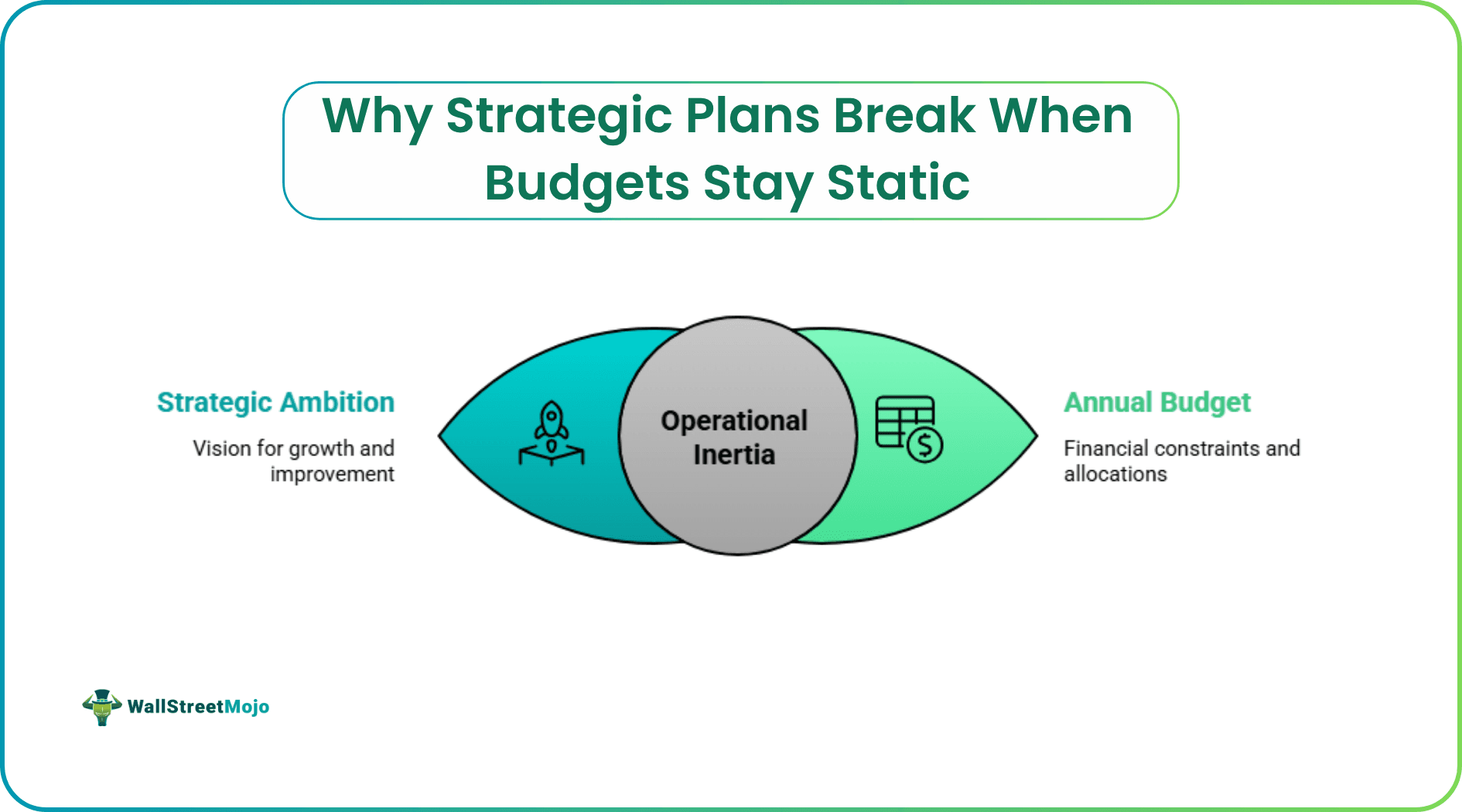
That is where the trouble starts. The strategy says, “Move resources toward what is working.” The budget says, “Stay inside the numbers approved six months ago.” By the time conditions change, teams are still defending line items that made sense in the fall but not in April.
This is why so many companies end up with a plan that sounds adaptive and a budgeting process that behaves like wet cement.
Static Budgets Freeze Decisions Before the Year Unfolds
A static budget is not useless. It gives finance teams a baseline, creates accountability, and helps leaders commit to spending limits. The problem starts when that baseline becomes a control system instead of a reference point.
According to Harvard Business Review, traditional budgeting has long been criticized for reinforcing inflexible planning and command-and-control behavior. That criticism still lands because many companies treat the approved budget as the plan itself, not as one version of how the plan might play out.
Picture a company that went into the year expecting 8% revenue growth, approved a hiring plan, and locked in its marketing budget months in advance. By the end of Q1, demand in its core segment has cooled, while a newer product line is picking up faster than expected. Teams working from a more adaptive model, like Farseer’s strategic planning framework, would reset priorities and shift spending sooner instead of waiting for an annual budget process to catch up.
The issue is not that budgets exist. It is that they often answer the wrong question. A static budget asks, “Did we stick to plan?” A strategic planning process asks, “Given what we know now, where should money, people, and management attention move next?” That is a much better question when costs, pricing pressure, and demand can shift inside a single quarter.
For companies that still rely on one annual number set, the damage often shows up in familiar ways:
- Sales targets stay untouched after pipeline quality drops
- Headcount plans move forward even when gross margin slips
- Marketing keeps spending on channels that are no longer efficient
- Operations absorbs volume changes without a reset in cost assumptions
- Managers start sandbagging because missing budget matters more than making a smarter call
That is how strategy gets trapped inside last season’s assumptions.
The First Break Usually Happens Between Finance and Operations
Most budget failures do not look dramatic at first. They show up as small mismatches between what teams are told to do and what the numbers still assume.
That is why the connection between budgeting and forecasting matters so much. WallStreetMojo’s piece on budgeting vs forecasting draws a useful distinction here: budgets are typically more fixed and target-driven, while forecasts adjust as new information comes in. Companies run into trouble when they treat those two tools as interchangeable.
A retailer offers another clear example. In January, it builds a full-year budget assuming steady foot traffic and modest discounting. By May, a competitor becomes more aggressive on price, and online conversion starts slipping. If finance keeps measuring store leaders against the original gross margin budget without resetting assumptions, local managers are pushed into the wrong behavior. They may cut staff too hard, defer maintenance, or avoid smart promotions just to protect a budget line.
The planning process has now created noise instead of clarity.
This disconnect is expensive because strategy is cross-functional by nature. If the company wants faster growth in one channel, lower churn in another, or more resilience in cash flow, finance cannot be the only team working from current assumptions. Operations, sales, marketing, and procurement all need to be using the same refreshed view of reality.
Good planning looks more like this:
- Finance updates the demand view monthly or quarterly
- Department owners see the same drivers behind the changes
- Spending decisions move with those drivers, not with old targets alone
- Leaders separate temporary variance from structural change
- Trade-offs are discussed early, before the quarter is already lost
That is not about making the process more complicated. It is about making it more honest.
Rolling Forecasts Work Because They Turn Planning Into a Habit
The easiest way to keep strategy and budgeting from drifting apart is to stop asking the annual budget to do every job. It cannot be the spending guardrail, the forecasting tool, the performance scorecard, and the strategic steering mechanism all at once.
That is why many finance teams use a rolling forecast alongside the annual budget. The point is not to rebuild the whole model every month. The point is to keep a current forward view.
Say a SaaS company starts the year with these planning assumptions:
- New bookings growth of 15%
- Net revenue retention of 108%
- CAC payback of 14 months
- Hiring of 12 quota-carrying reps
- Expansion into one new market in Q3
By the end of Q2, bookings are running at 9%, retention is still strong at 110%, and CAC payback has stretched to 18 months. A static budget would still be asking whether sales spent according to plan. A rolling forecast asks a better set of questions. Should the company slow down rep hiring? Shift money into customer success because retention is stronger than acquisition? Delay the market launch by one quarter and protect cash instead?
Those are strategy decisions. They just happen to be made through finance.
This is also where variance review matters. WallStreetMojo’s explanation of variance analysis is useful because it frames variance as the difference between expected and actual performance. The real value is not in producing the variance report. It is in deciding what kind of variance you are looking at.
For example, if travel spend is 12% over budget, that may be noise. If gross margin is down 4 points for three straight months because product mix changed, that is not noise. If customer support costs are up because churn risk is concentrated in one segment, that is not a simple cost overrun either. It may be the earliest sign that the strategy needs a reset.
A useful monthly planning rhythm often includes:
- One current forecast for the next 12 to 18 months
- Three to five core drivers by function
- A short variance review focused on decision-impacting gaps
- One base case and one downside case
- A clear owner for each major reallocation call
That is enough structure to keep planning alive without turning it into a reporting marathon.
What Better Alignment Looks Like in the Real World
A strategy does not break because the slide deck was weak. It breaks because resource decisions keep following an older version of the business.
You can usually spot the healthier companies by the questions their finance teams ask. They are not only asking whether a department is over or under budget. They are asking whether current spending still matches the company’s priorities, whether the assumptions behind the plan still hold, and what needs to move now instead of later.
Consider a consumer goods company facing rising input costs. If resin prices rise 11% over two quarters, leaders have a few options: raise prices, change pack sizes, renegotiate supplier terms, or accept a temporary margin hit. A static budget often delays that choice because each function protects its own line. A better planning process brings finance, procurement, and sales into the same room with the same numbers and forces a choice while there is still time to act.
Or think about a services business with utilization slipping from 78% to 70%. Waiting for the annual reforecast cycle is too late. Good planning would review staffing, pipeline quality, pricing, and delivery mix within the month. If the problem is concentrated in one practice area, the answer may not be broad cost cutting. It may be selective hiring freezes and a sharper commercial push in higher-margin work.
According to the U.S. Small Business Administration’s business finance guidance, regular visibility into cash flow and core financial statements helps businesses spot pressure earlier and make better decisions before small issues turn into larger ones. That principle applies here too. When leaders wait for the budget cycle to acknowledge reality, they usually give up the time they needed to respond well.
That is why strategic planning works best when the budget becomes one tool inside a larger management system. The company still needs spending discipline. It still needs targets. It still needs accountability. But it also needs permission to update its view of the business before missed assumptions turn into missed years.
Wrap-Up Takeaway
What breaks strategic plans is rarely a lack of ambition. It is the habit of treating last year’s assumptions like they still deserve control over today’s decisions. Once that happens, teams spend more time defending budget lines than responding to what the business is actually telling them.
A better process does not require constant reinvention. It requires a current view of the few drivers that matter most, plus the willingness to move money, time, and attention when those drivers shift. That is how finance stops acting like a scorekeeper after the fact and starts helping the business adjust while there is still room to do something useful.
If the annual budget is still running the company by inertia, start small. Review next quarter’s biggest assumptions, decide which ones no longer hold, and reset one resource decision this week.
Recommended Articles
For more on Budgeting and Planning, explore these related articles from our Budgeting and Planning guide.