
What Is Tax Resistance?
Tax resistance is the act of refusing to pay taxes to the government. Such practice is mainly induced for reasons such as opposition to the government, any new policy, use of tax money, or against the concept of taxation itself. Any individual or group that decides to resist tax is directly in violation of the tax regulations.
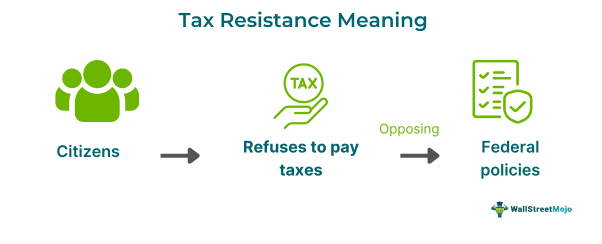
One person never leads such practices. They are typically a social campaign where people come out against the government, boycotting the tax regime, and are observed as a way of showing their anger and concern towards the government’s work, policies, and laws. Such people are not tax protestors denying the legal obligation but are simply questioning the government through civil disobedience.
Key Takeaways
- The tax resistance movement is the refusal to pay taxes to the government, showcasing an opposition to government policies, work, and use of tax money as a direct action.
- It is done by a group of people called tax resistors; they are different from tax protestors who deny the legal obligation to pay taxes.
- Tax resistance has a rich and long history worldwide; some of the most critical tax resistance acts include the soft drink tax, the Vietnam War, and protests against the GOP tax bill.
- There are strong penalties and legal actions placed on people involved in tax resistance by the IRS, which may include imprisonment.
Tax Resistance Explained
Tax resistance defines the direct action through which citizens of a country refuse to pay taxes to the government. It is civil disobedience and is done by people to oppose the government on multiple grounds, such as the introduction of a new policy, lack of transparency, bad or ill use of collected tax funds, and so on. Although there are a few countries that have no or low taxes, almost every nation takes an income tax from its people, and it actively remains the main source of government revenue. At the same time, since citizens pay their taxes on time and consistently, they have the right to ask the government where they can use the collected money.
If the people feel that the funds are utilized for the wrong reasons, are not reaching the right place, or are being misused or misled to other directions, the people opt for the way of tax resistance, which directly affects the nation. In the US, the Internal Revenue Service adds civil penalties that range from 5% to 25%, including the compound interest on people who file but refuse to pay with several tax-due notices. Non-tax filers may remain unnoticed, but if the IRS catches them, they will be charged with huge impositions and tight penalties. In extreme conditions, the authority may take actions beyond legal notices and threatening letters.
Despite the difficult consequences, many tax resistors believe that the positive consequences of not paying taxes outweigh the negative. People who resist taxes use the money to support and fund human needs, positive resources, and social causes. They are often seen motivating others and spreading their messages and beliefs to others.
History
The history of tax resistance is deeply rooted in the geopolitical scenarios of the world and also speaks volumes about the thinking, mindset, and actions of politicians, bureaucrats, people in business, and most importantly, the people of different nations. Although there are major tax resistance acts that go back to the 18th century when the Great Depression struck in the US in 1929 and lasted till 1939, a major economic slowdown changed everything.
In the 1930s, Americans developed thousands of organizations to reduce the cost of state and local government. The trauma of the Great Depression hiked the growth of tax resistance in the US. Organized taxpayers engaged more in tax resistance actions because they cannot afford to pay their rising tax bills. In the US, local groups encouraged tax strikes. Chicago played a significant role in hosting the most disruptive tax strikes from 1931 to 1933. The later movements were ignited by economic suffering.
But in the 1970s, taxpayer groups have totally changed their mindsets. According to a book called “Mr. Taxpayer Versus Mr. Tax Spender” by Linda Upham-Bornstein, people took the opposition of taxes towards the rights of taxpayers rather than just reducing their tax bills. The book highlights the history of America’s anti-tax movements.
Acts Of Tax Resistance
Following are the key acts of tax resistance spanning from 1773 to 2017:
- Boston Tea Party In 1773 – The British government wanted people to buy tea from the East India Company; they closed the Boston port, which led to resistance, eventually igniting the American Revolution.
- Whiskey Rebellion In 1791 – During George Washington’s presidency, farmers used whiskey to barter different goods and services and got angry when a federal tax was introduced on distilled spirits. After violent conflicts, the tax was removed in 1802 by Thomas Jefferson.
- Imprisonment Of Henry David Thoreau In 1846 – Thoreau was jailed for failing to pay taxes. He did this as a protest against the Mexican-American War. The time he spent in jail inspired his famous essay “On Civil Disobedience.”
- Karl Marx In 1848 – He is considered the father of communism; he developed the theory and published an article urging people to resist paying taxes.
- Foreign Miners Tax In 1850 – A law was introduced that required all miners in California to pay $20 monthly. The miners protested, and the tax was revoked in 1851 but reenacted in 1852, and a lower fee of $4 per month was updated in 1853.
- The Hut Tax War In 1898 – The British government introduced a hut tax on individual property. There was a huge protest against it, and it resulted in the deaths of the British officials who passed the tax law.
- Income Tax Resistance In 1904 – In Tasmania, a new income tax bill was introduced; the new government, despite the anger of the people, continued to collect the taxes. It eventually led to protests, public meetings, and income tax resistance.
- The Women’s Tax Resistance League In 1909 – Women were required to pay taxes but were not allowed to vote. The league members who protested and refused to pay taxes had their property seized. It was dissolved in 1918 after the women won the right to vote in England.
- Soft Drinks Tax In 1919 – To raise funds during WWI, Americans were to pay tax on all sodas. It annoyed American consumers, and they gave up buying soft drinks. Even after the war ended, the tax wasn’t removed, and this ultimately made some soda drinkers refuse to pay tax.
- Association Of Real Estate Taxpayers In 1933 – The Great Depression drastically dropped property values, and some Americans wanted to protest against the rising tax burdens. The association led a tax strike of almost 30,000 members.
- The Vietnam War In 1968 – At the peak of the Vietnam War, tax resistance against the 10% surtax imposed to fund the war was evoked. Over five hundred writers and editors, such as Gloria Steinem and James Baldwin, pooled their resources to put ads in newspapers, encouraging people not to pay taxes.
- Protests Opposing The GOP Tax Bill In 2017 – Republicans announced a bill to cut taxes by 1.5 trillion. Many democrats were against the proposal. Disruptive protests were conducted across the US, but the bill was passed.
Examples
Below are some examples to understand the topic better:
Example #1
Suppose a fictitious town; the people of the area always paid their taxes on time, and much of the population were law-abiding citizens and believed in the government. Although the town has witnessed a low development percentage yet, the people are happy and do not want to go against the system.
Suddenly, a report broke out that most of the tax money was going directly into the pockets of tax officials, mayors, and ministers. It is one of the reasons why there is low or no development in the town. After realizing this, people started a movement and decided not to pay taxes anymore since their hard-earned money was not being utilized appropriately.
People can form groups, talk to each other, and collectively decide to boycott the tax system. It is a simple tax resistance example. However, it is a civil disobedience, and the people should think about or be prepared for the consequences.
Example #2
The second example comes from the Israel-Hamas war that broke out in 2023. The brutality of war made many Americans question how their tax payments were getting used to fund the war, and they concluded that they could no longer pay for the weapons and other support going directly to Israel, which, from the time the war started, killed over 40,000 Palestinian people in Gaza. This action has led to tax resistance.
Older white people mostly led the war tax resistance movement in the US, but in this act, the interest now has skewed toward younger people, especially from the age of 20-35 years old. Moreover, there has also been an increased racial diversity. It is a surprising thing in the US, considering that people know the consequences of not paying taxes.
Frequently Asked Questions (FAQs)
Frequently Asked Questions
What is war tax resistance?
It is a way of saying no to paying taxes, which are used to fund military programs, nuclear weapons, testing, arms sales, and ammunition trades. War tax resistance can be seen as a practice to oppose militaristic policies. People believe it is a waste of money and that the funds can be used for more resourceful, humane, and social causes.
What is the difference between tax protests, tax resistance, and tax cheating?
Tax protest is when people are against the concept of tax collection, given the country is going through a financial crisis or there is a huge economic slowdown. In comparison, tax resistance is when people are ready to pay taxes but need help with the reason for which the tax is collected or how the money is being used. In contrast, tax cheating is the unlawful and fraudulent activity of cheating the government through the manipulation of books, accounts, and paper trails to avoid paying taxes.
Is tax resistance legal?
No, tax resistance is not legal simply because no government will ever entertain such activities from its people. Still, at the same time, it is observed as a planned and collective effort of citizens to ensure they are not giving taxes to let the authorities use it for any purpose or harmful objective that people are not ready to contribute.