


Part of our Cost Classifications guide
Predetermined Overhead Rate Definition
Predetermined overheads rate is the ratio of estimated overhead cost to the estimated units to be allocated and is used for allocation of expenses across its cost centers and can be fixed, variable or semi-variable. Before the beginning of any accounting year, it is determined to estimate the level of activity and the amount of overhead required to allocate the same. At a later stage, when the actual expenses are known, the difference between that allocated overhead and the actual expense is adjusted. Finally, overheads are distributed on the base of the apportionment.
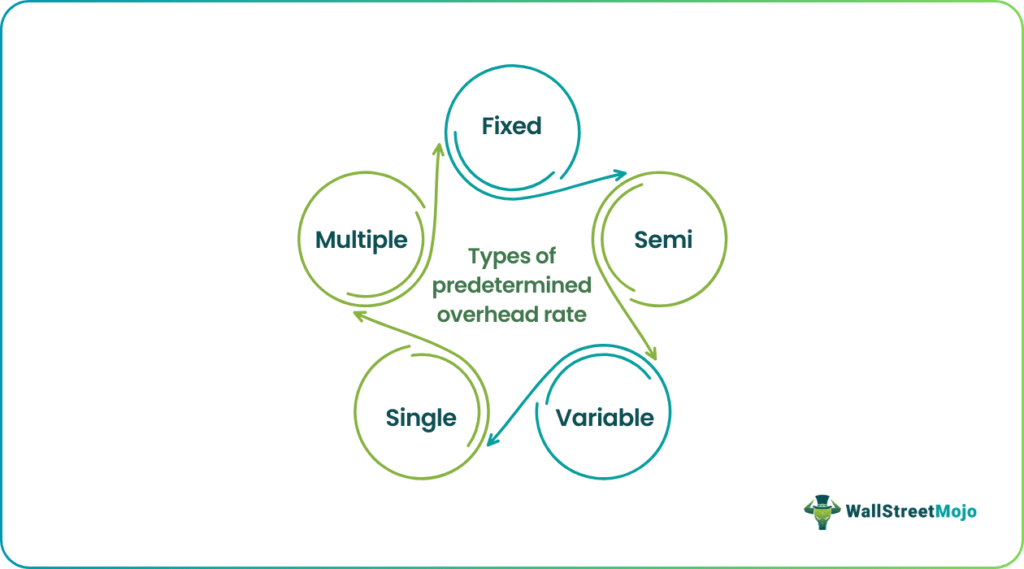
Types of Predetermined Overhead Rate
- Fixed Predetermined Overhead: These are fixed cost incurred for a particular period with a certain output level produced with a given input.
- Semi Variable predetermined overhead: It contains both variable and fixed components. Therefore, some parts of the cost can be identified, and some can’t because of its variable nature.
- Variable predetermined overhead: It is dependent upon the activity, it is very tough to identify, but by studying the past trends, the experts try to predict the variable predetermined overhead.
- Single predetermined overhead: This is calculated by using single apportionment bases. It is more useful in the case of small companies where there is less transaction involved. These types of rates are generally determined by following the past trends of the company.
- Multiple predetermined overheads: This type of predetermined rate is used for large scale businesses were the recovery rate depends upon multiple allocation bases. There are huge transactions involved in a single unit. Therefore, it becomes somewhat difficult to find the rate, although it has been found that the multiple predetermined overhead rates are more accurate and prominent.
Formula
Predetermined Overhead Rate = Estimated Overhead Cost/Estimated Units to be Allocated

The Overhead costs can be Material, labor, manufacturing, selling, and distribution.
We can calculate predetermined overhead for material using units to be allocated. For example, we can use labor hours worked, and for calculating overhead for the store department, we can use the quantity of material to be used.
Example
In a company, the management wants to calculate the predetermined overhead to set aside some amount for the allocation of a cost unit. Therefore, they use labor hours for the apportionment of their manufacturing cost. The manufacturing cost for the year has been calculated as $ 50,000. The labor hours estimated is 10,000 hours by the company. It is calculated following the past trends of the company.
Therefore, by using the above formula we get,
- Predetermined Overhead Rate formula = 50000/10000 hours
- = $ 5/Labor hr.
These are found using assumptions and are not accurate. The differences between the actual overhead and the estimated predetermined overhead are set and adjusted at every year-end. The adjusted overhead is known as over or under-recovery of overhead.
Advantages
- The predetermined overhead rate helps determine the overhead required for the particular cost center, and also, an estimate is provided to the management for the same.
- It helps allocate the overhead by calculating the overhead recovery rate if the allocation bases are known.
- The advantage is that the management draws a clear idea about the overheads, whether fixed or variable and how much it should be apportioned. It provides great help to the management for financial planning.
- It is calculated at the beginning of the year, and the difference is adjusted at the year-end. All the assumptions are based on somewhat past trends and analysis.
Disadvantages
- The mechanism used to calculate the predetermined overhead rate is assumption-based; therefore, many cost accountants and financial analysts claim that it is not realistic and thus should not be the basis for allocating overheads.
- The difference between estimated and actual overhead is adjusted in the books as under or over the recovery of overhead. It is a healthy accounting policy, but it also disturbs the profit/loss in the books of accounts because of the adjustments made.
- The inventory assets are also adjusted since the over, and under-recovery overhead disturbs the inventory level.
- It is being found out that the past trends which the companies generally use to find out the allocation bases are not accurate. The adjustment related to inflation in the market is generally not taken care of. Therefore, the allocation rate cannot be considered accurate.
Limitations
- The overhead is determined based on certain assumptions related to the past, which can be inaccurate sometimes.
- The allocation rate is calculated on the allocation bases, which are generally determined by the management; these assumptions can be incorrect.
- It can disturb the organization’s profits because the adjustments are made at the end of the year.
Conclusion
Predetermined overhead is determined at the beginning of the year. A large organization uses multiple predetermined overhead recovery rates to allocate its expenses to the cost centers. However, small organizations with small budgets cannot afford to have multiple predetermined overhead allocation mechanisms since it requires experts to determine the same. Therefore, the single rate overhead recovery rate is considered inappropriate, but sometimes it can give maximum correct results.
It helps the management to distribute the expenses to its cost centers. Thus the organization gets a clear idea of the expenses allocated and the expected profits during the year. The concept of predetermined overhead is based on the assumption that the overheads will remain constant, and the production value is dependent on it. It helps to improve the segregation of the costs to their respective cost centers, thus making it a helping tool if used properly by the organization and if the calculations are correct after taking somewhat accurate assumptions.
Recommended Articles
For more on Cost Classifications, explore these related articles from our Cost Classifications guide.