


What Is The Royalty Rate?
Royalty rate defines the payment amount offered by one party to another bound by a licensing agreement. The two parties are generally the licensee and the licensee and a licensor. The former is the one holding the license, and the latter is the one who allowed or issued the license in the first place.
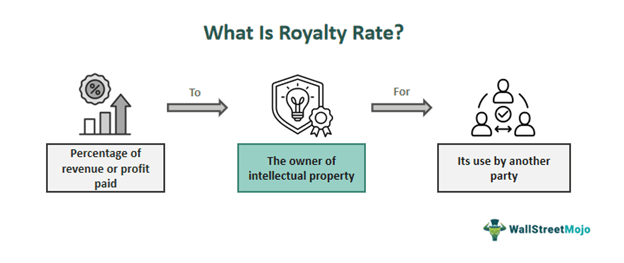
In most licensing agreements, an asset or product is involved, which is made to allow the licensee to use, sell, or promote. The royalty rate is expressed as a sales percentage or a payment per unit. Depending on the product or asset type, it can also be expressed in terms of a fixed value. The underlying asset can be anything from a tangible product or intellectual property that is linked to patents, trademarks, and copyrights.
Key Takeaways
- The royalty rate represents the percentage payment from total sales made by a licensee to the licensor under a royalty agreement.
- This payment typically pertains to owned assets, products, and intellectual property, including trademarks, copyrights, and patents, often generated from sales of music records, books, franchises, minerals, etc.
- Royalty agreements are commonly set for a specific period but can extend indefinitely. To calculate the royalty payment for any asset, multiply the agreed rate by gross revenue or sales and divide by 100.
Royalty Rate Explained
The royalty rate meaning refers to the percentage of sales that goes to the owner of the asset or product licensor. It is a common term especially related to intellectual property, which is typically the creation of the mind, such as music records, inventions, and literary and artistic works like books and paintings, including designs, symbols, images, and names.
In a general scenario, the creator or artist who creates a particular intellectual property owns it through copyrights, patents, and trademarks. When it comes to making it used, sold, or promoted in the market, another individual, entity, or party comes into the picture who has the network, connections, tools, and a whole framework to make it happen.
Both the owner and the other party form a licensing agreement. It is a crucial agreement in which every tiny detail, such as license period, territory, exclusivity rights, terms, and conditions, are negotiated and agreed upon along with it, which determines how much of the percentage of the total sales the second party is going to pay to the original inventor, artist or creator.
Depending on the asset or product type, the licensing agreement is drafted, so if it is a book, the terms will be different compared to if it is a music record or a painting. Likewise, a patent royalty rate will differ from a copyright royalty rate. This licensing agreement protects the rights of the original artist or creator. It ensures that they receive royalties as agreed and legally binds both parties to cooperate in the further process.
How To Calculate?
Royalty rates are commonly expressed in percentages that will allow both parties to calculate the royalty payment that is to be made and received from the licensee and the licensor, respectively.
Royalty payment = net sales or gross revenue x (royalty rate/100)
For instance, if a party agrees to a royalty rate of 9%, and the underlying product makes an annual sale of $45000, then.
45000 x 9/100 = $4050
Therefore, $4050 is the royalty payment that the license holder should pay to the licenser issuer. However, specific industries and markets operate on an average royalty rate, which is a set industry standard.
Examples
Let’s understand the concept with the help of some hypothetical and real-world examples.
Example #1
Suppose Jonathan is a budding novelist; he wrote his first novel and got busy in the publishing process. Only after facing multiple rejections did a small publication house read his manuscript and offer to publish it only on one condition: that they would offer a royalty rate of 2.7% only because Jonathan is a new writer and the novel could fail miserably. The terms and conditions were discussed, and an agreement was reached for the next nine months.
But Jonathan was both clever and confident. He smartly negotiated with the publication house that if the novel, after the first two months, became a success and a national bestseller. The royalty rate will be increased to 18%. The publication house agreed.
As expected, the novel became a hit two months after its release, and the publishing house published several editions of it, enjoying profit and at the same time giving 18% of the total sales to Jonathan as his royalties. It is a straightforward example, but in the real world, many other factors should be considered.
Example #2
US President Joe Biden has increased the cost of oil and gas drilling on public lands. He hiked the royalty rates, and this was done for the first time in a century ahead of November’s election. The Bureau of Land Management finalized a rule increasing the royalties drillers would pay to the government for the first time since 1920. The rule also includes the bonds that are required to cover the cost of clean-ups for the first time since 1960.
The interior secretary admits that such changes will cut wasteful speculation, increase returns for the public, and protect taxpayers from the saddled costs of environmental clean-ups. At the same time, this average royalty rate rise will increase the crude oil prices in the fear of supply disruptions and hiked inflation.
Frequently Asked Questions (FAQs)
What are the factors affecting royalty rates in brand licensing?
Several factors influence it, like brand licensing, including market demand, brand reputation, competition from alternative products, the duration of the licensing term, the level of brand innovation, and the exclusivity of rights and trademarks.
What are the tips for royalty rate negotiation?
Here are tips for negotiating royalty rates:
- Individuals or entities owning the product should seek fair and reasonable deals.
- Respect legal limitations and constraints.
- Discuss every detail, including duration, advance payment, future increases, location, and exclusivity.
- Maintain clarity and be ready to walk away from unsatisfactory deals.
- Document every detail in the licensing agreement.
- Consider appointing an intermediary to represent the parties if necessary.
What are the common mistakes one should avoid when setting royalty rates?
Here are common mistakes to avoid includes:
- Failing to discuss and negotiate it and future increases.
- Lack of clarity regarding terms and conditions.
- Ignoring changing circumstances and failing to detail agreements.
- Inadequate protection of intellectual property.
- Lack of flexibility and specificity in the royalty agreement.