


What Is A Batch Processing?
Batch processing is a method of executing tasks where jobs are scheduled to be carried out as resources permit, often without the need for end-user involvement. This method is commonly used for handling large volumes of data, including tasks such as report generation, billing, and image processing.
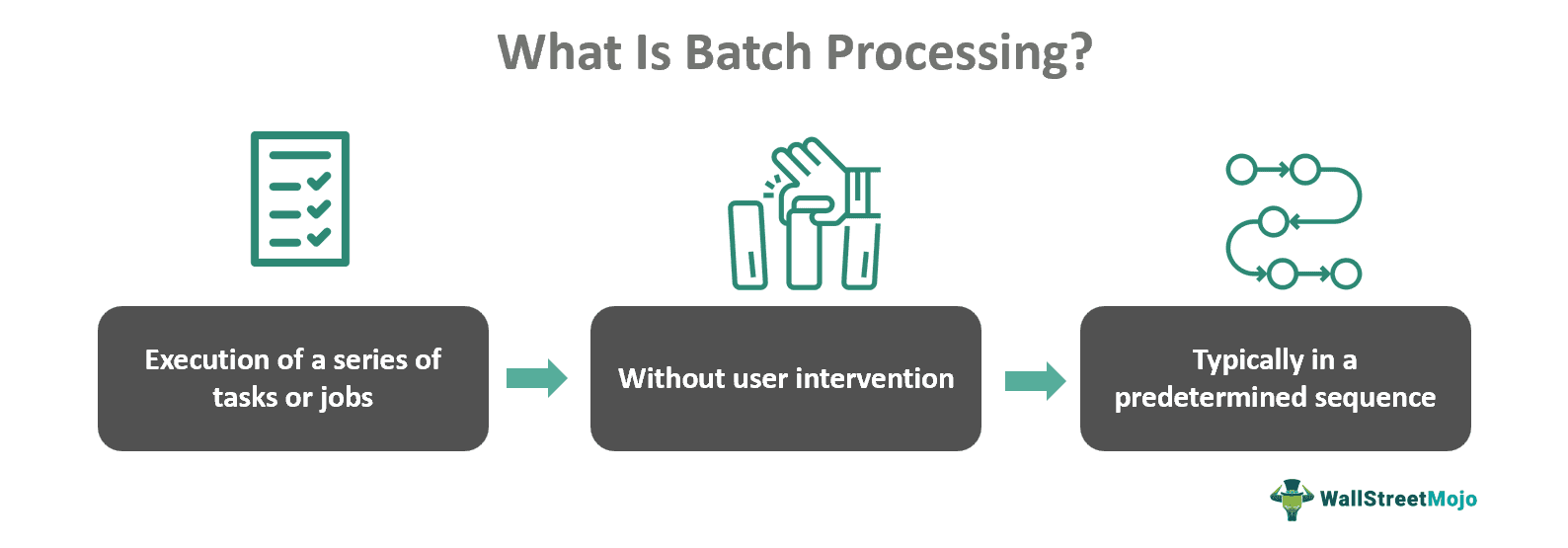
Batch processing can handle enormous amounts of data quickly and cost-effectively. Once initiated, the process continues until completion or until an issue or anomaly is encountered. If an issue arises, the system alerts the relevant management or staff member. This method typically results in more accurate data, higher user satisfaction, and lower operating expenses due to the reduction of human errors.
Key Takeaways
- Batch processing is a technique for executing tasks where jobs are scheduled to run as resources allow or without the need for end-user interaction.
- It enhances productivity by swiftly managing repetitive tasks.
- This method often deals with large volumes of data, such as generating reports, billing, and processing images.
- Historically, this method was used when computer resources were limited. Jobs were typically run at the end of the day to free up essential resources and enable the system to process large datasets efficiently.
How Does Batch Processing Work?
Batch processing definition refers to a technique of execution where multiple jobs are gathered into a group and processed sequentially in a fully automated manner without human involvement. This method is used across many industries to improve efficiency, manage multiple tasks, and ensure systematic processing.
A batch processing operating system may efficiently use its resources, such as CPU time, memory, and storage, by planning and processing operations in batches. Users submit their input or jobs to these operating systems, which add them to a processing queue after receiving the jobs. Without any user input, the system completes each job one at a time.
The strategy was employed when computer resources were less plentiful and powerful than now. These batches were run towards the end of the day, freed up critical computer resources, and allowed the system to analyze large amounts of data quickly. Businesses use the method because it reduces the need for human interaction and boosts the productivity of repetitive activities. Batches of jobs with numerous records can be processed together when the computer power is most easily accessible; this puts little stress on the systems. Additionally, less human administration or oversight was needed for it. The system immediately alerts the relevant personnel to address any problems encountered. Managers employ a hands-off strategy, relying on their processing tools to do the task.
Examples
Let’s understand the concept with the help of some real-world and hypothetical examples.
Example #1
Let’s take the example of Dave, an employee who had to run batch jobs, and to do the same, he had to give inputs to the system. Some of them were the following:
- Name of the user submitting the job
- Specifying the processes and programs that need to be run.
- Details of system behavior for data input and output.
- The details of the batch window and its time of execution
- The batch size
- The details of work units the system needs to complete in a single batch operation, etc.
Example #2
For Jay Kreps, CEO of Confluent and co-creator of Apache Kafka, real-time business operations are crucial. He observed a disconnect between business needs and batch processing methods during his time at LinkedIn. Kafka was developed to address this, providing a platform for real-time data handling. Now, Kafka is the backbone for major companies like Uber and Netflix, enabling instant interactions with customers. Confluent introduced Apache Flink to enhance real-time data processing capabilities further. Flink’s integration with Kafka on Confluent Cloud signifies a push towards unified interfaces for processing streaming data and streamlining business operations for real-time responsiveness.
Advantages And Disadvantages
The advantages and disadvantages of the process are as follows:
- Cost savings: the process is mainly automated and does not require much human intervention. This reduces the operational costs as only a few employees are required, and once the input is set, the process goes in a flow and gets executed as fast as possible.
- Accuracy: there is little human interaction, and hence, the scope of human errors is smaller. This saves a lot of correction time and money. Fewer errors guarantee more client or customer satisfaction.
Disadvantages:
- Training of staff and personnel: as with any technology and software, this task associated with computers also requires prior training. The employee needs to understand the “know-how.” The understanding of processes may seem complex, especially if errors are encountered.
- Suitability: The implementation of the process is suitable for large business entities with large data volumes. They will have entry staff and the infrastructure to accommodate the necessary technology. Hence, it may only be suitable for some enterprises.
Batch Processing vs. Stream Processing vs. real-time processing
Batch processing, stream processing, and real-time processing are three distinct data processing paradigms, each suited to different use cases and operational requirements. Let us understand them through the following comparative table.
| Key points | Batch Processing | Stream Processing | real-time processing |
| Concept | “Batch processing” describes the bulk processing of large amounts of data over a set period. | The term “stream processing” describes the instantaneous processing of a continuous data stream. It performs real-time streaming data analysis. | Systems for real-time processing are employed in settings where large numbers of events—typically external—must be accepted and handled quickly. Quick transactions are necessary for real-time processing, characterized by providing an immediate response. |
| Data processing | Batch processing processes data in bulk all at once. | Stream processing processes and analyzes streaming cross-device information in real-time. | A real-time operating system processes data quickly (in seconds).
|
| Challenges | Batch processing may require employees to be trained to adapt to the technology. | In stream processing, the data output rate shall equal the input rate; otherwise, issues crop up. | Real-time operating systems may be difficult to implement. |
Batch Processing vs. Online Processing
When it comes to handling data and executing tasks in computing, two primary methods stand out: batch processing and online processing. Let us understand their differences through the comparative table given below.
| Key points | Batch Processing | Online Processing |
| Concept | Batch processing is the execution of tasks in one go. | Online processing, sometimes called “interactive processing,” involves the system processing input as it is entered. |
| Process | When using this method, the software may pause to ask the user a question before continuing in response to that response. Hence works by interaction. | All necessary data is obtained in batch processing before a job’s processing (or execution) is requested. Usually, numerous batch jobs can be executed simultaneously. |
| Examples | Tax calculation | payroll processes |
Frequently Asked Questions (FAQ)
Frequently Asked Questions
Is batch processing still relevant?
Yes, it is still relevant today, as these batches can operate in the background whenever it’s convenient to avoid interfering with crucial procedures. Previously a static procedure, batch processing is now innovative due to workflows and processes based on rules that produce a more agile, effective, and reliable process.
When to use batch processing?
The two situations where this method is most frequently employed are when dealing with large data volumes and when data sources are old, and systems cannot send data in streams. It is also suitable for handling multiple cases in one execution.
Can batch processing process unstructured data?
ETL (extracting, transforming, and loading unstructured data) is one of the most commonly used cases of batch processing.
How does batch processing differ from hbase operations?
HBase is a non-relational database management system that is column-oriented and runs on the Hadoop Distributed File System, while batch processing is a method of task execution. Hbase is suited for real-time data processing.