


What Is A Brand Narrative?
A Brand Narrative is a streamlined, concise marketing strategy that supports an organization’s communications and marketing endeavors. The purpose is to engage customers and ensure brand messages resonate with them, building an emotional connection. It is influenced by employees, customers, corporate branding, and the public.
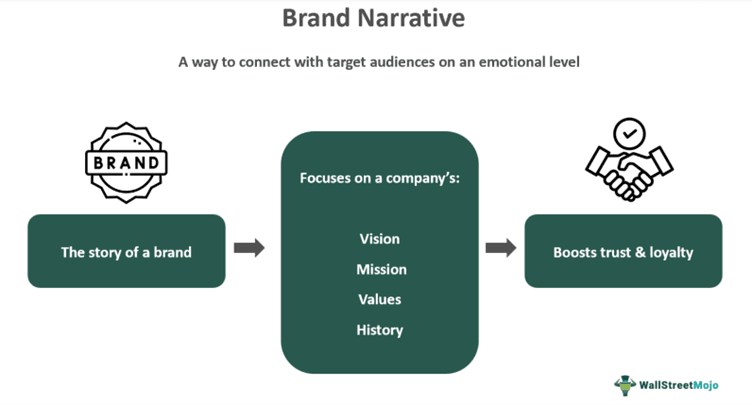
The company name, mission and vision, foundation and history, marketing resources, business operations, and brand tone are some important elements of a brand narrative. By enabling entities to differentiate a brand in various markets crowded with multiple products in the same category, it helps establish trust. This results in strong customer relationships, motivating them to buy a company’s products.
Key Takeaways
- A brand narrative is a concise communication strategy that organizations use to differentiate products, engage with their consumers in competitive markets, and establish an emotional connection with customers.
- It can be created by defining a brand’s values, understanding the target audiences, sharing its foundation and origin information, addressing customer pain points, introducing unique selling points, and creating a memorable brand identity.
- It helps attract and retain consumers, strengthens customer relationships, optimizes resources, sets the brand apart, builds trust, and boosts sales.
- Companies can modify their narratives if needed. A brand story, on the other hand, has a fixed structure.
Brand Narrative Explained
The brand narrative meaning tells us that it is instrumental in defining a successful brand strategy. This is because it focuses on attracting more customers by employing a unique and consistent style of brand communication. A brand narrative strategy is based on a brand narrative framework. A typical narrative has certain elements or features:
- It is unique, consistent, and genuine.
- It caters to a specific audience, and a well-thought-out message connects the company with its audience.
- It helps people understand how the corresponding product or service caters to their needs.
- It helps companies build a reputation for reliability.
It creates an emotional impact, shows commitment and promise, shares a compelling narrative as part of external expression, and maintains consistency in communication. It can be a short but clear description of how a brand lives up to its promises. Emotional impact evokes unique feelings associated with a specific brand among the target audiences.
Furthermore, a strong brand layout ensures the message reaches the target audiences in the manner desired. It should be laid out to suit all audiences, enabling them to follow the purpose of a brand. It focuses on a company’s vision, mission, beliefs, and values.
Another important aspect is to integrate the narrative of a brand with all brand communications. Stakeholders may personalize the narrative according to their needs and experiences, but the messaging must be uniform across all platforms. This ensures brand awareness, relationship building, loyalty, and repeat business. Such efforts help companies build a strong brand identity, thereby leading to profitability and increased revenue.
It helps marketers formulate marketing strategies. In content creation, it boosts customer engagement and retention, bringing authenticity and uniformity across all customer touchpoints.
How To Create?
From the above discussion, we can see that a strong brand narrative is crucial for success. In this section, let us see how to create an attractive narrative.
- Step 1: Define brand values and identity
Set up guiding principles and brand essence to develop an authentic and consistent portrayal of a company’s strategic vision and mission.
- Step 2: Understand the target audience
Determine and include the pain points and needs of the target audiences into the narrative to create engagement and build customer loyalty.
- Step 3: Share the brand’s origin
Put forward the inspiring story of the inception of the brand to connect with the consumers at a deep emotional and personal level.
- Step 4: Define the issues solved by a brand
Articulate the particular issue that the brand can solve for customers, making it valuable to them and ensuring the brand stands out from others.
- Step 5: Introduce the brand’s unique selling point
Put the focus on a brand’s unique selling points (USPs) and qualities and beneficial aspects of the product in sight of the target audience, presenting it as the best choice for them.
- Step 6: Construct the structure of the narrative of the brand
Using a structured narrative, develop a motivating brand story that resonates with customers to engage them fully.
- Step 7: Incorporate verbal and visual branding
All elements of design, tone, and visuals must consistently reflect the brand’s journey, creating a memorable and cohesive brand identity.
Companies may use a brand narrative template to build a streamlined narrative, ensuring they have a solid launchpad to initiate their communications and marketing efforts.
Examples
Let us study a few examples to understand the topic.
Example #1
A December 2023 article discussed the shifting dynamics of brand narratives in marketing. It highlighted the fact that in the current scenario, marketers no longer have full control over their narratives because influencers on social media have a considerable impact on how a brand might be viewed.
Due to social media, customers have ample information while making buying decisions. Hence, brand messaging does not work in isolation anymore. Influencers have a role to play in how consumers view and accept products and services sold in today’s times. As a result, companies are required to onboard influencers and use their popularity to set a positive brand narrative for their products and services.
The article stated that building genuine relationships with influencers to make collaborations possible and fruitful is important. It further stated that any attempt to eliminate influencers from the branding process may result in ineffective brand management.
This tells us how important brand narratives are to companies in modern times.
Example #2
Suppose Evergreen Wild, a company producing camping gear, partnered with Profound Marketers in 2019 because it noticed a decline in the sale of its tents. Stacy, an account manager at Profound Marketers, found that young adults did not buy Evergreen Wild’s tents as much as the company would have liked.
She conducted studies and understood that young people were interested in buying fancy camping products that offer comfort but deliver style. Therefore, she asked the company to change its brand narrative to suit the audiences’ preferences. Stacy asked executives at Evergreen Wild to introduce certain new features to support the company’s changed narrative.
As a result, Evergreen Wild launched a new line of easier-to-assemble tents with colorful designs, particularly for Generation Z. It also changed its brand narrative on social media. Within a year, the company saw an increase in its tent sales by up to 35%.
Benefits
Developing a credible narrative offers companies multiple benefits. They have been discussed below:
- Customer acquisition: As the messages are clear and precise, they can help companies attract consumers. A company’s principles, values, and mission can be effectively communicated to existing and potential customers through such efforts.
- Positive customer connections: It helps forge strong bonds between a brand and customers, increasing customer loyalty and enhancing the probability of endorsements and recommendations.
- Sales boost: A cogent brand narrative triggers exponential conversion and boosts sales going beyond just deals.
- Low-cost marketing: Small businesses that lack adequate financial resources for large brand promotions can attract new customers despite their limited budgets through such marketing efforts.
- Stakeholder engagement: It enables stakeholders (employees, customers, vendors, etc.) to understand the brand and its message.
- Messaging consistency: Employees can deliver correct and attractive messages using a company’s approved narrative to old, new, and potential customers.
- Distinctive appeal: It sets apart the brand and the company from its rivals, leading to customer trust and loyalty.
Brand Narrative vs. Brand Story
The table below shows the differences between brand story and narrative. Let us study them to understand how companies use them to boost customer acquisition rates.
| Points | Brand Narrative
| Brand Story |
| Scope | It is flexible and continuously shaped by external elements and different voices/viewpoints that influence a brand. | It has a definitive structure consisting of an opening, middle, and closing. |
| Primary Stakeholders | The focus is on customers and business, with products forming the base of all decisions. | It is majorly business-centric. |
| Evolution | It develops and evolves with time. Hence, it is dynamic. | It narrates a specific story and offers an ending in the form of a conclusion. |
| Marketing angle | In the context of marketing, it offers a psychological narrative, presents opinions, shapes customer experiences, and helps generate trends and projections. | It conveys a specific story or message to the target audience. |
| Adaptation | Companies can change narratives based on new information and market conditions. | A brand story is fixed because the focus is on a specific incident, event, or point of view. |
Frequently Asked Questions (FAQ)
Frequently Asked Questions
What is a strategic brand narrative?
A strategic narrative is designed and developed in a manner that suits the company’s comprehensive marketing strategy and business objectives. It facilitates brand positioning and supports marketing communications efforts to ensure conversions and customer acquisition.
What is brand narrative vs brand messaging?
Brand messaging means delivering a direct and short message summarizing what a brand represents in terms of the values offered and the way it is distinct from its competitors. A narrative speaks for a brand, presenting how useful it is and what impact it will have on users. Along with all this, it focuses on offering consumers insights into why and how the brand was established and developed. Customers love this emotional angle and develop an affinity toward specific products and services due to strong brand narratives.
What are some factors companies must avoid when creating a brand narrative?
Companies must avoid inconsistent messaging. Also, complicating a narrative can have adverse effects. If companies ignore target audiences’ requirements or stakeholder feedback, it can derail the entire campaign. Hence, narratives should never be ambiguous, insincere, and rigid.
What is Apple’s brand narrative?
Apple’s narrative revolves around creativity, user experience, and continuous innovation. It encourages users to leverage technology in a fruitful manner and achieve progress in their personal and professional lives.