


What Is SUTA Tax?
SUTA tax stands for State Unemployment Tax Act and is a part of the payroll tax paid by employers established to offer unemployment benefits to displaced workers. A displaced worker is someone who lost their job because the company they used to work for failed or closed and is currently unemployed.
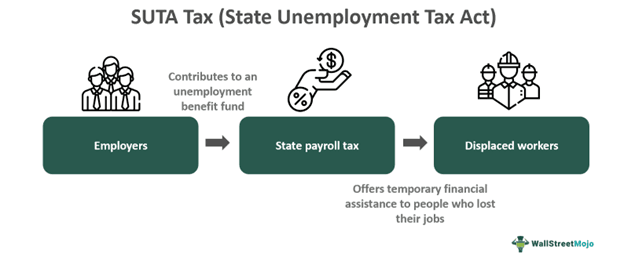
The state collects these imposed tax funds to pay for the unemployment insurance benefits for unemployed workers. Each state has its version of the SUTA tax; therefore, the rules, rates, and guidelines vary from one state to another. Typically, it is an employer-only tax, but states like New Jersey, Alaska, and Pennsylvania also impose contributions from employees.
Key Takeaways
- SUTA tax, or State Unemployment Tax Act, is a state-level tax imposed on employers. It is further used to support and offer benefits to displaced workers.
- It was introduced along with the FUTA tax, which is a federal employer payroll tax, in 1939 to help people during the Great Depression.
- The tax rate differs from one state to another. It is a state payroll tax for employers, but in the states of Pennsylvania, Alaska, and New Jersey, it is imposed on employees too.
- In case an employee works from multiple states, they must state the correct state to establish the procedure of this tax for the employer.
SUTA Tax Explained
SUTA tax is a state payroll tax imposed on employers to collect funds. It is used to support and assist individuals who have lost their jobs due to financial hardship, recession, layoff, or other reasons beyond their control and are actively seeking work. The SUTA was established in the US in 1939, parallel to the FUTA tax, to help people during the Great Depression.
Employers are liable to pay both SUTA and FUTA taxes to the Internal Revenue Service. However, if a company’s SUTA tax is paid on time, it can file Form 940 to receive tax credits up to 5.4% and reduce its FUTA by 0.6%. SUTA is primarily employer-only for the United States, except in Alaska, New Jersey, and Pennsylvania.
It is a mandatory tax, but the tax rate and wage base criteria change from one state to another. If there is a new employer, they are assigned a new employer rate, and over time, they are provided with an experience rating. This rating is derived from observing how many former employees have taken unemployment benefits on the employer’s account. Other factors, such as company size and industry, are also checked. The history of unemployment claims is an important aspect.
As a company, the employer is responsible for reporting its SUTA tax liability to their state and making payments. Mostly, these are quarterly SUTA payments. The company must fill out a SUTA tax form, file a return, and report to the state’s unemployment tax office. Many states allow online payment methods, but additional information about the employees, such as their SOC codes, is to be submitted. Standard Occupational Classification (SOC) codes must also be submitted.
Rates And Limits
The SUTA tax rates 2024 along with minimum and maximum limits, are as follows:
| States | Wage Base | Minimum (%) | Maximum (%) | 2024 Employee Rate (%) |
|---|---|---|---|---|
| Alabama | $8,000 | 0.2 | 6.8 | |
| Alaska | $49,700 | 1 | 5.4 | 0.5 |
| Arizona | $8,000 | 0.08 | 20.93 | |
| Arkansas | $7,000 | 0.225 | 10.125 | |
| California | $7,000 | 1.5 | 6.2 | |
| Colorado | $23,800 | 0.81 | 12.34 | |
| Connecticut | $25,000 | 1.1 | 7.8 | |
| D.C. | $9,000 | 1 | 7.4 | |
| Delaware | $10,500 | 0.3 | 6.5 | |
| Florida | $7,000 | 0.1 | 5.4 | |
| Georgia | $9,500 | 0.06 | 8.1 | |
| Hawaii | $59,100 | 1.7 | 6.2 | |
| Idaho | $53,500 | 0.352 | 5.4 | |
| Illinois | $13,590 | 0.85 | 8.65 | |
| Indiana | $9,500 | 0.5 | 11.2 | |
| Iowa | $38,200 | 0 | 7 | |
| Kansas | $14,000 | 0.1 | 6 | |
| Kentucky | $11,400 | 0.3 | 9 | |
| Louisiana | $7,700 | 0.09 | 6.2 | |
| Maine | $12,000 | 0.28 | 6.03 | |
| Maryland | $8,500 | 0.3 | 7.5 | |
| Massachusetts | $15,000 | 0.56 | 8.62 | |
| Michigan | $9,500 | 0.06 | 10.3 | |
| Minnesota | $42,000 | 0.1 | 9.00 | |
| Mississippi | $14,000 | 0 | 5.4 | |
| Missouri | $10,000 | 0 | 5.4 | |
| Montana | $43,000 | 0 | 6.12 | |
| Nebraska | $9,000 | 0 | 5.4 | |
| Nevada | $40,600 | 0.25 | 5.4 | |
| New Hampshire | $14,000 | 0.1 | 7.5 | |
| New Jersey | $42,300 | 1.2 | 7 | 0.425 |
| New Mexico | $31,700 | 0.33 | 5.4 | |
| New York | $12,500 | 2.025 | 9.825 | |
| North Carolina | $31,400 | 0.06 | 5.76 | |
| North Dakota | $43,800 | 0.08 | 9.68 | |
| Ohio | $9,000 | 0.4 | 10.1 | |
| Oklahoma | $27,000 | 0.3 | 9.2 | |
| Oregon | $52,800 | 0.9 | 5.4 | |
| Pennsylvania | $10,000 | 1.419 | 10.3734 | 0.07 |
| Rhode Island | $29,200 | 1.1 | 9.7 | |
| South Carolina | $14,000 | 0.06 | 5.46 | |
| South Dakota | $15,000 | 0 | 8.8 | |
| Tennessee | $7,000 | 0.01 | 10 | |
| Texas | $9,000 | 0.25 | 6.25 | |
| Utah | $47,000 | 0.3 | 7.3 | |
| Vermont | $14,300 | 0.4 | 5.4 | |
| Virginia | $8,000 | 0.1 | 6.2 | |
| Washington | $68,500 | 0.27 | 6.02 | |
| West Virginia | $9,000 | 1.5 | 8.5 | |
| Wisconsin | $14,000 | 0 | 12 | |
| Wyoming | $30,900 | 0.48 | 9.78 |
Some states may exempt certain businesses from the SUTA tax, such as nonprofit organizations and companies with few employees. To set up and make payments for the SUTA tax, several crucial documents and important paperwork are required, including:
- An employer identification number (EIN)
- Enrollment in the Electronic Federal Tax Payment System (EFTPS)
- A new-hire reporting account
- Proof of worker’s compensation insurance
How To Calculate?
It is calculated using the following formula:
SUTA tax = Wage Base X Employer Tax Rate
Here, both the tax rate and wage base vary from one state to another. They can fall in a minimum to maximum percentage bracket.
A key point to remember is that if an employee works in two or more states. The employer must state the correct state in which to pay SUTA. The identification may involve considering where the employee has an office or the state where they receive orders and tasks from the employer. Only after a precise determination can the employer pay SUTA for the correct state.
Examples
Let us consider these examples for a better understanding of the concept:
Example #1
Suppose Jennifer is a new employer who started a handbag company. To determine her employer tax rate, she multiplies her state’s new employer tax rate by the wage base. For this example, Jennifer is in Washington, DC. Her wage base is $9000, and there is a minimum and maximum tax rate of 1% and 7.4%, respectively. As Jennifer is a new employer, suppose the state has assigned her the new employer SUTA tax rate of 4.95%.
Jennifer has a total of nine employees in her handbag company. She multiples the standard SUTA tax rate by the wage base:
9000 x 4.95% = $445.5
For nine employees 445.5 x 9 = $4009.5
Jennifer owes a total of $4009.5 to the state government as SUTA tax. It is a simple example, but in the real world, the exact tax rate depends on the state and varies and changes from one year to the next based on many market factors.
Example #2
The Maine Department of Labor announced the 2024 employer tax schedule and declared that it should remain stable at Schedule A, the lowest unemployment rate schedule, as per the regulations. The state of Maine has a wage base of $12000, and approximately 55000 employers pay the SUTA tax.
As per Schedule A, the average tax per employee who was compensated with at least $12000 in wages is expected to be $244.80 annually. This showcases an average hike of $8.40 per employee. To date, the Maine Department of Labor has paid over $84 million in state unemployment benefits.
FUTA Tax and SUTA Tax
The key differences between the two taxes are as follows:
| Aspect | FUTA Tax | SUTA Tax |
|---|---|---|
| Imposing Authority | Imposed by the federal government. | Imposed by the state government. |
| Tax Rate | 6% | Varies from state to state and is influenced by multiple factors |
| Wage Base | It applies to the first $7000 of an employee’s wages for the year. | Its guidelines vary from one state to another; some have no demand for it, while others have a maximum wage limit. |
| Reporting Requirements | Employers must file Form 940 with the IRS. | Employers must comply with state-specific laws and regulations. |
Frequently Asked Questions (FAQs)
Frequently Asked Questions
Are SUI and SUTA the same?
Yes, the SUI (State Unemployment Insurance) tax is the same as the SUTA tax. Some US states have different names to address the same. Alongside SUI, the other names given to it are reemployment tax, state unemployment benefit tax, and more.
What does the SUTA wage base mean?
The wage base is the amount of employee earnings that becomes subject to the SUTA tax. The tax rate may vary, but the wage base remains the same, and it applies to all employees. It has been preassigned for the given state. This amount is maximum and hence is also referred to as a wage limit.
What happens if an employer fails to pay the SUTA tax on time?
An employer may be subject to penalties and fines, including interest charges on the overdue amount if they fail to pay this tax on time. In addition, they may also face additional financial penalties and possible harm to their company’s reputation if the state decides to sue them.