


What Is Transaction Tracking?
Transaction tracking is the process of analyzing every step of a financial transaction to ensure its successful execution and detect suspicious financial activities. It is crucial for businesses and is considered a subset of transaction tracing and monitoring. It becomes complex when multiple enterprises work together.
Every business requires a system that ensures proper tracking and the outcome of real-world business transactions. A business transaction can be routed through different systems of separate companies. Still, an effective tracking system enables management to monitor it at every step and ensure it reaches its completion. The main purpose of transaction tracking is to identify illegal transactions, promote AML compliance, and fight financial crimes.
Key Takeaways
- Transaction tracking is monitoring the step-by-step process of a business financial transaction to ensure it is executed properly and completed successfully.
- Companies and financial institutions track business transactions, online payments, and online purchases or sales of shares to identify suspicious financial activities.
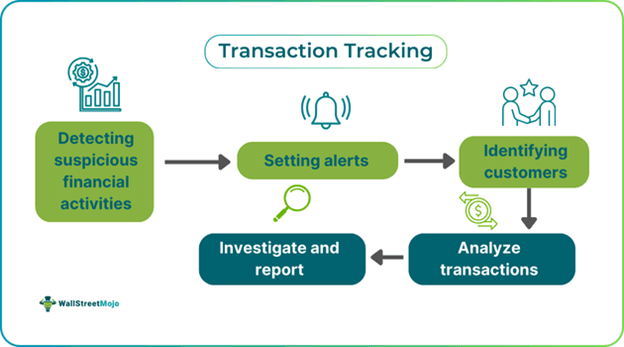
- The process begins with detecting suspicious activity, setting alerts, identifying customers, analyzing transactions, investigating, and reporting to concerned authorities.
- It has a wide scope in different sectors and is used by law firms, accounting firms, fintech companies, banks, real estate enterprises, insurance companies, and others.
Transaction Tracking Explained
Transaction tracking is the concept of tracking and analyzing financial transactions. It is done by banks, financial institutions, and regulatory bodies not only to ensure successful payment completion but also to identify suspicious financial activities, patterns that may indicate money laundering, terrorist funding, or any form of financial fraud, scams, or even tax evasion. It is a framework that operates as a tool to help financial institutions prevent criminal activities. In the modern world, technology has made it swift, with new payment service providers working in compliance with anti-money laundering regulations.
When a business transaction is initiated, a series of steps occur that complete the transaction pathway. However, banks and legal authorities track these transactions to ensure they are not being used to fund terrorism or money laundering or are not involved in any financial crime, scam, or fraud. This makes bank transaction tracking an essential element in the whole financial framework.
With time, the scope of financial crimes has evolved, and so this process has become significantly crucial for the safety, security, and protection of the financial system. Today, this process is implemented by every business in different sectors, such as banks, insurance companies, law firms, small businesses, real estate agencies, accounting firms, fintech companies, and global corporations.
How To Do?
The steps to perform transaction tracking are as follows:
- Spotting suspicious behavior – suspicious financial behavior is spotted through set parameters that indicate if a transaction is potentially suspicious or illicit. It is based on bank transaction tracking number, transaction amount, geographic location, and frequency.
- Setting alerts – Alerts are part of the AML transaction tracking process. These are typically automated alerts preset with criteria. Each bank or financial institution can have its customized alert that it can use, including money laundering typologies.
- Customer identification – This is a general process that involves verifying the information. Brokers and dealers must keep a record of all securities trades. Such information is vital in detecting any suspicious activities.
- Transaction analysis – In this step, each transaction is analyzed separately and tracked by its amount, origin, and destination. This helps detect money laundering and other financial crimes.
- Investigation – This step only occurs when a potential suspicious activity is detected. When it comes to actually investigating transactions, different law enforcement authorities and compliance teams come together.
- Reporting – Banks and financial institutions report the detected suspicious activity to the concerned authorities and other federal regulatory bodies. It is mandatory, and any firm failing to do so can face severe penalties and reputational damage.
- Review and audits – This step assesses the software, ensures all parameters are relevant, and tries to spot areas for improvement. In accordance with the review, banks and financial institutions also perform audits to create a trail for monitoring and investigation. It assists in regulatory compliance.
Examples
Below are two distinct examples of this process:
Example #1
Suppose Tulip is an investor who uses an online trading application. She initiates the transaction by selecting the listed company she wishes to invest in. Then, Tulip adds the number of shares she wants to buy and finally clicks on the buy button. Now, as soon as Tulip submitted the transaction, a series of automated steps began to occur, which basically, in combination, form an overall transaction pathway. Now, Tulip can’t see these steps and is practically unaware that there are actually so many steps involved. All these steps are part of transaction tracking to ensure that Tulip’s transaction is not illegal, illicit, or involves any form of money laundering, financial crime, or funding.
With modern technology, all financial software or payment service providers are linked to anti-money laundering services and follow AML compliance to check on transactions. The best part is that all of these steps occur in milliseconds. In case Tulip’s transaction had an error, in-built error messages will be displayed if her transaction gets rejected. In the real world, it allows authorities to trace illegal financial crimes and scams and fight money laundering and illicit funding.
Example #2
In September 2024, the Central Bank of Nigeria (CBN) instructed all payment service providers to use a CBN-approved payment terminal service provider to handle all transactions from PoS terminals at agent and merchant locations. The purpose of this regulation was to decentralize PoS transaction routing and improve electronic transaction tracking throughout Nigeria.
The directive came with a 30-day deadline requiring all service providers to follow the enhanced guidelines. The directive was challenged in court, and the CAC announced that it has begun taking significant actions, including shutting down PoS businesses that failed to register. It will ensure that all transactions are executed, monitored, and tracked under one single entity.
Importance
The importance of this process are listed below:
- Works with AML compliance to fight against cybercrime and financial fraud and prevent illegal transactions from occurring.
- Ensure that a financial transaction reaches from point A to point B with proper data recording and approval through concerned authorities.
- It helps verify whether a platform is being used for money laundering or any other financial crimes.
- Plays a crucial role in safeguarding both a nation’s financial system and the global financial system.
- Creates a whole framework of safety and security to spot suspicious financial activities and mitigate financial risks.
Frequently Asked Questions (FAQs)
Frequently Asked Questions
What are the challenges faced in transaction tracking?
The common challenges faced are listed below: – The implementation and maintenance costs of transaction tracking are expensive. – False detection of suspicious transactions affects the accuracy of transaction-tracking frameworks. – Failure to comply with regulatory regulations and sanctions regarding transaction tracking can result in huge penalties and reputational damage for companies and banks.
What triggers an alert in transaction tracking?
The common triggers that prompt an alert are: · Unusual transaction amounts · High transaction frequency · Transactions with sanctioned entities · Unexplained change in customer behavior · Unusual transaction patterns · Structuring transactions in a certain way · Transactions that involve politically exposed individuals
What are the best practices for transaction tracking?
Its best practices are given below: – Establishing clear policies and procedures for tracking transactions. – Reviewing transactions and tracking rules from time to time and updating accordingly. – Implement a framework for investigating suspicious transactions. – Have a compliance team and anti-money laundering transaction tracking system.