


What Is Overleveraged?
Overleveraged is a term used to define businesses burdened with debt and facing financial crises because of restricted revenue generation and an inability to manage operating expenses. Such companies have way too much debt compared to their equity and operating cash flow, which simply means that the company has too much to pay while the cash inflows are limited.
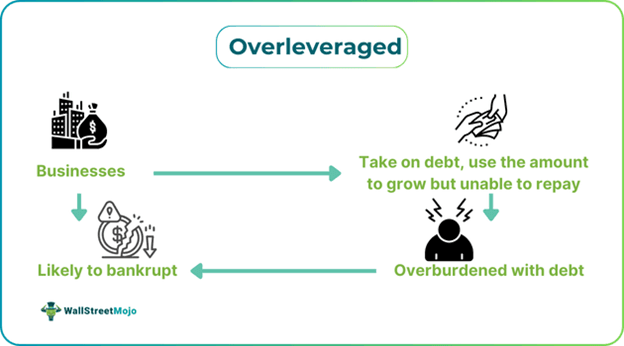
Given the limited revenue generation and restricted growth, these businesses face challenges in paying off their debt, be it interest payments or the principal amount. When overleveraged, the company’s incoming cash flows are majorly utilized in operational expenses, and hence, other commitments requiring finances are put on hold, thereby affecting the process flow and production.
Key Takeaways
- Overleveraged businesses are companies with too much debt, and most of their cash flow is used for operational expenses.
- In such a situation, companies find it difficult to pay off debt and fall into a debt trap.
- The effects and disadvantages of an overleveraged situation are financial instability, bankruptcy issues, loss of control and market reputation, loss of assets, and high vulnerability to external shocks.
- Businesses can come out of overleveraged scenarios with consistent, wise decisions, financial support and resources, but it is a time-consuming process.
Overleveraged Explained
Overleveraged signifies the state where a business is overburdened with debt and exposed to financial crisis. This state occurs when companies take too much debt to finance their initiatives for business growth, but they end up being incapable of repaying the same. Slowly, their financial stability starts to deteriorate. Though companies earn significant revenue, a large portion of it goes to daily expenses and operational costs, leaving them with little or no extra funds to meet their debts or to pay back their creditors. It induces a series of defaults and an increase in interest rates, making the company fall into a debt trap.
Taking on debt is a common practice in business and finance as it helps businesses grow and expand. As long as a company can manage its debt, it is a preferred option compared to other means of raising capital. However, when it is not dealt with properly, it leads to overleveraging, where businesses have borrowed too much money from multiple sources but are unable to repay the lenders or creditors, which sometimes becomes the major reason behind a business’ bankruptcy.
In contrast, a less leveraged company can use its cash flow in the right direction, expand, invest in new projects, buy capital assets and enhance its reputation in the market. Overleveraged companies can definitely regain their original financial stability and growth, but only if they make a series of wise decisions to escape the trap.
Examples
Here are two instances to understand the overleveraged meaning better:
Example #1
John opened a bakery; he took multiple business loans to start a lavish bakery store in the center of the local market. Initially, the business went well and attracted many new customers. Still, within nine months, John realized that most of its capital and cash flow was being utilized in keeping the bakery active and into operational costs, such as raw materials, inventory, shop rent, utility bills and, of course, the monthly interest payments to all his business loans.
At first, John tried to cut additional and unnecessary costs with all the miscellaneous expenses. But, with late payments, the interest grew and in the next three months, his bakery became overleveraged. John could see that he was falling into a debt trap with his bakery. John asked his friends and family to help him financially to regain business, but it took him months.
Example #2
An October 2024 report highlighted how the major lenders in India have been suffering because of the overleveraged state of the retail borrowers. According to the analysts, this scenario is likely to tighten credit loans, making it difficult for loan seekers to get even their personal loans approved easily. The banks have started keeping extra funds aside to cover the bad loans, given the chances of an increase in defaults.
This shows how overleveraged situations can broadly affect financial institutions and the nation as a whole.
Effects On Finances
The effects of being overleveraged on business finances include the following:
- Induces financial instability and loss of control.
- The company gets pushed into a recessionary spiral, leading to a debt trap.
- The business becomes vulnerable to external shocks.
- Even a slight decline in revenue can increase the interest rates and debt becomes unsustainable.
- In an overleveraged scenario, lenders can seize assets if the company fails to fulfill its obligations.
- Overleveraged companies can start practicing layoffs or salary reductions of employees to cut costs and keep the business operations active and running.
Disadvantages
The disadvantages of overleveraged are –
- The company needs immediate capital and resources to pay off debts.
- With an overleveraged situation, a company is always exposed to the risk of bankruptcy.
- Investors withdraw themselves and avoid investing in an overleveraged company.
- The company slowly begins to lose its market reputation and goodwill.
- Overleveraged businesses require a lot of time to regain their earlier position, even with the right measures and strategies.
Frequently Asked Questions (FAQs)
Frequently Asked Questions
How do you tell if a company is overleveraged?
A company is referred to as overleveraged if – – It has more debt than other players in the industry. – Businesses are cutting additional costs and reducing expenses. – The company has a bad debt-to-equity ratio and debt-to-total assets ratio.
How does financial counseling help an overleveraged customer?
Some financial counselors offer counseling and education on various financial topics and issues, such as budgeting and debt management, and provide credit counseling. They can help an overleveraged customer with tools and resources to regain financial control and stability, which proves indispensable to people stuck in overleveraged scenarios.
What is overleveraged in trading?
Overleveraged in trading is a term that defines the state where a trader borrows an unrealistic amount of money that they can afford to repay. Traders use this money to increase their market position; leveraging it allows them to control large market positions with less capital. At the same time, it is extremely risky and one of the common mistakes that novice traders make. It leads to financial crises and even bankruptcy.