


What Is A Knowledge Worker?
A knowledge worker is a competent professional capable of using their expertise, critical problem-solving attitude, interpersonal skills, and critical thinking ability to deliver value to the organization by developing an innovative product or service. These are generally high-level employees who apply their theoretical and analytical learning to make a living.
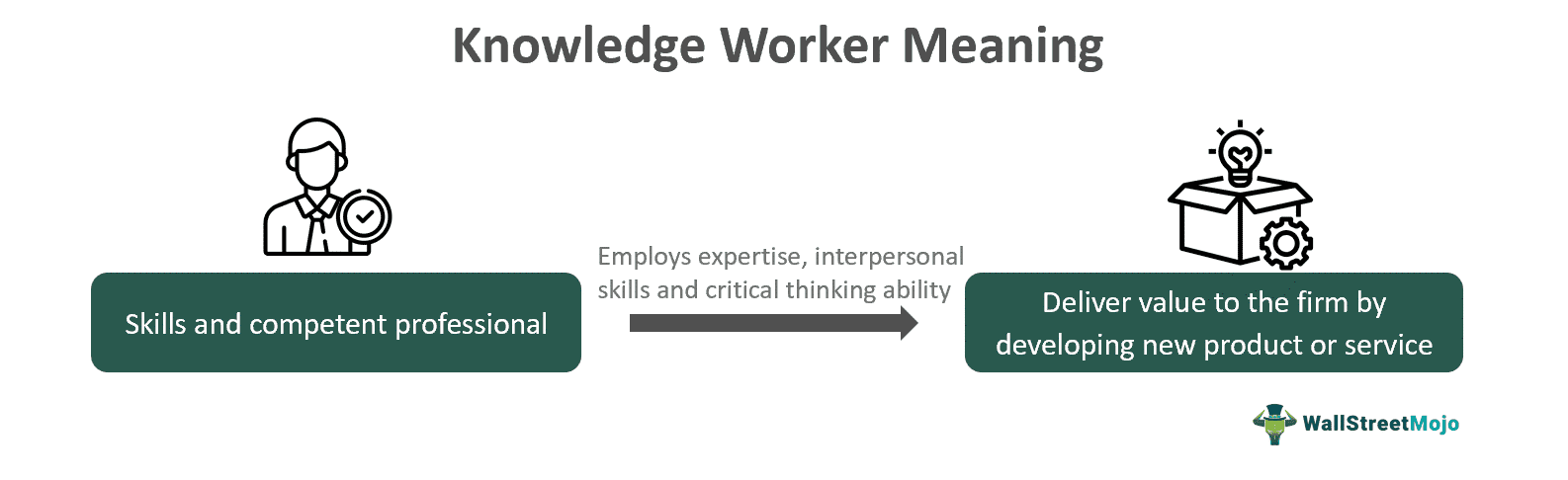
These workers undergo formal training to learn the skills required to develop a product or service. They include engineers, designers, programmers, physicians, lawyers, technical writers, financial analysts, system analysts, architects, researchers, and others. Their contributions are vital for enhancing productivity, fostering development, and maintaining the competitiveness of business entities in the present-day knowledge-centric scenario.
Key Takeaways
- A knowledge worker is a learned individual who creates value for the company by using their competencies, professional and interpersonal skills, and critical thinking abilities to solve complex business problems and support informed decision-making.
- Some critical attributes of such professionals include innovation, brainstorming, collaborative aptitude, learning behavior, self-motivation, initiators, decision-makers, communication, and interpersonal and professional skills.
- Managing knowledge workers is critical in modern organizations. They can be divided into three categories: Knowledge Users (KU), Knowledge Creators (KC), and Knowledge Facilitators.
- They differ from task and wisdom workers. Task workers are taught to complete routine or repetitive tasks that require little expertise. Wisdom workers have knowledge, proficiency, and the ability to apply their discernment and expertise comprehensively and strategically.
Knowledge Worker Explained
A knowledge worker is an individual whose primary responsibilities revolve around tasks demanding skills like critical thinking, creative problem-solving, and specialized expertise. They explore explicit and tacit knowledge to shape the future of their organizations. Such roles are evident in education, research, consulting, writing, software development, and data analysis. Their contributions center on intellectual abilities rather than physical exertion. Moreover, they are well-equipped with proper training and specialized skills to foster business growth.
These employees hold significance in contemporary economies and organizations. Their capacity to analyze, comprehend, and utilize information is highly prized, as it leads to innovation, effective troubleshooting, and informed decision-making. These professionals usually possess specialized skills, enabling them to develop valuable products or services in their respective fields. Hence, companies are now focusing on efficiently managing knowledge workers.
Characteristics
Knowledge workers primarily engage with information and ideas to address intricate problems and contribute to the success of their organization. They possess distinct qualities, which include:
- Intellectual Expertise: Knowledge workers hold specialized skills, education, and expertise crucial for their specific roles.
- Analytical Proficiency: They excel at dissecting situations, recognizing obstacles, and devising innovative resolutions.
- Autonomous Decision-Making: They often enjoy independence in their work, making choices based on their knowledge and insight.
- Ongoing Learning: Such professionals remain up-to-date with the latest industry developments and information to be in the business.
- Collaborative Approach: They frequently collaborate with other professionals, exchanging ideas and insights to attain collective objectives.
- Critical Thinking: The capacity to critically assess information and make well-informed decisions is crucial among knowledge workers.
- Innovation: Knowledge workers contribute to creation by conceiving novel concepts, procedures, and products.
- Effective Communication: Proficient communication is essential for conveying intricate ideas to peers, stakeholders, and clients.
- Adaptable to Changes: These workers must readily adapt to evolving circumstances, technologies, and challenges.
- Individual Responsibility: Such professionals take the initiative of transforming ideas into reality, holding themselves individually responsible in case of failures.
- Result-Oriented: Such workers are driven by objectives, focusing on delivering tangible results and value.
- Self-Motivated: They are self-driven and enthusiastic individuals whose primary source of motivation is their knowledge and ideas.
Types
Managing knowledge workers is essential since they play a crucial role in modern organizations. Some of the different types of such professionals are as follows:
- Knowledge Users (KU): Professionals use, analyze, and interpret the available information to perform routine work. Hence, they believe in the practical implementation of knowledge to improve their work. Some examples are financial analysts, officers, accountants, etc.
- Knowledge Creators (KC): These include artists, writers, designers, software developers, scientists, engineers, or others who produce original content, products, or services. They work solely or in a team with other knowledge workers to deliver value to organizations.
- Knowledge Facilitators (KF): Such individuals are responsible for storing, preserving, refining, indexing, and making the knowledge available for reuse as and when required. They include system administrators, educators, and legal practitioners.
Examples
We are surrounded by many friends, relatives, or known ones who serve as knowledge workers for their organizations—doctors, lawyers, technical writers, financial analysts, project managers, engineers, vloggers, etc. Let us look at some examples:
Example #1
Suppose Mrs A is an architect who conceives and plans physical spaces. She uses her expertise, learning and knowledge to make the best possible use of every square foot of a property to deliver value to her clients. She is a knowledge worker who solves spacing problems.
Example #2
According to the McKinsey report, generative AI has the potential to revolutionize the global economy and labor market, but it also raises concerns about job displacement among knowledge workers. The hybrid work model, which combines remote and in-office work, is a promising solution. In-person interactions foster creativity, problem-solving, and relationship-building, which AI cannot replicate. In-office presence enables knowledge workers to make nuanced decisions and use emotional intelligence, ensuring their roles remain secure in the face of AI disruption.
Knowledge Workers vs Task Workers vs Wisdom Workers
Knowledge, task, and wisdom worker are distinct terms used to categorize different roles within a workplace. These individuals are dissimilar in the following manner:
| Basis | Knowledge Worker | Task Worker | Wisdom Worker |
|---|---|---|---|
| Definition | These workers employ their expertise, critical thinking and problem-solving skills to create organizational value. | Task workers are trained to perform routine or repetitive tasks that require little expertise. | Wisdom workers possess knowledge, proficiency, and the capacity to apply their discernment and expertise comprehensively and strategically. |
| Skill Set | Intense and specialized. | Narrow, functional, and limited. | Dynamic and amalgamated skills enabling emotional creativeness. |
| Focus | Complicated business problems and innovation. | Routine tasks, targets, and performance. | Make use of an engaging narrative to engage the customer or audience. |
| Responsibilities | Generating, using, and facilitating information for developing new products or services. | Performing repetitive, routine tasks that demand minimal decision-making and limited creative input. | Amalgamating information, making high-level judgments, and offering guidance on the respective subject matter. |
| Roles | Medical practitioners, architects, programmers, content creators, researchers, analysts, engineers, and consultants. | Assembly line workers, data entry clerks, and customer service representatives. | Senior executives, mentors, advertisers, content managers, public relation officers and visionary leaders. |
| Performance Metrics | Process effectiveness | Target achievable or task deliverable | Employee productivity |
| Skill Obsolescence | Rapid | Slow | Slowest |
| Loyalty Towards | Profession and connections. | Organization | Profession |
| Foundation | Formal learning and education and external contacts. | Internal training, development, established processes and guidelines. | Emotional intelligence, creative thinking. |
| Contribution | Central or strategic decision-making for long-term business growth or sustainability. | Accomplish small objectives that take the master plan ahead. | Significant impact on brand image and business growth in the long run. |
Frequently Asked Questions (FAQs)
Frequently Asked Questions
Who coined the term knowledge worker?
The term’ knowledge worker’ was introduced by a business consultant, Peter Drucker, in 1959 in his book ‘The Landmarks of Tomorrow,’ where he emphasized the concept of ‘the knowledge society,’ explaining how such workers will turn out to be the most valuable assets for organizations by 2021.
How can managers empower knowledge workers?
They are critical assets for corporate growth and development. Managers must provide an environment for creative thinking and unrestricted idea-sharing for these employees. They must be well-informed of the organizational strategies and given due respect.
Why are knowledge workers so crucial to an organization?
Such talented employees determine an organization’s future; they are the creative heads behind the innovation and development of new products or services, generating value for the business, society, and economy.