


What Is An Indexed Bond?
An indexed bond is a fixed-income investment vehicle whose principal sum and returns are associated with a particular economic factor or inflation indicator, like the price index. Hence, these securities mitigate inflation-related risk while offering investors a real rate of return and stability.
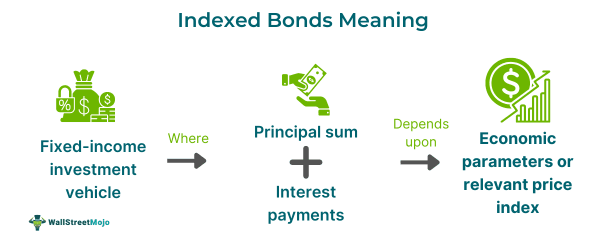
As we know, the bonds usually have a fixed coupon rate but a long maturity period. However, these interest payments may need to be more apt to beat the rising level of inflation. Hence, an index-linked bond potentially provides equivalent returns compared to a reference index. Moreover, the investors can redeem the bond at its face value during deflation.
Key Takeaways
- An indexed bond is a security issued by the government and corporations to protect the investors from inflation risk by linking and adjusting the bond’s principal redemption and interest payments to the relevant price index or economic parameters such as CPI or commodity index.
- It aims to hedge bond returns against rising inflation rates and thereby enhance the purchasing power of such interest income for investors or bondholders.
- While it helps investors diversify their portfolios, the government sometimes uses it as an effective measure for wealth distribution in the economy.
Indexed Bond Explained
The indexed bond refers to an inflation-protected investment opportunity that associates and adjusts the investors’ capital and interest returns to the change in inflation rate until its maturity. Such security has a coupon rate that is constantly changed with the inflation indicator or other indices, i.e., the consumer price index (CPI), retail price index (RPI), and commodity index.
Thus, it allows the investors to reap a real rate of return and secures the purchasing power of such interest income in the long run. Also, on maturity, the investors get a principal amount at its actual value, i.e., after being adjusted according to the preferred index.
Such an investment protects investors from the low returns offered by ordinary bonds, even when the country’s rate of inflation rises. However, it may underperform in a deflationary economic scenario. Since the principal amount reaches the minimum of the bond’s face value, its returns may look unattractive compared to those of other bonds and securities, yielding a higher interest income. These bond coupon payments are payable quarterly, semi-annually, or annually and are usually taxable by the government.
Examples
Indeed, the indexed bond is a balanced investment option that offers favorable returns at minimal risk, as demonstrated by the following examples:
Example #1
Suppose there are two institutional investors, A and B. A invests in regular bonds, and B invests in indexed bonds in 2023. Both these types of bonds have a $200 face value, a coupon rate of 4.5%, and a 1-year maturity. Let us say that the CPI of a nation in 2023 is 197, whereas on maturity, i.e., in 2024, the CPI is 202. Therefore, the returns with the principal on maturity for both investors are as follows:
A’s maturity yield:
$200 + ($200*4.5/100) = $209
B’s maturity yield:
[$200 + ($200*4.5/100)]*(202/197) = $214.30
Thus, B, who invested in an indexed bond, yielded $5.30 more than A, who bought the regular bond, due to the rising inflation rate as measured through a positive change in the consumer price index.
Example #2
Britain recently completed the sale of a new inflation-linked bond or inflation-indexed bond, raising £4.0 billion ($5.1 billion) with investor orders exceeding £56 billion. This bond, set to mature in 2054, was priced to yield 1.5 basis points more than the benchmark index-linked gilt. The transaction marked the conclusion of the bond syndication for the 2023/24 financial year by the UK Debt Management Office (DMO). In the future, the DMO aims to raise £237 billion through gilt sales by the end of March, including around £29 billion through the sale of index-linked gilts.
For the upcoming financial year, the DMO plans to raise £265 billion through gilt sales, including £9.0 billion through three index-linked gilt syndications and £19.9 billion through 15 index-linked gilt auctions. This decline in index-linked gilt sales reflects concerns about exposure to increased interest payments during inflationary periods, as observed in 2021 and 2022.
Advantages And Disadvantages
The indexed bond funds secure the investors against the uncertainties pertaining to inflation and negative returns. However, along with various pros, such investment vehicles have specific cons, as discussed below:
| Advantages | Disadvantages |
|---|---|
| Indexed bonds provide a real rate of returns to investors and keep up with the real value of the securities, hedging them against inflation risk in the long run. | Although these assets provide inflation-protected returns, the yield is still lower than that of other investment opportunities like equity. |
| These securities provide greater stability while matching the returns of the relative price index (usually the consumer price index). | Such bond income is not tax-free, and the holders may have to pay hefty taxes on the unrealized gains from such investments. |
| The bond returns are independent of the bond market and other fixed-income securities. | According to some experts, the indexes to which these bonds are linked, including the commodity index or CPI (consumer price index), are not suitable for measuring inflation in the economy. |
| Also, such bonds increase the purchasing power of the holder’s investment income compared to that of regular bonds. | Such fixed-income investments have lower liquidity, which makes early redemption difficult for the holders. |
| These bonds involve less risk and volatility. | Such bonds have a complex mechanism compared to regular bonds, requiring the holders to keep a close look at the inflation. |
| Moreover, these assets diversify the investment portfolio, adding low-risk and stable return components. | If the inflation rate remains low, these bonds may perform poorly, offering lower interest payments than fixed-income bonds. |
| Some of these bonds provide a premature redemption facility to the holders. | |
| The lowest value that the investors would receive is the face value of these bonds in case of deflation. | |
| Corporations and the government often issue such securities to fund business expansion and infrastructural projects that bolster the country’s growth and development. | |
| It helps the government to issue inflation-protected investment offerings to ensure the redistribution of wealth in the nation. |
Capital Indexed Bond vs Inflation-Indexed Bond
The two prominent types of index-linked fixed-income securities are capital and inflation-indexed bonds. They differ in the following ways:
| Basis | Capital Indexed Bond | Inflation Indexed Bond |
| Definition | A capital-indexed bond is an income security that can be redeemed at an inflation-adjusted principal value and coupon payment. | IIB is a fixed-income security issued by the government to offer a stable return to investors irrespective of the prevailing inflation rate. |
| Objective | Preserve the real value of invested capital. | Maintain the real value of bonds while balancing interest income with current inflation rates. |
| Linked to | Commodity or financial index. | Price indexes like the Retail Price Index (RPI) and the Consumer Price Index (CPI) |
| Adjustment Focus | It adjusts the capital invested or principal amount to the referred index. | It links the principal and interest to the relevant inflation indicator. |
| Benefits To Investors | Offers protection of capital from inflation risk while ensuring the redemption of bonds at inflation-adjusted value on maturity. | Provides real rate of return while improving the purchasing power of the interest income so yielded by the bondholders. |
| Drawbacks | It is challenging to find a suitable index. Also, the performance has index biases; even the interest income is taxable. | Prone to deflation and interest rate risks, it also provides lower returns than the stocks. |
| Suitable For | Institutional investors who desire a return matching a particular index returns. | Institutional investors who aim to shield their investment against inflation. |
| Hedge Against Inflation Risk | Limited | Comprehensive |
| Interest Payment | Based on the index-adjusted principal amount. | According to the prevailing inflation rate. |
Frequently Asked Questions (FAQs)
Frequently Asked Questions
How to buy inflation-indexed bonds?
Investors can buy IIB through various mediums, such as brokers, banks, and government official bonds. Moreover, bondholders and investors can buy and sell these bonds on the stock exchange, similar to other securities.
What are treasury-indexed bonds?
Treasury-indexed bonds are medium—and long-term fixed-income securities issued by the federal government. The value of capital invested is constantly adjusted and linked to changes in CPI (consumer price index). Such securities provide a fixed interest payment quarterly throughout the investment period.
What is the difference between a bond and an indexed bond?
An ordinary bond offers a consistent fixed rate of interest to the holders along with the principal amount at face value on maturity. On the other hand, an indexed bond fund provides interest at a real rate of return and the real value of the bond on maturity.
How to price inflation-indexed bonds?
The inflation-indexed bond price is evaluated by summing up the bond’s face value with the value derived from multiplying the change in the relevant index with the gearing ratio. The actual rate of return is computed by subtracting the coupon rate from the inflation rate.