


What Is A Customer Journey Map?
A customer journey map follows the customer’s interaction with a brand or company across different stages in chronological order. Through a mapping process, a company can examine and interpret what is going on inside a consumer’s mindset. When this happens, a brand can comprehend the customers’ needs, perceptions, and demands.
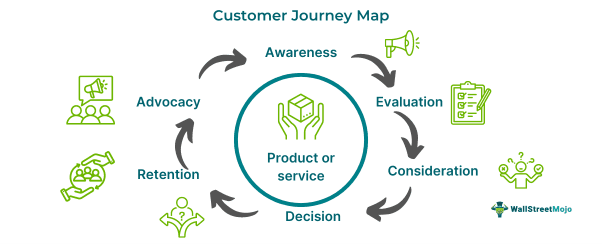
This mapping process applies to both online and offline customer understanding. Once a company accurately measures customer needs and wants, it can improve customer service and product quality. Additionally, these insights assist in making stronger decisions. Customer journey mapping expands on the customer’s experience with the product.
Key Takeaways
- A customer journey map summarizes customer experience with a brand of a company’s product to understand their needs, perceptions, and expectations.
- The mapping process has six stages: awareness, evaluation, consideration, decision, retention, and advocacy.
- The mapping helps companies and brands look directly inside the customer’s mind and expand on their experience with the product or service. Hence, it is created according to the businesses’ target audience.
- It can be done multiple times for every type of customer. The mapping allows businesses to create a blueprint of visual actions taken by customers in the buying process.
Customer Journey Map Explained
A customer journey map is a powerful tool that outlines the stages an individual or potential customer navigates when they encounter a specific brand, product, or service. It’s not just about the first impression; it’s about the myriad of thoughts and considerations that lead to the final purchase decision. By delving into the customer’s mindset, businesses can gain invaluable insights into their behavior and preferences.
Even a product with numerous features and problem-solving capabilities can struggle in the market if not presented effectively. When a customer encounters a product, they evaluate it based on their knowledge, needs, price, features, durability, service, satisfaction, and reviews, among other factors. Such a map can guide companies in presenting their products in a way that aligns with these customer expectations, thereby enhancing the overall customer experience.
The customer journey map model is a tool for understanding customer behavior and a strategic guide for companies. It helps them align their product strategy, marketing efforts, surveys, and customer data. Additionally, testimonials, insights, and feedback are used to deliver a superior customer experience. For sales executives, it provides a roadmap to understand the customer’s journey and pitch the product effectively at each stage. This approach ultimately leads to a successful deal closure.
There are many customer journey map templates available online that companies can use to create a 360-degree view of how a customer is engaging with the product or company. With digital marketing, social media, and e-commerce websites, customers may enquire about a certain product by writing a post, browsing online, reading online reviews, and checking ratings. They might then call the online support number for more information and finally reach a landing page from where they can buy it. This whole process can be summed up in a map explaining to the customer how, what, and from where the customer arrived at its destination.
Stages
It has six stages, including:
- Awareness – The very first stage is when the customer comes across a brand. It can be both through online and offline mediums. It creates awareness, which ultimately means that the customer knows that this product exists in the market.
- Evaluation –The customer tends to know more about the product and makes a basic evaluation. Now, they have more than surface-level knowledge about the product.
- Consideration – Competition begins at this stage. The customer knows about the product and also about its alternatives and similar products available. In an active market, the customer is now shortlisting the product, among others, based on aspects like price, features, reviews, affordability, satisfaction, limitations, and so on.
- Decision – This is the final purchase decision. Customers decide whether to buy the product, invest in it, give it a try, or explore further options. This stage is crucial as it involves committing to a purchase and ensuring satisfaction with the product or service.
- Retention – No business aims to sell just one product. Profits and revenue come from selling thousands or even millions of products. A brand not only seeks to make initial sales but also aims to retain customers, which is more cost-effective than acquiring new ones.
- Advocacy – The last stage is arguably the most challenging part of the customer journey mapping. It refers to good reviews, word-of-mouth publicity, and endorsements of happy customers. Suppose a brand has done everything right. The customers will advocate for the product, and this is far better than any form of advertising and marketing strategy.
Examples
Below are two examples to understand the concept better:
Example #1
Suppose Jennifer has a handbag business. She doesn’t have a physical store but has a strong online presence. She enjoys her initial sales figures. Recently, Jennifer posted all pictures of her new handbag collection on social media platforms. She realizes that the sales have become stagnant.
Jennifer decides to create a customer journey map. She noticed that customers visit her business’s Instagram page and browse through posts like a bag. However, they then have to go to the official website and search for it again in the online catalog to make a purchase. Jennifer knows that this small error makes people leave without spending much time on the site.
Finally, Jennifer came up with a solution. Now, whenever she posts a handbag picture on her Instagram page, she adds a clickable link to it. When customers click on the link, they are immediately directed to the final buying page, which includes the correct photos of the handbag, price details, offers, discounts, and delivery time. Within a few weeks, the sales showed a good positive response.
Example #2
A great real-world example comes from Spotify, one of the world’s most used audio streaming services. Whenever they want to improve their services, they hire a marketing firm that creates a customer journey map for them. The end goal of this map is to seek the best music-sharing features that align with a better customer experience. The map represents the entire user experience, starting from when they open Spotify to the moment they like a song shared by a friend.
The map extensively describes what the customer is doing, thinking, and feeling. The agency uses the data and other customer surveys to provide relevant information and insights. Through the marketing firm’s report, Spotify was able to identify its users’ pain points and thus address the issues to improve customer satisfaction.
Importance
The importance of such maps is listed below:
- It elaborates on customer experience with a product or service across various stages.
- The customer journey map allows companies to understand what goes inside the mind of their target audience.
- Customer journey map tools help companies collect feedback, analyze, assess, and understand what a customer wants based on their needs, desires, satisfaction, and expectations from the product.
- Based on the insights and information crafted by these maps, businesses improve, enhance, and change their products and services.
Customer Journey Map Vs. Experience Map
Although both have a linear model following a chronological order, the critical differences between them are listed below:
| Customer Journey Map | Experience Map |
|---|---|
| It concentrates on customer experience when they are interacting with one specific product or service. | Experience maps cover the customer’s journey with brands at multiple channels. |
| Customer journey map models are created differently for every single customer type. | An experience map covers all types of customers in a single model. |
| It focuses on indicating particular issues and problems within the customer journey. | Companies use experience maps to cover broader challenges and conflicts. |
Frequently Asked Questions (FAQ)
Frequently Asked Questions
How many customer journey maps should a company have?
There is no specific number of customer journey maps that a company should make or maintain. It all depends on the type of product or service the business is selling or offering. For brands with multiple products catering to diverse market segments, creating a separate journey map for each customer type is advisable.
How long should creating a customer journey map take?
The process and period to create such a map depend on the type and size of data available to the business. It can be long or short based on the number of people and stakeholders the company decides to involve. Processing, analyzing, and comprehensively reviewing extensive data can be time-consuming, requiring thorough examination across all facets of market research.
What are the 7 steps to map the customer journey?
The steps to follow to create such a map include: – Develop a buyer persona – Identify target customer – Ascertain all customer touchpoints. – Observe customer actions – Analyze and interpret – Evaluate the customer journey. – Make business decisions