


If you are working out how to prepare for case interview rounds, plan for the hardest version first: the interviewer reads the prompt out loud, once, and you have nothing on screen to re-read. You hear a client, a problem, three or four numbers and an objective in about a minute, while you write, think and manage nerves at the same time. Most prep happens with the text in front of you, so this is where good candidates lose figures, mishear the question or structure the wrong problem.
The five methods below train exactly that moment: what you capture, how you confirm it, and how you work with numbers you only heard.
1. Rehearse with an AI interview copilot during mock cases

The read-aloud problem is about what you heard and what you missed. A transcript of each mock shows you both.
Recreate the spoken-prompt conditions
- Start a short Zoom, Google Meet or Teams call with a practice partner.
- Ask your partner to read the prompt once at normal speed. No screen share, no repeat.
- Run an AI interview copilot such as interviewcopilot.ai for case interviews on your own computer. Interview Copilot is a desktop app for macOS and Windows that listens to your computer’s audio, so no bot joins the call, and it builds a live transcript of what was said.
You still write figures and sketch your first-level structure by hand. The transcript only keeps the exact wording for review afterwards.
Turn the transcript into an audit trail
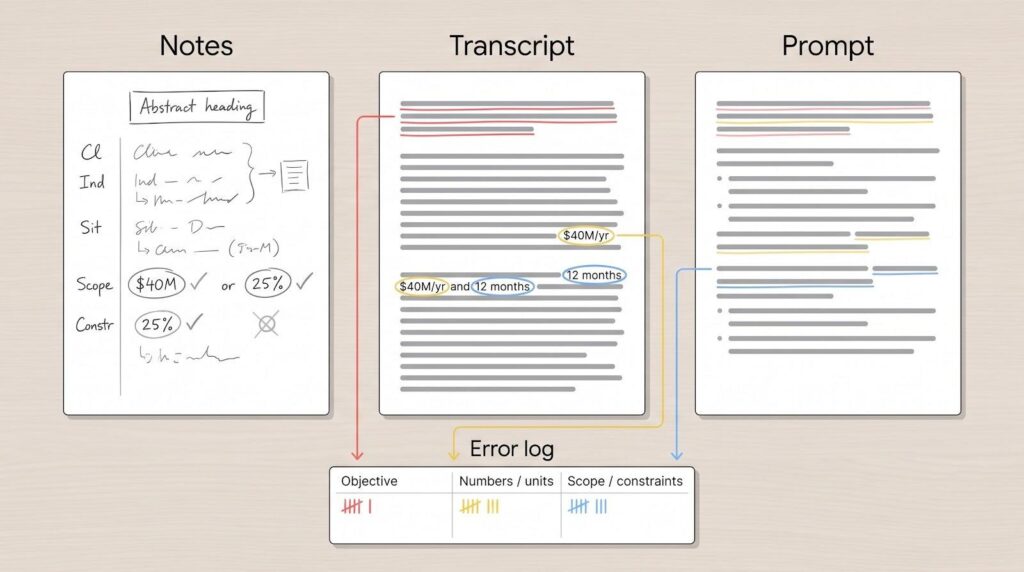
Put three pages side by side: your handwritten notes, the transcript and the original prompt. Then check:
- Objective. Does your decision statement match the interviewer’s exact words?
- Numbers and units. Circle every figure in the transcript and tick it off in your notes.
- Scope and constraints. Did you write “US stores only” when the prompt said “all stores”?
Log each miss under objective, numbers and units, or scope and constraints. Aim for fewer than three misses in the next mock.
Re-run the opening with no help
Close the transcript, take a blank sheet and give yourself 90 seconds to rebuild the recap and first-level structure from memory. Then reopen the transcript and grade objective, numbers and structure fit. Aim for three out of three in two consecutive mocks before you move on.
Check employer rules before any live assistance
Use the copilot for practice, not for the real interview, unless the employer says otherwise. Deloitte US says candidates should not “receive real-time assistance from AI tools or another person during an interview or assessment unless Deloitte has explicitly permitted it.” Deloitte UK is stricter: “Interviews must be completed without AI assistance.” Both allow AI before the interview; Deloitte UK says “You may use AI feedback tools to practice for interviews.” Check each firm’s policy, and use live assistance only with the employer’s explicit permission.
2. Set up your page before the prompt starts, and write only what you will use
A fixed page layout lets you capture facts in seconds and frees your mind to structure the case.
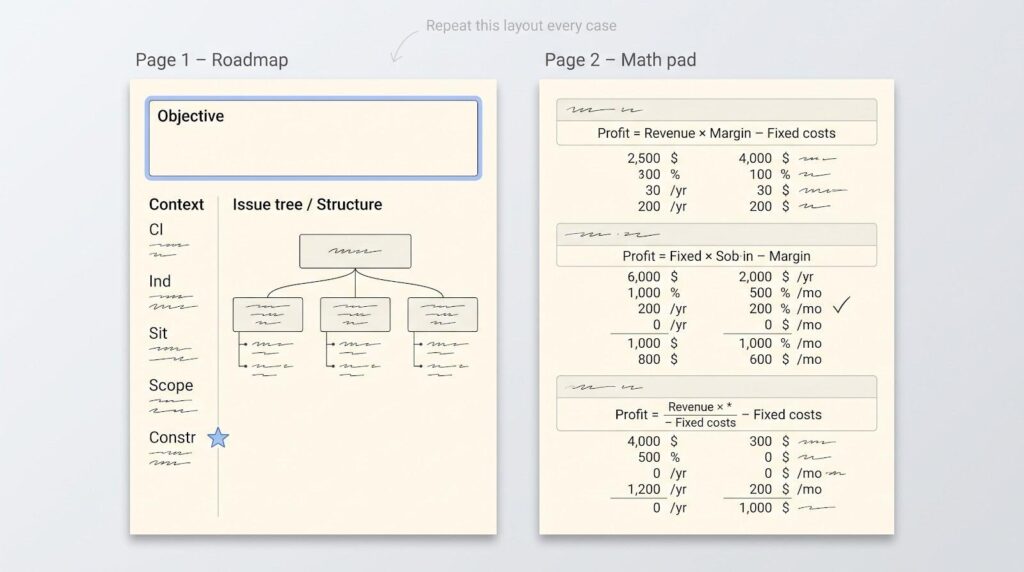
Lock in a two-page layout
Page 1, the roadmap:
- Top strip: box the objective.
- Left third: client, industry, situation, constraints (labels only).
- Right two-thirds: leave blank until the prompt ends; it becomes your issue tree.
Page 2, the math pad: title each calculation, write the equation first and line up numbers with their units. Bain’s own advice for in-person rounds is short: “Bring pen and paper: You’ll need them for notes and case work.”
Use the same zones in every mock, so your pen knows where each detail belongs.
Capture a decision brief, not a transcript
When the prompt begins, write only seven items: client, industry, situation, objective, metrics, scope and constraints. Use shorthand to keep pace (Cl, Ind, Sit, Obj, R for revenue, C for cost, arrows for up and down). Pair every figure with its unit, such as $12M/yr, 40k units/mo or 18% margin, so zeros and time frames never drift. Box the objective, circle numbers and star constraints; these marks become anchors under pressure.
Prove it in a one-minute drill
Ask a partner to read a prompt once. Spend 60 seconds filling your template. Compare your page with the printed text and log misses under objective, number, unit, or scope and constraint. Redo the opening until you record zero misses in two consecutive runs. It is a faster path to accuracy than another full-length case.
3. Recap the prompt in one sentence, then ask only questions that refine your structure
A crisp recap proves you heard the problem and buys time to think. One or two sharp questions then fill any gaps.
Craft a one-sentence recap
Template: client + problem or change + desired outcome + key scope or time frame.
Example: “Our client, a US specialty retailer, saw operating profit fall from $40 million to $25 million over two years and wants a plan to regain the lost profit within 12 months. Is that correct?”
Georgetown University’s career center gives the same advice: “Paraphrase back to the interviewer to make sure you heard them correctly.”
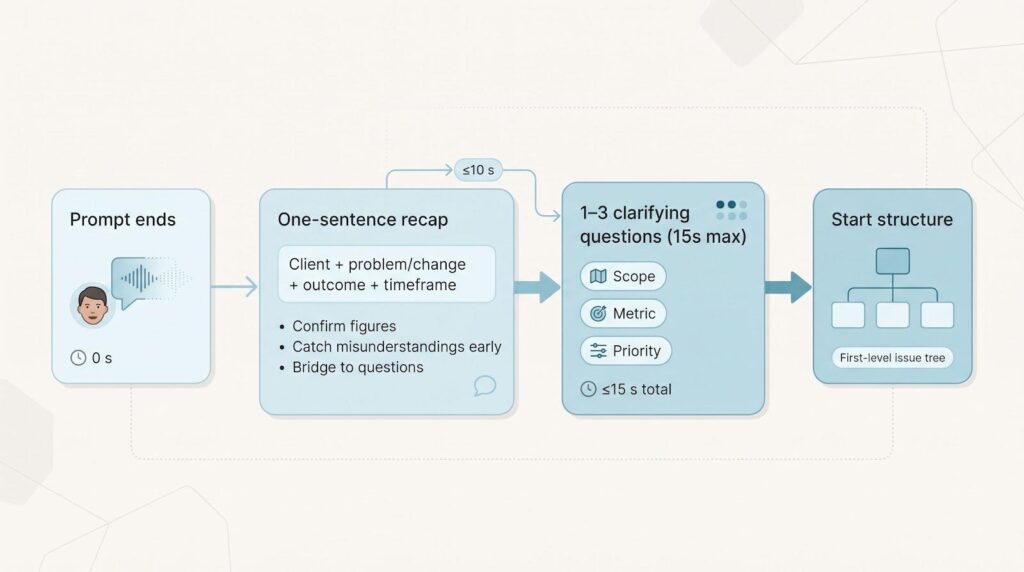
One sentence does three things:
- Confirms every figure.
- Surfaces misunderstandings while the stakes are low.
- Creates a bridge to clarifying questions.
Ask only the questions that change your structure
One to three clarifying questions is the usual range. Ask only those whose answer changes the scope, the metric or the priority.
Profitability examples:
- “Should I focus on operating profit, net income or margin?”
- “Is the decline concentrated in a product, channel or region?”
Market-entry examples:
- “Is success defined as positive EBITDA or a two-year payback?”
- “Are partnership, acquisition and organic build all on the table?”
Recover a missing figure immediately
State what you captured, name the gap and ask for the exact number, instead of guessing:
“I noted revenue of $84 million and fixed costs of $18 million per year. Could you repeat the gross margin?”
Ask once, early. A missing number found during the math costs far more time than a quick request after the recap.
4. Train your listening: how to prepare for case interview prompts you hear, not read
Listening is a skill you can drill just like math. A few spoken-only reps each day turn vanishing words into reliable notes.
Swap one screen session for a spoken drill
Ask a partner to read a case prompt once at normal speed, which usually takes 60 to 90 seconds. No text, no replay. Then:
- Capture the brief on your template.
- Recap the objective in one sentence.
- Ask one or two clarifying questions.
- Sketch the first-level structure.
No partner today? A free text-to-speech app can read a casebook prompt to you. Bain’s advice to “Think aloud: Share your reasoning and calculations, even if you’re unsure” is another reason to practice the whole opening out loud.
Know when the interviewer drives the flow
In an interviewer-led case, the interviewer asks a set series of questions and hands out new data as the case moves on. It is the format most often associated with McKinsey. In this stop-start flow you cannot count on hearing a number twice, so lock every figure, unit and constraint on paper the first time. Spoken-prompt drills train this reflex.
Follow a one-week spoken-opening schedule
| Day | Drill | Goal |
| Mon to Fri | 3 spoken openings (partner reads once; you brief, recap, clarify and outline) | 5 minutes or less each |
| Tue and Thu | 1 full read-aloud mock | Timing and flow |
| Sat | 1 full mock in an unfamiliar industry or with a new partner | Transfer the skill |
| Sun | Redo your two weakest openings from the error log, cold | Zero misses |
Score every opening in 60 seconds
After each drill, check the objective (yes or no), figures (correct out of total), units and time frames (correct out of total), scope and constraints (yes or no), and the seconds to your first structure. Aim for at least 90 percent capture and under 30 seconds from recap to structure before you add more full cases.
For overall volume, university benchmarks vary. Yale’s Office of Career Strategy recommends 4 to 6 weeks of preparation, about 2-3 cases per week in the middle weeks, and around 8-10 cases before a mock with a firm representative. The Harvard Griffin GSAS Consulting Club suggests practicing with a partner “3-5 times per week for two months before interviews.”
5. Drill mental math on numbers you only heard
Quick, accurate math keeps a case moving. One slip in units or zeros can sink a recommendation. BCG says strong candidates “analyze data, perform quick calculations, and identify the most important factors.”
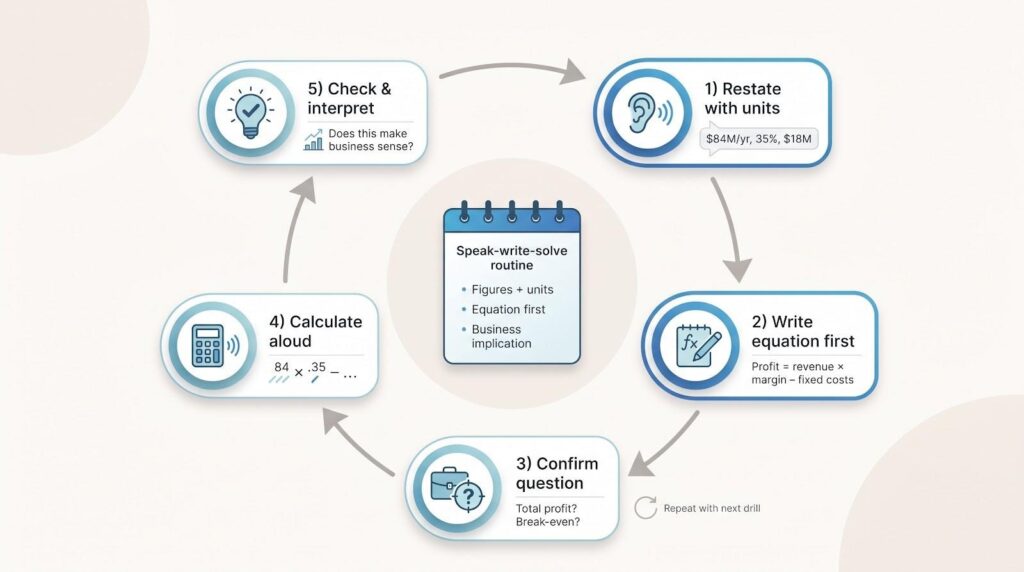
Follow a speak-write-solve routine
- Restate every figure with its unit: “Revenue $84M per year; gross margin 35 percent; fixed costs $18M.”
- Write the equation before you calculate: operating profit = revenue × margin minus fixed costs.
- Confirm the business question. Are you finding total profit, break-even volume or a margin change?
- Round only if the interviewer agrees.
- Calculate aloud, then sanity-check.
Five 90-second spoken-number drills
- Echo drill. Your partner reads three figures; you repeat them with units and write the equation.
- Growth-rate drill. Revenue goes from $48M to $60M; you state the formula and report 25 percent growth.
- Margin drill. $120M revenue, $72M variable costs, $18M fixed costs; you calculate $30M profit and a 25 percent margin.
- Break-even drill. $24M fixed costs and $6 contribution per unit; the result is 4M units.
- Annualization drill. 2.4M customers × $35 per month; the result is $1.008B per year.
Score each rep in 15 seconds
Tick three boxes:
- Figures and units 100 percent correct.
- Equation stated before the math.
- Business implication said out loud.
Aim for 10 perfect reps in a row, each under 90 seconds, before you lengthen the numbers. Log any miss and redo that drill the next day.
One-week and four-week case interview preparation plans
Pick the track that matches your calendar: a seven-day sprint when time is tight, or a four-week build when you can pace the work.
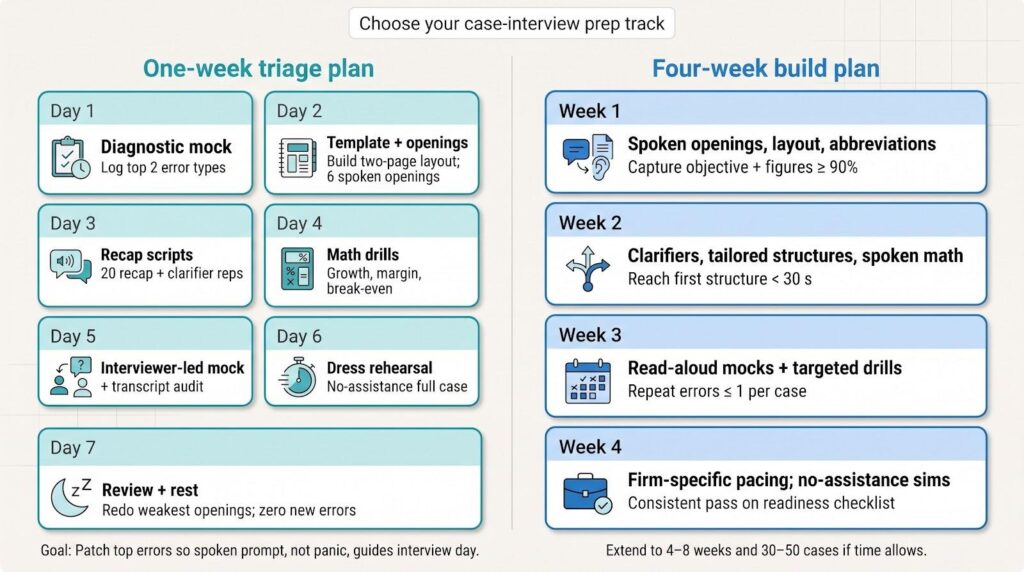
One-week triage plan
| Day | Core drill | Target |
| 1 | Read-aloud diagnostic mock | Log your top 2 error types |
| 2 | Build the two-page template; run 6 spoken openings | Objective and all figures captured in at least 4 of 6 |
| 3 | Recap and clarifying-question scripts (20 reps) | One-sentence recap in 10 seconds or less |
| 4 | Growth, margin and break-even drills | 100 percent accuracy on 10 problems |
| 5 | Interviewer-led mock plus transcript audit | Fewer than 3 listening misses |
| 6 | Dress rehearsal with no assistance | Finish the case within the time limit |
| 7 | Redo your weakest openings; light math; rest | Zero new errors |
Four-week build plan
| Week | Focus | Target |
| 1 | Spoken openings, page layout, abbreviation set | Objective and figures captured at least 90 percent of the time |
| 2 | Clarifying questions, tailored structures, spoken math | First structure in under 30 seconds |
| 3 | 2 to 3 full read-aloud mocks plus targeted drills | No more than 1 repeat error per case |
| 4 | Firm-specific pacing; simulations with no assistance | Consistent pass on your readiness checklist |
Finish each week only when you meet its targets; performance, not hours, signals readiness.
Common mistakes when the case prompt is read aloud
Avoid these seven errors; each one costs seconds you cannot buy back.
| Mistake | Why it hurts | Quick fix |
| Writing full sentences | Your hand lags behind the speaker and figures slip past | Use labels, symbols and units only |
| Structuring while the interviewer still talks | An early anchor leads to the wrong objective | Finish listening, recap, then outline |
| Guessing a missing figure | One zero error wrecks the math | Repeat what you have and request the gap |
| Dropping units or time frames | $5M/mo is not $5M/yr | Write every number with its unit |
| Silent mental math | The interviewer cannot correct your setup | State the equation aloud, then calculate |
| Asking a checklist of generic questions | Signals you did not listen | Ask only what changes scope, metric or priority |
| Using live AI without permission | May break the firm’s interview rules | Check the policy, practice with AI, switch it off for the interview |
Conclusion
Read-aloud prompts test listening as much as problem solving. Build a fixed page layout, recap in one sentence, ask only the questions that change your structure, drill spoken numbers, and review every mock against what was actually said. A transcript from an AI copilot makes that review precise in practice; in the interview itself, your preparation does the work.
Frequently Asked Questions
How long should I prepare for a case interview?
Benchmarks vary. Yale’s career office recommends 4 to 6 weeks, and the Harvard Griffin GSAS Consulting Club suggests partner practice 3-5 times per week for two months. If you already solve cases quickly, one focused month of targeted drills is often enough.
Can I ask the interviewer to repeat part of the prompt?
Yes. Wait until the prompt ends, repeat what you captured and request the specific gap: “I have the client, objective and time frame. Could you repeat the revenue figure?”
How many clarifying questions should I ask?
Usually one to three. Zero is fine when the prompt is clear. Ask only if the answer changes the scope, the metric or the priority.
Can I use AI during the live interview?
Only if the employer explicitly permits it. Deloitte US says AI “may be used before the Deloitte interview process” but bars real-time assistance “unless Deloitte has explicitly permitted it,” and Deloitte UK states that “Interviews must be completed without AI assistance.”
How many practice cases are enough?
You are ready when you consistently capture the objective, keep every unit, explain your math aloud and give a clear recommendation in unfamiliar industries. Volume without feedback only repeats mistakes.
Will the prompt appear on screen in a virtual interview?
Do not assume it will. Train for spoken-only prompts first; reading a prompt on screen is the easier case.