


What Is Mark Twain Effect?
Mark Twain Effect is a financial market phenomenon indicating a historical pattern of stock market downturns or increased market volatility occurring in October. Hence, this month tends to be unfavorable for trading due to heightened turbulence in the financial markets. It is also referred to as the October effect.
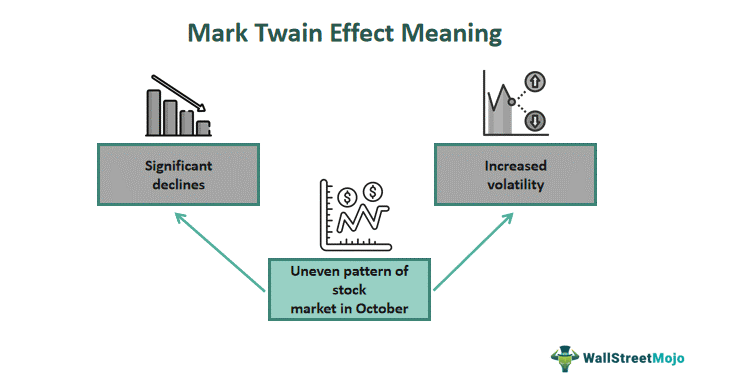
The concept of this effect was initiated by a sarcastic comment by the famous American writer Mark Twain in his novel Pudd’nhead Wilson about the stock market condition. He stated that, October is among the most peculiar and hazardous months to trade stocks is this one. The remaining ones are February, May, March, June, December, August, January, September, April, November, and July.
Key Takeaways
- The Mark Twain effect refers to the observed historical tendency of the stock market to experience significant declines or increased volatility during October.
- Any statistical concept does not advocate this phenomenon; it is instead based upon a psychological belief or observation, making it a less reliable method for predicting stock market behavior.
- There have been 37 instances since 1928 when the stock market performed negatively or experienced excessive volatility in October. These events include the Great Depression in 1929, Black Friday in 1987, and the Stock Market Crash in 2008.
Mark Twain Effect Explained
The Mark Twain effect is an observed pattern of a downtrend in the stock market during October. It has been identified that since 1928, the stocks have been low almost 37 times in October. However, the market bounced eight times in these 37 years. According to this phenomenon, the month is known for roller-coaster stock market fluctuations; it is always advisable for investors to avoid sentimental sell-offs but hold the stocks till the conditions improve. Simultaneously, this period is considered favorable for buying stocks at their lows.
However, skeptics argue that the Mark Twain effect is merely a statistical anomaly or coincidental clustering of market events. They emphasize that stock market movements are influenced by various factors, including economic indicators, corporate earnings reports, geopolitical events, investor sentiment, and market participants’ behavior. Hence, attributing a specific pattern to a particular month may not be reliable for indicating future market behavior. Thus, this effect is considered more of an anecdotal observation than a reliable predictor of market behavior.
The analysis of some economists, researchers, and stock market experts has proven this phenomenon vague. Moreover, if a large section of market participants anticipate market declines during October and act accordingly by selling their positions, it can create a downward spiral in stock prices. Therefore, investors must approach investment decision-making with a comprehensive and informed perspective, considering a wide range of factors rather than relying solely on historical patterns or specific months of the year.
Examples
The Mark Twain Effect gained attention due to several significant events in stock market history. Some of these were as follows:
- Great Depression, 1929: One notable event was the stock market crash of 1929, which occurred between October 24 to October 29, 1929, and marked the beginning of the Great Depression. During the period, the Dow Jones Industrial Average crashed by 30%, which panicked the investors who started capitulating. Further, the hefty trading activities resulted in delayed ticker tape reporting, leading to current stock trading price confusion. Panic selling, over-speculation, economic slowdown, and overextended margins marked the beginning of the Great Depression.
- Black Monday 1987: Another significant occurrence was the stock market crash of 1987, commonly referred to as “Black Monday,” which occurred on October 19, 1987, and resulted in a severe one-day decline in global stock markets. The Dow Jones Industrial Average dipped by 22.6% on this day due to spontaneous panic selling due to delayed trading in the options market. Moreover, the dollar value declined as the US reported a negative trade deficit. Imposing the circuit breakers into the trading system immediately halted the rapid capitulation.
- Stock Market Crash 2008: Amidst the Fed’s passing of the bailout bill in response to the 2008 global financial crisis, the Dow Jones Industrial Average fell by 800 points on October 6, 2008, its highest loss since 2004.
Importance
The Mark Twain Effect effect is identified as a pattern, and its significance has been debated among financial experts. However, some of the reasons for using it in future predictions are as follows:
- Emphasizes Historical Precedence: Throughout history, there have been notable stock market crashes, significant downturns, and other such events that have occurred in October 37 times. These events have contributed to the perception that October is volatile for the stock market.
- Psychological Impact on Investors: The awareness of historical market downturns during this month may make investors and traders more cautious in their trading decisions.
- Favorable for Buying Stocks: This phenomenon suggests that stock prices tend to decline or fluctuate considerably during October. Hence, the market speculators and investors can benefit from buying the assets at a low price and then later selling them at a high price when the market improves.
- Adjusting to Seasonal Factors: Some analysts attribute this effect to seasonal factors, such as the end of the fiscal year for many companies and investment funds. During this time, portfolio managers may engage in portfolio reallocation and tax planning, leading to increased selling or profit-taking, potentially impacting market performance.
Frequently Asked Questions (FAQs)
Frequently Asked Questions
Is the Mark Twain effect real?
It is more of a psychological perception than an accurate market behavior predictor. Any statistical inference does not support it. Indeed, Sam Stovall, the Chief Investment Strategist at CFRA, a market research firm, found in an analysis of the S&P 500’s October month performance that the stocks made an average gain of 0.9% in this month since 1945. Thus, according to his firm, it is one of the year’s best-performing months.
How to combat Mark Twain effect?
It is crucial to promote media literacy and critical thinking among people in order to counteract this effect. Misinformation can be stopped by teaching people how to recognize trustworthy sources and urging them to double-check information before forwarding it to others.
Why does Mark Twain effect point out October?
In his Novel Pudd’nhead Wilson, Mark Twain referred to the October Effect, which indicates a particular pattern of a stock market crash or downtrend, usually in October month, based on the events of October 1929, 1987, and 2008.