


Introduction
Hiring managers at banks, consulting firms, and Fortune 500 finance teams increasingly evaluate candidates on demonstrated modeling ability rather than the name on a diploma. This shift has made it genuinely possible to become a financial analyst without a finance degree. That said, a candidate needs to prove technical competence in Excel, financial modeling, and financial statement analysis. Recruiters at credit-intermediation firms, asset managers, and corporate FP&A teams routinely hire candidates from non-finance backgrounds. Engineers, liberal arts graduates, and career switchers can stand out with certifications, modeling portfolios, and practical finance skills.
This article breaks down how to become a financial analyst without a finance degree and what separates successful candidates from those who stall out. It uses a comparison-first framework covering traditional and skills-first paths. It also benchmarks certification programs side by side and presents salary data from the U.S. Bureau of Labor Statistics. Readers will leave with a step-by-step roadmap, a realistic skills checklist, and an honest view of where structured coursework accelerates the transition.
Key Takeaways
- Learning how to become a financial analyst without a finance degree requires building practical skills in financial modeling, Excel, and financial statement analysis.
- Non-finance graduates can build analyst careers by demonstrating practical skills through certifications, portfolios, and case studies.
- Financial analyst roles require financial statement analysis, modeling, budgeting, forecasting, and ratio-based analytical judgment.
- A focused skills-first path can help career switchers build relevant capabilities within three to nine months.
- Practical modeling portfolios can provide tangible evidence of skills during financial analyst interviews.
- FP&A, budget analyst, and financial analyst roles offer potential entry points for candidates transitioning from non-finance backgrounds.
Can You Become a Financial Analyst Without a Finance Degree?
If you are exploring how to become a financial analyst without a finance degree, the first step is understanding what employers actually evaluate. The U.S. Bureau of Labor Statistics notes that financial analysts typically need a bachelor’s degree to enter the occupation. Nevertheless, employers routinely accept degrees in engineering, economics, mathematics, statistics, or unrelated fields if the candidate can demonstrate financial modeling proficiency.
Moreover, the individual should showcase Excel fluency and an understanding of financial statements. The degree requirement functions more as a proxy for analytical rigor than a strict finance-major mandate. Also, note that certifications plus portfolio projects increasingly substitute for that signal.
The table below compares the two realistic paths that you must evaluate if you are wondering how to become a financial analyst without a finance degree.
| Factor | Traditional Finance-Degree Path | Skills-First Path (No Finance Degree) |
| Typical timeline | 3-4 years (undergraduate degree) | 3-9 months (certification + portfolio) |
| Core proof of competence | Coursework, GPA, campus recruiting | Certification, Excel models, case studies |
| Cost | Full degree tuition | Course fee, typically far lower |
| Entry roles available | Financial analyst, equity research associate, IB analyst | FP&A analyst, financial analyst, budget analyst |
| Biggest risk | Time and opportunity cost | Needs deliberate skill-building and networking |
| Strongest fit for | Fresh graduates planning finance from the start | Career switchers, non-finance graduates, working professionals |
The Skills That Actually Get You Hired
Financial analyst roles are judged almost entirely on four technical competencies. They include financial statement interpretation, Excel-based financial modeling, forecasting and budgeting methods, and ratio-based analytical judgment. Understanding these core competencies is an important part of learning how to become a financial analyst without a finance degree.
The table below highlights the key skills recruiters look for and how non-finance candidates can build them.
| Skill | Why Recruiters Screen For It | How Non-Finance Candidates Build It |
| Financial statement analysis | Every analyst role starts with reading income statements, balance sheets, and cash flow statements | Structured coursework covering liquidity, profitability, efficiency, and solvency ratios |
| Financial modeling & DCF | Forecasting, valuation, and capital budgeting all run through a working model | Hands-on modeling practice using downloadable templates and real case studies |
| Budgeting & forecasting | FP&A and corporate finance teams operate around annual budgets and rolling forecasts | Exposure to fixed, flexible, zero-based, and activity-based budgeting frameworks |
| Excel and data tools | Nearly all financial reporting and dashboarding still runs through Excel and pivot tables | Repeatedly build models instead of simply watching tutorials. |
| Corporate finance fundamentals | NPV, IRR, and payback period decisions underpin capital allocation | Applied capital budgeting exercises tied to real company scenarios |
Candidates transitioning from operations, engineering, or consulting backgrounds often already possess strong Excel and analytical instincts. What they lack is structured exposure to finance-specific frameworks like discounted cash flow modeling and cost-volume-profit analysis. This is precisely the gap a focused course is designed to close.
Step-By-Step Path From Non-Finance Background to Financial Analyst
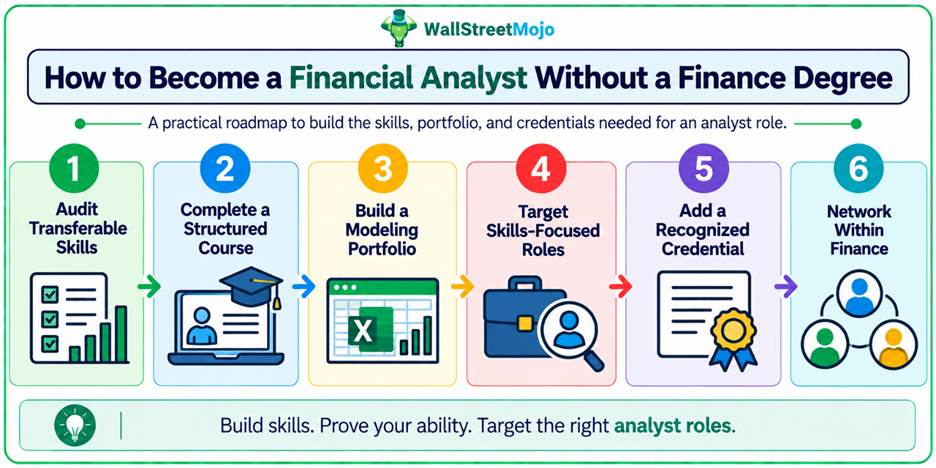
The following steps explain how to become a financial analyst without a finance degree through a practical, skills-first path:
- Audit existing transferable skills: Excel proficiency, data analysis experience, and quantitative coursework from engineering, statistics, or economics backgrounds count as a head start.
- Complete a structured, certification-backed course: A program covering budgeting, forecasting, financial statement analysis, and financial modeling compresses years of on-the-job learning into a focused curriculum. WallStreetMojo’s Financial Planning & Analysis (FP&A) Course walks learners through this exact sequence across four phases. It begins with FP&A fundamentals and then advances into cost management, dynamic financial modeling, and strategic decision-making topics.
- Build a small modeling portfolio: Three or four completed models, such as a three-statement projection, a DCF valuation, and a budget variance analysis, give interviewers concrete proof of ability.
- Target roles that value skills over pedigree: FP&A analyst, budget analyst, and financial analyst openings at mid-sized companies and shared-services centers tend to weigh demonstrated modeling ability more heavily than the university listed on a resume.
- Layer on a recognized credential: Certifications built around case studies and practical examples help address the trust gap that non-finance graduates face during resume screening.
- Network deliberately within finance functions: Informational interviews with FP&A managers and controllers often surface openings before they are posted publicly.
Certifications And Courses That Signal Credibility
No single certification guarantees a financial analyst role. That said, structured courses with practical examples consistently outperform generic online tutorials. Choosing the right structured training can therefore be an important part of how to become a financial analyst without a finance degree.
The following table compares selected financial training programs based on their format, key features, and considerations.
| Course / Program | Format | Key Features | Considerations |
| Wall Street Prep – Financial Modeling Training | Self-paced and cohort programs | Financial modeling, valuation, Excel, and case-based training | Program focus varies by offering |
| Breaking Into Wall Street – BIWS Premium | Online, video-based | Financial modeling, Excel, PowerPoint, case studies, and interview preparation | Strongly oriented toward investment banking and related roles |
| CFI – Financial Modeling & Valuation Analyst (FMVA) | Self-paced online certification | Financial modeling, valuation, financial analysis, forecasting, and Excel | Requires completion of the prescribed curriculum and electives |
| Coursera – Relevant Finance Programs | Online courses and certificate programs | Courses from universities and companies across financial analysis and related topics | Content and hands-on work vary by program |
| WallStreetMojo – Financial Planning & Analysis (FP&A) Course | Self-paced | FP&A fundamentals, budgeting, forecasting, financial modeling, case study, and Excel templates | Dedicated FP&A career focus |
Candidates evaluating options for a financial analyst or FP&A track specifically should weigh how closely the curriculum mirrors real job tasks. A program that combines budgeting types, forecasting techniques, ratio analysis, and DCF modeling with practical examples provides broader preparation than isolated Excel tips. It can help candidates prepare for interview questions at the FP&A analyst and financial analyst levels.
What Financial Analysts Earn: US and India Benchmarks
In India, AmbitionBox reports financial analysts with 1-7 years of experience typically earns ₹6.6 lakh to ₹7.3 lakh per annum. In the United States, according to Salary.com, the average financial analyst salary is $68,006 per year as of September 1, 2026.
For a broader U.S. benchmark, the U.S. Bureau of Labor Statistics reports a median annual wage of $103,570 for financial analysts in May 2025. It also projects 7% employment growth from 2025 to 2035, compared with 3% for all occupations.
These figures show that compensation can vary substantially depending on the market, employer, experience, and role. For someone entering the field without a finance degree, the salary data should be viewed as a long-term benchmark rather than an expected starting salary. Building skills in financial modeling, Excel, financial statement analysis, budgeting, and forecasting can help candidates qualify for analyst roles and progress toward higher-paying positions.
Common Mistakes Non-Finance Candidates Make
Avoiding these common mistakes can help candidates become a financial analyst without a finance degree and build stronger skills for the role.
- Skipping financial statement fundamentals and jumping straight into advanced modeling without understanding how the three statements connect
- Treating certifications as a checkbox rather than building an actual portfolio of completed models to discuss in interviews
- Applying only to bulge-bracket investment banks, which still recruit heavily from campus programs, instead of targeting FP&A, corporate finance, and mid-market roles that value demonstrated skill
- Underestimating Excel depth, since pivot tables, sensitivity tables, and dynamic formulas are tested far more often than candidates expect
- Ignoring cost accounting and budgeting concepts, which dominate FP&A interviews but are frequently skipped in generic “finance for beginners” content.
Conclusion
For candidates researching how to become a financial analyst without a finance degree, a finance degree is helpful but not always necessary for financial analyst, FP&A, or budget analyst roles. What consistently moves candidates from application to offer is demonstrated modeling ability, a working knowledge of budgeting and forecasting frameworks, and a credential that gives recruiters confidence in that ability.
For professionals ready to build that foundation methodically, WallStreetMojo’s Financial Planning & Analysis (FP&A) Course offers a structured path from FP&A fundamentals to financial modeling and strategic decision-making.
Frequently Asked Questions
Can I become a financial analyst with a non-finance degree?
Yes, employers commonly hire financial analysts with degrees in engineering, economics, mathematics, or business. This makes non-finance graduates financial analyst roles an increasingly relevant career path. Candidates should also demonstrate financial modeling skills, Excel proficiency, and an understanding of financial statements. These skills are often validated through a certification or portfolio.
Do I need an MBA or CFA to work in FP&A?
No, FP&A roles typically prioritize practical skills in budgeting, forecasting, cost management, and financial modeling over advanced credentials such as an MBA or CFA charter. These credentials are more commonly pursued for career advancement than for entry-level hiring.
How long does it take to become job-ready as a financial analyst without a degree in finance?
Most career switchers can become interview-ready within three to nine months by following a structured course. They can reinforce the coursework through independent practice building three-statement models and DCF valuations.
What is the difference between a financial analyst and an FP&A analyst?
A financial analyst typically evaluates investments, companies, or securities for external decision-making. An FP&A analyst works inside a company on budgeting, forecasting, and internal financial planning. However, both roles require overlapping skills, including financial modeling and ratio analysis.
What salary can a financial analyst expect without a finance degree?
In the United States, financial analysts earn an average annual salary of $68,006 per Salary.com data, while in India, AmbitionBox reports a typical salary range of ₹6.6 lakh to ₹7.3 lakh for 1-7 years of experience annually. Note that the compensation varies on the basis of specific factors, like location, job role, etc. These figures also provide useful context when researching financial analyst without a finance degree salary expectations.
Which skills matter most for financial analyst interviews?
Interviewers most frequently test financial statement analysis, three-statement and DCF modeling, budgeting and forecasting methods, ratio analysis, and Excel proficiency, since these map directly to daily analyst responsibilities.