


What Is The London Metal Exchange (LME)?
The London Metal Exchange (LME) is a non-ferrous metals or commodities market in London, England that facilitates the trading of futures and options contracts executed upon base metals such as copper, aluminum, nickel, zinc, lead, silver, gold, plastic, and steel.
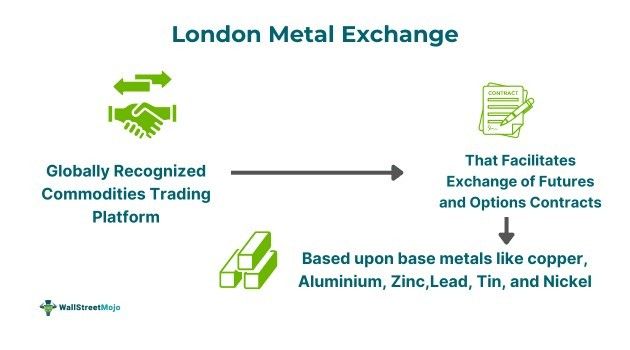
It is one of the biggest markets for commodities futures and options trading worldwide. Since 2012, Hong Kong Exchanges and Clearing has owned London Metal Exchange. It is a global exchange platform for metals that generates and is a major earning source for the U.K., as 95% of its trading occurs internationally. Moreover, it standardizes the prices of base metals globally.
Key Takeaways
- London Metal Exchange (LME) is a global commodities exchange established to trade futures and options contracts based on non-ferrous, ferrous, E.V., and precious metals.
- LME was founded in 1877 in London, England. The platform is globally recognized for trading and price determination of non-ferrous base metals such as copper, aluminum, zinc, tin, lead, nickel, and zinc.
- While it is one of the prominent commodities exchanges in Europe, it ranks 10th in the topmost futures and options market on the international front.
- In 2012, London Metal Exchange was occupied by the Hong Kong Exchange in a £1.4 billion deal.
How London Metal Exchange Works?
London Metal Exchange (LME) is an international commodities trading platform that enables traders, hedgers, and speculators to exchange futures and options contracts where the underlying assets are different metals, including non-ferrous, ferrous, E.V., and precious metals. There are three different mechanisms of trading on LME:
- Open Outcry: This age-old system allows the traders to engage in face-to-face ring trading pit. However, with the flaring popularity of e-trading, the existence of this system is skeptical.
- Telephone System: It is a facility that trades LME components 24×7 through the telephone market.
- LME Select: It is an electronic trading platform that functions just like any other stock market.
Notably, LME has 7 different ways of trading metal and related contracts, including options, futures, Monthly Average Futures, TAPOs, Trade at Settlement, LMEminis, and HKEX London Minis. Amidst the rising preference for electronic trading, this is Europe’s kind commodities market with an open outcry model for the physical Exchange of metals. It is a widely used platform by industrial hedgers to mitigate the price fluctuation risk of buying and selling metals in the future. Also, it is one of the favorite profit-making avenues for speculators who target short-term price changes of metals.
History
However, the initial traces of a platform for metal commodities trading are deeply rooted in the establishment of the Royal Exchange, London, in 1571; the London Metal Exchange (LME) was officially chartered in 1877. The primary purpose of LME was to address the risks associated with metals price fluctuations that occurred amidst the Industrial Revolution of 1760-1840. Initially, in the 1800s, the merchants traded metals like copper and tin informally in coffee houses (especially the Jerusalem Coffee House), but the formation of LME formalized such trades with forward contracts and an open outcry trading system, which is still now a popular exchange platform for metal traders.
Although LME was temporarily closed during 1914 due to the onset of World War I, it was shortly opened during the autumn season of the year. The Exchange has expanded its contracts and delivery periods to suit industrial needs and maintains strict quality standards for metals. The LME is a global trade-driven market with approved warehouses worldwide, used mainly by metal producers, processors, and consumers for hedging purposes.
Later, in 1985, a crisis occurred in the London Metal Exchange market with the collapse of the World Tin Council’s buffer stocks. Also, in 1996, the London Metal Exchange copper market witnessed another crisis caused by a Sumitomo Corp trader. Further, in 2005, the market was disrupted by the running away of a Chinese government trader, Liu Qibing.
After all these ups and downs, LME made significant changes in its administration and strategic direction. Then, between 2011 and 2012, the Exchange formed its own clearing house and finally got acquired by the Hong Kong Exchange for £1.4 billion.
Metals Traded
London Metal Exchange is one of the biggest futures trading platforms around the world, enabling the Exchange of different metal futures and options based on these commodities. Let us have a quick look at different commodities traded on LME:
#1 – Non-Ferrous Metals
As discussed earlier, the LME facilitates the international trading and global price standardization of non-ferrous industrial metals, including:
- Copper
- Aluminium
- Lead
- Zinc
- Nickel
- Tin
- NASAAC
- Aluminium Alloy
- Aluminium Premiums
- Alumina (Platts)
- LME Aluminium UBC Scrap US (Argus)
#2 – Ferrous Metals
Being a physical commodities market, LME also serves as a platform for the trading of steel and steel raw material industries through its futures contracts, curated explicitly in association with the steel society for optimal risk management. So far, it has 7 cash-settled ferrous futures contracts that can be bought and sold over the LMEselect for 15 months through the inter-office market. It includes:
- LME Steel Scrap CFR Turkey (Platts)
- LME Steel Rebar FOB Turkey (Platts)
- LME Steel HRC FOB China (Argus)
- LME HRC NW Europe (Argus)
- LME Steel HRC North America (Platts)
- LME Steel Scrap CFR India (Platts)
- LME Steel Scrap CFR Taiwan Argus
#3 – EV Metals
Other than the ferrous and non-ferrous metals, the market trades electric vehicle (E.V.) metals to serve the diverse requirements of the minor metals communities through the following futures contracts:
- LME Lithium Hydroxide CIF (Fastmarkets MB)
- LME Cobalt (Fastmarkets MB)
- LME Cobalt
- LME Molybdenum (Platts)
#4 – Precious Metals
Also, this platform supports the Exchange of precious metals in association with the London Platinum and Palladium Market, enabling the trading of contracts like:
- LBMA Palladium
- LBMA Platinum
Examples
LME has been facilitating hedging and speculation trades since the late 1800s for those who want to invest or make profits from non-ferrous metals. Let us have an overview of this unusual commodities market through the following examples:
Example #1
Suppose Mr. Holmes has a keen interest in aluminum. He expects the price of this metal to decline in the next three months. According to him, aluminum will drop by 3.7% during this period from its current price of $2289. Therefore, he enters into a three-month London Metal Exchange aluminum futures contract of a lot size of 25 tons, freezing a future selling price of $2289, with an expectation of making a considerable profit from the fall in the prices of the underlying commodity.
Example #2
On May 07, 2024, Barchart article of TradingView –https://www.barchart.com/story/news/26024015/is-copper-heading-for-a-new-record-high, it was discussed that the price of July COMEX copper futures was $4.6255 per pound on May 6, 2024, approaching towards its previous high of $5.01 in March 2022. On May 14, 2024, these futures contracts reached a new high above $5. Indeed, on May 20, 2024, it touched a peak of $5.1990 per pound before its price correction with a fall below $4.50. Notably, the three-month London Metals Exchange copper forwards climbed up to $11,104.50 per ton on May 20, 2024, breaking through its March 2022 previous high of $10,845.
Since 2005, copper has been rallying in an uptrend, with COMEX futures prices above $2 since early 2016 and above $3 since October 2020. Moreover, copper futures have consistently seen higher low and high values over the past years, while the metal is considered a key economic indicator, particularly for China.
The CPER ETF, which tracks COMEX copper futures, reached a record high in May 2024, with shares priced at $27.79 and AUM above $236 million. It trades approximately 320,000 shares every day at a management fee of 0.88%. The DBB ETF comprises other metals alongside copper, such as aluminum, lead, nickel, tin, and zinc. The DBB ETF traded at $20.11 per share, with an AUM of $190 million. While this ETF experiences a daily trading of more than 223,500 shares daily, its management fee is 0.77%. However, both CPER and DBB are available for Exchange only during U.S. market hours; both of these ETFs effectively track the base metals prices over time.
Frequently Asked Questions (FAQs)
Frequently Asked Questions
Who is the CEO of London Metal Exchange?
The current CEO of the London Metal Exchange, U.K., is Matthew Chamberlain, who was appointed as the chair on April 21, 2017. He is also a member of the HKEX Group’s Management Committee.
Can anyone trade on the LME?
Anyone, including physical market participants, institutional hedgers, or proprietary traders, can engage in trading activities on the LME either by joining this international Exchange as a member or becoming a client of an existing LME member. In the latter case, traders can approach members of categories 1, 2, and 4 or their respective Independent Software Vendors (ISVs) to participate in LME contracts.
Who is the head of Legal at London Metal Exchange?
The London Metal Exchange appointed Susan Small as its head of Legal or General Counsel, who joined the team in June 2024 to handle all the legal matters of LME and LME Clear.
What is the risk committee in LME?
The LME Board has a subcommittee known as the Board Risk Committee (BRC), which functions under the LME Clear to ensure risk management by gauging potential uncertainties, advising and assisting the Board, and undertaking the responsibilities of risk management failure.