


What Is Customer Service Platform?
A customer service platform refers to a program that comprises various tools to help business entities manage their customer support and service channels efficiently. It, thus, aims to enhance customer experience by addressing, prioritizing, and resolving customer complaints and queries.
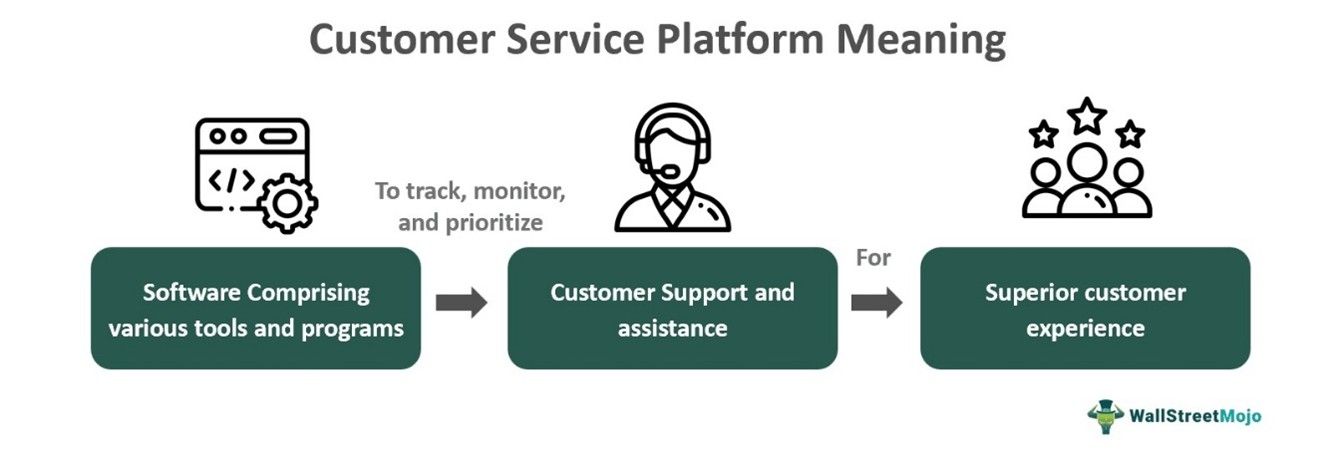
Companies nowadays prefer customer service software that is customized to their unique requirements and customer service goals, usually the ones that provide all-in-one solutions. These platforms are crucial for businesses to develop a robust system for interaction between the customers and the company while ensuring that the support team has all the resources to help the clients.
Key Takeaways
- A customer service platform is a program that helps business entities keep track of customer interactions with their customer support team, analyze their communication history, and improve their overall experience.
- The popular types of customer service software include phone support, messaging and live chat, automation and AI, self-service systems, customer relationship management software, and suites.
- This software has unique features like automation of workflows, customer database management, multi-channel support, knowledge base or information repository, reporting and analytics, ticket management, and Service Level Agreements.
- Some of the best customer service platforms include Zendesk, HelpScout, and Salesforce.
Customer Service Platform Explained
A customer service platform is a software or set of tools that facilitate business entities to monitor, review, and improve their customer support system and interactions to provide an enhanced customer experience. In the era of digitalization, customer service has taken a new dimension, where people are assisted by automation and artificial intelligence. However, customer service is nothing new, but the customer service platforms have made it convenient for both the customers and the support teams since people now don’t need to walk into the stores for minor issues or queries. While there are many companies providing software solutions to businesses for customer service, the best-known customer service platform is Zendesk.
Some of the prominent features of the customer service software include:
- Creating and maintaining a knowledge base with self-service resources for the customers to self-resolve their issues by going through the FAQs.
- Processing reports on key performance metrics while gauging the scope for improvement.
- Generating, tracking, managing, and closing the customer support tickets issued for the reported problems or inquiries.
- Assisting different channels like phone calls, emails, chat, messages, social media, etc.
- Ensuring timely resolution to customer issues by creating service level agreements (SLAs).
- Maintaining the customer’s database, including their interactions, responses, preferences, profiles, etc.
- Automating the recurring tasks and other customer service activities to save the team’s time.
Types
A customer service platform is a valuable arrangement for using various tools that help the customer support team to work efficiently. Some of the valuable tools include:
- Customer Relationship Management: The CRM software is a system that gathers customer interaction data, keeps a record of such communication, and tracks customer purchases, preferences, demographics, and responses.
- Automation and Artificial Intelligence: These AI-leveraged platforms allow customers to interact with the chatbots for quick support, technical assistance, and inquiries.
- Ticketing Systems: This tool includes generating a customer ticket, I.e., assigning a number to each inquiry or complaint, monitoring its resolution, and closing the ticket.
- Messaging and Live Chat Software: Through such software, customers can approach customer service agents via emails, messages, or live chat for instant assistance.
- Phone Support: These platforms facilitate the support and service to those customers who call the provided numbers through call routing, self-service call options, and CRM software.
- Self-Service Portals: There are various other self-service software that direct the customers to websites or particular resources to let them help themselves. It includes Frequently Asked Questions, Chatbot messaging, blogs, Information, video tutorials, etc.
- Suites (All-In-One): The businesses may use a combination of the software mentioned above to ensure a more efficient and robust customer service system by creating a complete solution.
How To Choose?
Companies can adopt different customer service software; while some standard ones fulfill their basic requirements, they can get these platforms customized to meet their unique customer service needs and objectives. However, the customer service platform selection involves the following steps:
- Understand Business Requirements: The foremost consideration is the individual business needs, including the functions and features regarding customer service; also, the companies need to analyze their size and prevailing customer service channels before finding a suitable platform.
- Assess Integration Capabilities and Scalability: The businesses must opt for a system that can incorporate the business scalability as the customer demand rises. Also, it should integrate with the current customer service channels and tools.
- Analyze Pricing Models and Customer Response: It is equally essential to go through the pricing models stated by the software providers to ensure that the company gets a fair deal. There can be different pricing models, such as tiered, user-based, or agent-based. Thus, the company needs to find one that is within its budget and fulfills all its requirements.
Examples
No matter what the company size is, customer service is the foremost priority since the current era, where buyers check other customers’ reviews before making a purchase. Moreover, after-sales service or customer service is a top-notch priority. Some examples of these customer service platforms are:
Example #1 – Customer Service Platforms for Small Business
Suppose ABC Ltd. is a budding mobile phone manufacturing company based in China. It has a consumer base of 0.9 million worldwide. The company has a customer service suite that includes a chatbot, phone support, and self-service software. The brand aims to grow its operations by 47% in the upcoming year; thus, it aims to add customer relationship management software to the suite to offer a unique customer experience and satisfaction while increasing sales and profit.
Example #2
Zendesk Inc. has unveiled new generative AI features to boost productivity for its customer service platform, which serves approximately 100,000 organizations. These updates are part of Zendesk’s first major product release since being acquired by Hellman & Friedman and Permira for $10.2 billion in November 2022, after eight years on the Nasdaq. The highlights of this new inclusion are as follows:
- Enhanced chatbot customization for sectors like travel, human resources, and technical support
- New monitoring tools for chatbots to ensure AI-generated answers meet customer needs
- Adjustable tone settings for support responses, ranging from casual to professional
- AI-generated responses can now pull information from multiple help desk articles
- A new entity detection feature to help identify critical details in customer inquiries.
Additionally, Zendesk introduced artificial intelligence for voice, which can transcribe support calls, generate summaries, and assess customer sentiments. Moreover, the new ‘Advanced Data Privacy & Protection Package’ launched by Zendesk aims to improve cybersecurity by logging data access and encrypting sensitive information.
Benefits
In the present competitive scenario, every business thrives to strengthen its customer service system to attract and retain customers due to the following advantages:
- Ensures Goal Achievement: The companies can employ the data gathered through this software to achieve their desired objectives.
- Enhances Customer Satisfaction and Experience: When the customers can easily approach the support team and get instant resolution for their problems, they experience higher satisfaction.
- Streamlines Communication: Such a system makes interaction with the customer support team very easy for customers, as they can reach the agents through emails, phone calls, messages, and other modes.
- Data-Backed Decision Making: The data on customer communication provided by these platforms helps the sales and marketing team and the management to make critical business decisions.
- Gauges Patterns: There is a pattern in customer complaints, queries, and resolutions, which are analyzed by business entities with the help of artificial intelligence to make efficient decisions based on real-time data.
- Measure and Track Team Performance: The sales managers and other senior-level executives can monitor every interaction of the customer support agents to gain better visibility of their performance as a team.
- Provides Anytime Anywhere Service: There are no location or time barriers in such platforms since they run on automation, enabling the companies to offer customer services anytime and anywhere.
- Makes Business Efficient: The modern business scenario is about more than just selling; sales are complete only with the provision of customer support, assistance, and other services. Thus, such software makes companies more competent and sustainable.
Frequently Asked Questions (FAQ)
Frequently Asked Questions
What is the best customer service platform?
Every customer service software has its pros and cons. However, the most preferred platforms by the companies include Zendesk, Help Scout, and Salesforce customer service platforms.
Why businesses need customer service platform?
Customer service is a priority for business entities. Since then, the business world has evolved from a sales era to a service one. Moreover, customers give due importance to the brands that are able to provide a valuable customer experience both before and after-sales. Thus, customer service platforms help companies remain informed of their customer communication and make it more convenient for both the customer support team and the customers.
Who can use customer service platform?
The customer service software is specially curated to streamline the process of the customer support department. However, it can be employed by anyone; it is majorly helpful for: – Frontline customer service agents and professionals who offer customer assistance and serve as point of contact – Contact center agents who handle queries, tickets, inquiries, etc. – Any other personnel who needs to track or monitor customer interaction