


What Is Pay-Per-Mile Insurance (PPMI)?
Pay-per-mile insurance (PPMI) or pay-per-use refers to automobile coverage where an insurer charges the monthly premium for the number of miles an individual drives the vehicle during a given month. Also, the plan benefits remain the same as that of traditional auto insurance.
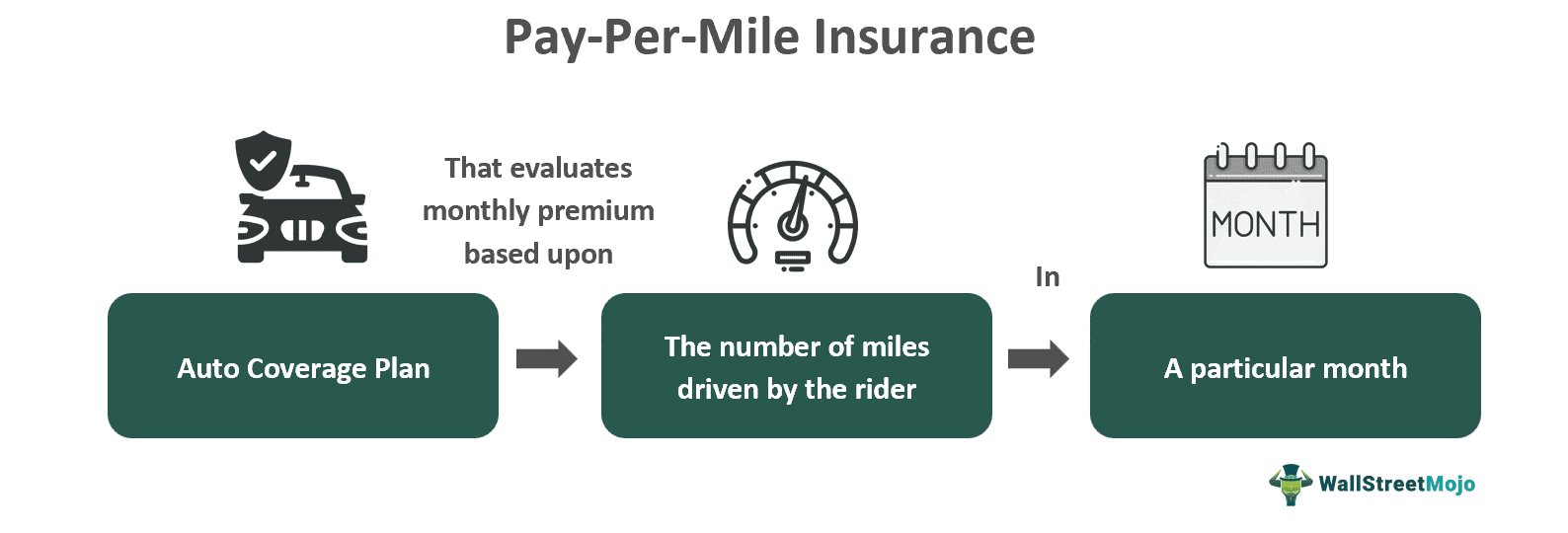
PPMI is one of the best ways to save on auto insurance when the vehicle is not in much use. The rider has to pay a base monthly rate and an additional per-mile rate for the overall distance in miles the vehicle covers in a month. However, the insurance cost will still be less than the regular plan.
Key Takeaways
- Pay-per-mile insurance is a car insurance plan that determines the premium on the basis of how many miles the rider drives the car or other respective automobile.
- It is a suitable insurance facility for those who don’t drive too much, like students, work-from-home professionals, senior citizens, people with alternative vehicles, or those who mostly prefer public transportation.
- Some of the major insurers in this category are USAA, Allstate, Nationwide, and Metromile. Also, such plans are not available in every state, nor do all the insurance providers offer them.
How Does Pay-Per-Mile Insurance Work?
Pay-per-mile insurance is a cost-saving coverage plan for automobiles that allows riders to pay a premium based on the number of miles they drive instead of a fixed lump sum amount. Such an insurance program provides complete coverage to the riders, just like traditional auto insurance, but at a lower cost. Most of these plans offer liability coverage, rental car reimbursement insurance, comprehensive and collision coverage, roadside assistance, and more.
The insurance providers keep track of the daily mileage of the rider’s vehicles, i.e., the number of miles driven each day, with the help of a plug-in device or a mobile application. In the first tracking method, the provider plugs or installs a telematics device to the vehicle, whereas, in the second method, they let the rider download a mobile application on their smartphones. Thus, the insurance company gets complete information about the driving behavior and mileage covered.
However, there are certain limitations to such an insurance plan. The most significant setback is that this insurance facility is not available in every state and may not be provided by every insurer. Further, some insurance providers ascertain a maximum cap on the daily mileage. Thus, riders who constantly drive more than this upper limit may be charged a higher premium, sometimes even more than that of the contemporary coverage plan.
Moreover, the instrument that tracks the mileage raises privacy issues for the riders by following their driving behavior and providing such data to the insurers. Also, the insurers may require the riders to maintain or deposit specific amounts into their accounts beforehand for additional security, thus increasing their upfront expenses.
How Much Does Pay-Per-Mile Insurance Cost?
The premium for this kind of coverage depends on multiple factors like driving history, marital status, age, and location, just like other auto insurance plans. However, the most significant factor is the distance covered by the vehicle in miles.
The PPMI plan imposes monthly premium charges on the rider, which has two different parts, as discussed below:
- Base Rate: It is the minimum fixed premium that the insurer charges from the rider each month or every day.
- Pay-Per-Mile Rate: The next part is the premium charged by the insurer based on the miles traveled on the vehicle on a particular day or month. Generally, the insurers charge 6 to 8 cents for each mile.
So, the total monthly premium is evaluated as follows:
Base Rate Per Month + (Pay-Per-Mile Rate * Total Miles Driven In A Month)
Thus, the insurer first needs to compute the pay-per-mile premium of a certain month by multiplying the total number of miles covered by the vehicle during the month with the rate of premium for each mile driven. Next, this monthly pay-per-mile premium is added to the monthly base rate.
Examples
Allstate provides a pay-per-mile insurance Washington State plan starting at a rate of just 6 cents a mile. Meanwhile, the Metromile PPMI, California, has allowed riders to save up to $947 annually. While such an auto coverage plan may not be for all, it can save a lot for those who don’t use their vehicle most often. Let us have a better understanding of the benefits of pay-per-use insurance through the following examples:
Example #1
Suppose Mr. Clinch observes that he drives his car only 5,00 miles in a year. So, he plans to switch to a PPMI program, which he finds more feasible than his existing coverage. His earlier insurance plan was charging him a premium of $1,500 annually; however, the new coverage plan has a monthly base rate of $60 and 6 cents per mile as the pay-per-mile rate. Now, in January, Mr. Clinch drove 535 miles. Therefore, his monthly PPMI premium is as follows:
Total Monthly Premium = Base Rate Per Month + (Pay-Per-Mile Rate * Total Miles Driven In A Month) = $60 + (0.06 * 535) = $92.10
Mr. Clinch would have paid a monthly car insurance premium of $125 ($1,500 / 12) with his earlier plan. However, with this new pay-per-use coverage, he will be charged a premium of $92.10 for January.
Example #2
Metromile allows considerable savings through its pay-per-mile insurance, but it’s only available in eight states and has yet to be rated as the best plan. Lemonade acquired Metromile in 2022, which increases its potential to expand its services in collaboration with Lemonade’s offerings. Meanwhile, this Metromile insurance plan provides affordable coverage for those who don’t drive much and a smartphone app that has features such as engine diagnostics and vehicle location services. Other inclusions are roadside assistance and rental car coverage.
However, the program relies upon uninterrupted cell service for its Pulse device, which can be challenging in rural areas or underground garages. Moreover, it doesn’t offer various additional coverage options that other insurers offer.
Notably, Metromile scored 7.4 out of 10 due to its excellence in availability, coverage, and customer experience. But, its industry standing and cost-related discounts are scored less by the riders. Also, its Pulse device, essential for tracking mileage and maintaining coverage, encounters connectivity issues in areas with poor cell service. Thus, the riders can also check out alternative programs like Allstate’s Milewise and Progressive’s Snapshot.
Comparatively, Allstate’s Milewise is available in 21 states and has a broader range of coverage options in its PPMI program. Similarly, Progressive’s Snapshot rewards good discounts to drivers for low mileage and safe driving behaviors.
Is Pay-Per-Mile Insurance Worth It?
Pay-as-you-go insurance is only for some, especially if the rider has a single vehicle that is used exhaustively for all their commutes; this coverage program may not seem viable. Thus, such a plan is specifically curated for those vehicles that cover a mileage range of 8,000 to 10,000 miles in a year.
Thus, a PPMI program is suitable in the cases where the riders:
- Have short commute to their institutions, offices, or any other places
- Are on work-from-home jobs
- Have an alternative vehicle, or don’t use this vehicle on an everyday basis
- Use public transportation most often instead of a personal vehicle
- Retired individuals who don’t need to commute much
Frequently Asked Questions (FAQs)
Frequently Asked Questions
Who offers pay-per-mile insurance?
The top three insurance providers that facilitate the PPMI programs include United Services Automobile Association (USAA), Nationwide, and Allstate. However, Metromile is also preferred by riders due to its free trial period feature, which allows them to try the plan and compare the costs.
Is pay-per-mile insurance available in Massachusetts?
No, the riders may not find any provider with pay-as-you-go car insurance in Massachusetts. Even the Metromile doesn’t offer any such flexible coverage to Massachusetts drivers.
What’s the difference between usage-based and pay-per-mile insurance?
The pay-per-use insurance plan enables riders to pay the premium based on the number of miles they drive. In contrast, usage-based coverage determines the insurance premium according to the driver’s behavior and habits, like the braking, speeding, or timing of the ride.