


What is the Andean Community?
The Andean Community (CAN) refers to a South American trade bloc created through the Cartegena Agreement in 1969 to promote agricultural, industrial, and trade cooperation. This regional group of member nations initially included Columbia, Bolivia, Peru, Chile, and Ecuador; however, Chile withdrew itself from the organization in 1977.
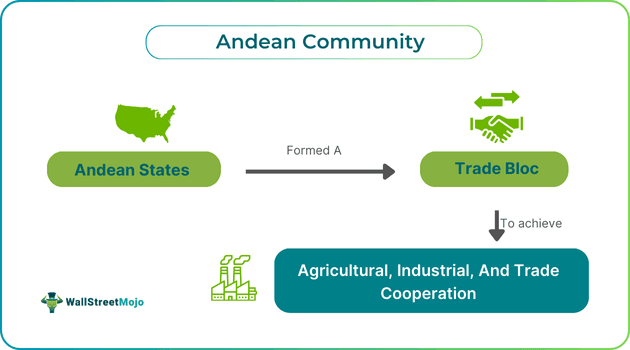
The Andean community headquarters are situated in Lima, Peru. The community also has an Andean Integration System comprising of various organizations with a unanimous objective of ensuring integration between the member nations. Thus, CAN aims to foster social and economic integration and harmonious and sustainable development of all its member countries.
Key Takeaways
- The Andean Community of Nations (CAN) is a regional group of South American countries that came together to form a trade bloc in 1969 to ensure industrial, trade, and agricultural cooperation among the member nations.
- The initial Andean Community countries at the time of incorporation were Bolivia, Peru, Chile, Ecuador, and Columbia.
- However, the recent members of CAN include Brazil, Argentina, Peru, Columbia, Bolivia, Chile, Paraguay, Ecuador, and Uruguay. The headquarters of CAN are also situated in Lima, Peru.
- It aims to foster free trade, social and economic integration, stable and consistent development, and harmony and cooperation among its members.
Andean Community Explained
The Andean Community of Nations or La Communidad Andina (CAN) is a trade bloc incorporated by the South American countries, including Bolivia, Peru, Columbia, Chile, and Ecuador, in 1969 to bring economic equality and encourage free trade among the member countries. The associate members of the bloc included Brazil, Argentina, Uruguay, and Paraguay. At the same time, the observers are Mexico, Spain, and Panama. The headquarters of the Andean Community countries is located in Lima, Peru.
The Andes region extends from the South America to North America. The significant nations in the region are Bolivia, Argentina, Columbia, Venezuela, Peru, Chile, Ecuador, and Western Venezuela. Meanwhile, the sole objective of the Andean Integration System is to achieve integration of these nations. It comprises of:
- The Andean Presidential Council that involves the Presidents of the member nations;
- The Andean Parliament is honored by the national legislatures’ members; however, in the 21st century, the parliament hosts direct elections;
- The Andean Community Commission is responsible for making policy decisions;
- The Andean Community Court of Justice, comprising 5 members responsible for framing and governing the CAN laws and their equal implication in each state;
- The Latin American Reserve Fund, whose primary function is to ensure sound monetary and fiscal policies;
- The Andean Development Corporation that promotes investment and trade; and
- The numerous other labor and business advisory councils.
History And Purpose
The Andean community is a group of regional Andean states that function for the betterment of the South American member nations. It was created in 1969 by Peru, Brazil, Bolivia, Columbia, and Ecuador. The primary purpose of this organization was to ensure consistent, balanced, stable, and sustainable growth of the member nations. Also, it aims to achieve agricultural, industrial, and trade cooperation between these countries and promote their social and economic integration.
Venezuela became a part of CAN in 1973. However, its membership sustained only till 2006, after which the country backed off from this group. Indeed, Chile, which had been a member since the CAN formation, left the bloc in 1977.
Also, Peru discontinued its membership in 1992 but rejoined the community in 1997. In 1987, the community adopted the Quito Protocol, which was not helpful in establishing the customs union and fostering industrial development programs. It then created a free trade zone in 1993, formed an agreement in 1994 after negotiation on customs policy, and came up with a joint foreign policy in 1998. It further negotiated with the Mercosur to enter an agreement, enacted on July 01, 2004, after rigorous negotiations to ensure a free trade zone between Mexico and Argentina.
Member Countries
Initially established by the South American countries – Bolivia, Peru, Columbia, Chile, and Ecuador, the Andean community of nations witnessed multiple entries and exits. Given below is a list of CAN’s current member nations:
- Brazil: It has a surface area of 8,516,000 km² and a population of 215.31 million. The country’s GDP is USD 1.920 trillion.
- Argentina: This nation covers an area of 2,780,000 km²; while its population is 46.23 million, it has a GDP of USD 631.13 billion.
- Peru: It is the third most prominent member of CAN in terms of surface area, which is 1,285,000 km². The country’s population is 34.05 million, and its GDP is USD 242.63 billion.
- Columbia: This nation expands over 1,142,000 km², and has a population of 51.87 million. Its GDP is USD 343.62 billion.
- Bolivia: It has a surface area of 1,099,000 km², a population of 12.22 million, and a GDP of USD 44.01 billion.
- Chile: This country covers 757,000 km² of area, its population is 19.6 million, and its GDP is USD 301.02 billion.
- Paraguay: It expanded over 407,000 km², has a 6.78 million population, and USD 41.72 billion.
- Ecuador: This country has a surface area of 256,000 km², a population of 18 million, and a GDP of USD 115.05 billion.
- Uruguay: This one is the smallest member nation by area, covering 176,000 km², a population of only 3.42 million, and a GDP of USD 71.18 billion.
Meanwhile, Andean community countries have expanded over 16.42 million km2. Moreover, it benefits 5.1% of the overall population in the world, I.e., 407.5 million people. Also, the member nations’ consolidated GDP or economic output is approx. 3.7% of the global GDP, I.e., USD 3.71 trillion. It emphasizes the free export of goods and services from the member nations, thus initiating a total export of USD 822.93 billion.
Examples
Now, moving ahead, let us have a look at some of the recent updates of the Andean community members:
Example #1
In response to increased gang violence in Ecuador, President Daniel Noboa declared an “internal armed conflict” on January 9, 2024. The Andean Community of Nations (CAN) convened in Lima, Peru, on January 22, 2024, with security officials from Bolivia, Colombia, Ecuador, and Peru to address the crisis. They adopted the Resolutive Action Plan (PAR), focusing on enhancing border security and establishing an Andean Data Bank within two months.
Since the state of emergency declaration in January 2024, Ecuador has arrested almost 9,500 individuals and seized over 64 tons of drugs by February 22, 2024. Further, the United States is supporting Ecuador with criminal intelligence and technological assistance.
Example #2
The presidents of the Andean nations, including Colombia, Ecuador, Peru, and Bolivia, expressed a desire for Venezuela, Chile, and Argentina in 2022 to join the Andean Community amid a leftward shift in South America. Left-leaning governments have come into power in Bolivia, Peru, Colombia, and Chile since 2020, while Ecuador remains governed by the right. Previous members, Venezuela and Chile, exited the group in the early 2000s and 1976, respectively. The leaders emphasized the potential advantages of enlargement, while the Peruvian President Pedro Castillo also proposed integration with Argentina.
Importance
The need for economic cooperation and integrity resulted in the formation of the Andean community by the South American nations. CAN holds significance for the following reasons:
- Agricultural, Industrial, and Trade Cooperation: The primary motive of CAN was to foster the agriculture, industries, and trade activities of the member nations by ensuring that there are harmonious relations between these countries.
- Social and Economic Integration: It also focuses on the integration and blending of the member nations on social and economic grounds to ensure global equality.
- Sustainable Export of Goods and Services: It further focuses on easing the export of goods and services for the member nations to generate foreign income.
- Market Expansion: CAN also promote liberalization and expansion of the markets for goods or services in the participating nations.
- Stable Economic Growth: The formation of CAN helped the nations to experience considerable and constant growth in their GDP over time.
- Free Trade: It formed a customs union with the Andean states as members to create a free trade zone for the member nations.
Frequently Asked Questions (FAQ)
Frequently Asked Questions
Is the Andean community a customs union?
Yes, the Andean community includes a customs union, which was incorporated in February 1995.
Who is not a part of the Andean Community?
The Andean community of nations was left by Venezuela in 2006, while Chile left in 1977. While Chile has been a member since the incorporation of CAN, Venezuela joined as a member in 1973. However, they are no longer the member countries of this trade bloc.
Why did Chile leave the Andean Community?
The primary reason behind Chile leaving the Andean Pact was the crisis prevailing in the organization. This decision was made under Pinochet’s dictatorship.
What is the Andean Community Trujillo protocol?
The Trujillo protocol changed the name of the Andean Pact to the Andean community in 1996. Also, the treaty revised the Cartagena agreement to form a General Secretariat, which will be responsible for handling the technical and political functions for better integration.