


What is ecommerce fulfillment?
E-commerce fulfillment is the part of an ecommerce business that involves operations that take place after receiving an order. It may include actions such as picking up products, packing them, shipping and delivering them according to the delivery instructions to the consumer’s doorstep.
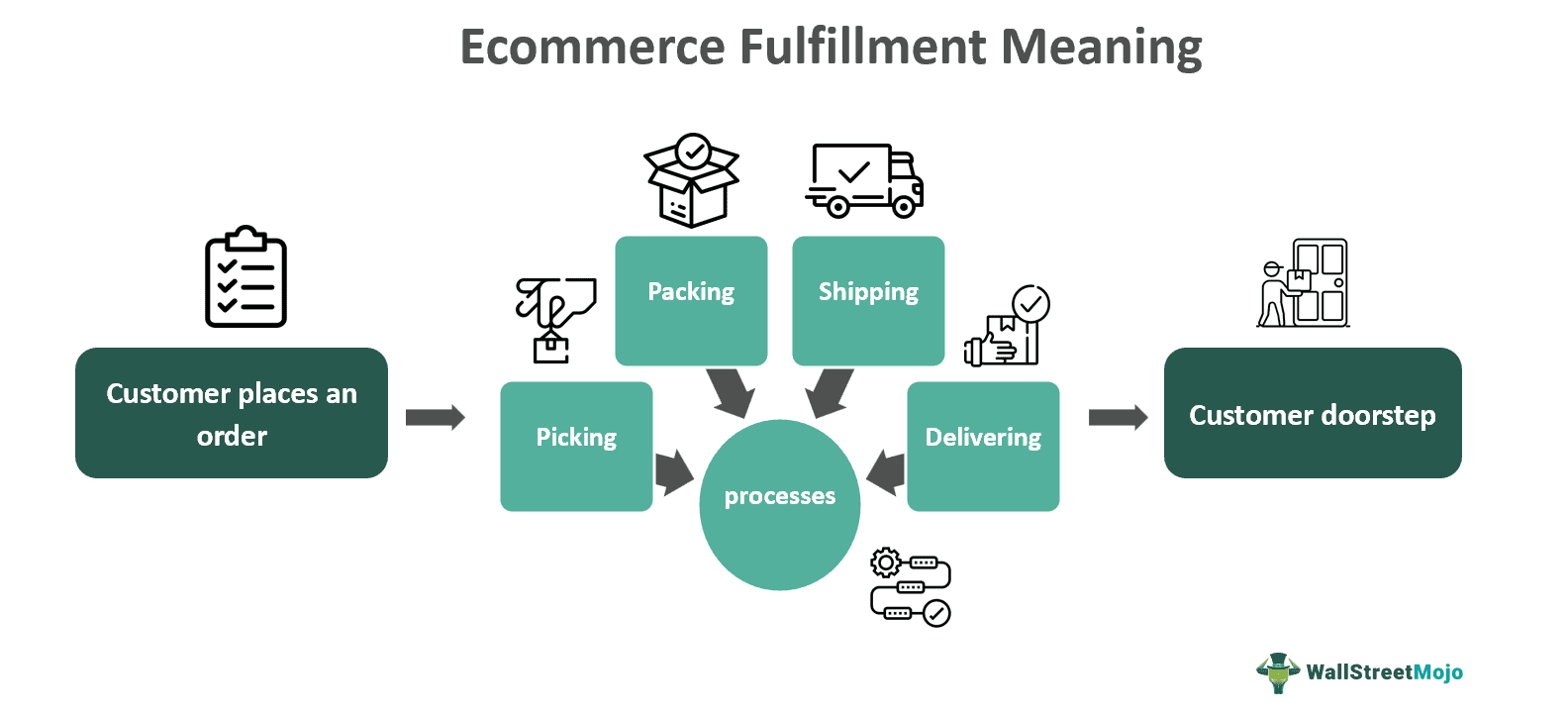
Order fulfillment is a crucial part of any e-commerce business. It involves planning from the business’s side about infrastructure, the process, systems employed, resources and human resources required. These factors determine how well the business is run and contribute to customer satisfaction which directly affects the business’s profitability.
Key Takeaways
- E-commerce fulfillment refers to the processes that take place after a customer places an online order. The process includes stocking inventory, picking orders, packing the products, shipping and delivering them.
- Key steps in the fulfillment of the e-commerce process include inventory, storage, order processing, shipping and processing returns.
- It benefits the company through increased sales, customer satisfaction, and reduced cost, among other things.
- However, the process can be complex and may possess certain issues, such as forecasting demand for inventory, high shipping costs, data security breaches, and quality control.
E-commerce Fulfillment Explained
E-commerce fulfillment is the process of getting orders ready for customers who shop online. The process involves activities such as receiving stock or inventory, storage, packing, shipping and customer service. It may also involve handling returns. Handling order fulfillment thus plays a major role in the successful running of a business. It applies to both large-quantity shipments for big-box retailers and order shipments to single customers.
Fulfillment helps businesses to process orders, ship them and deliver them to customers within the promised time. If the process does not go well, it leads to delivery issues such as receiving the wrong or damaged item, delivering it to the wrong place and late delivery. Poor fulfillment process erodes customer’s trust and leads to their dissatisfaction. There are high chances of customers choosing another business over this due to the mistakes made.
The absence of systematic processes can result in common errors and unintended delays. This degrades the customer experience and pushes them to choose businesses that offer better services, which results in poor sales and a negative reputation. Businesses with a proper system stand ahead of their competitors.
Businesses can choose various fulfillment options such as self-fulfillment, signing up with 3rd party providers or use Multi channel fulfillment. In self or in-house fulfillment, the process involves storing and shipping the products from the place of business.3rd party fulfillment involves outsourcing activities to a third party. This includes shipping logistics and managing the returns. Multi channel fulfillment is a process where the business uses multiple channels to manage and deliver products. This means customers can order business products from various channels such as the business website, its social media, or a physical store.
Process steps
There are several steps involved in the fulfillment process, and it can be summarized into 5 steps.
#1 – Inventory and storage
The first and foremost step in any fulfillment strategy is obtaining and storing products that the customers have ordered in an appropriate location. It could be with the business itself or hiring a separate warehouse for storage. If the business chooses to opt for a third party route, the business shall check its guidelines for packing and labeling to streamline the process of receiving. If the business uses direct order fulfillment, such as drop shipping, they can coordinate with the manufacturers or distributors to source these products.
#2 – Storage and maintenance
Storing the inventory is the second step in the process. Businesses can use fulfillment statuses such as awaiting fulfillment, fulfilled or pending fulfillment and categorize the stock accordingly. This can help in the smooth flow of the work process. This helps them track the inventory and make sure it is accessible when it is required to be delivered within the stipulated time. They can also track stock levels and communicate them to the customers.
#3 – Order processing
Businesses shall take great care in selecting the products in appropriate quantity as demanded by the customers to pack and ship them. A critical part of the process can be attributed to the packaging. Businesses could choose what type of packaging they can include for their products, and labeling them correctly will help reach customers quickly. Implementing a pick-and-pack fulfillment system makes things easier here.
#4 – Shipping
Businesses shall choose different types of delivery methods according to the orders. For small orders, e-commerce companies shall use parcel delivery services such as Postal services FedEx or UPS in the U.S. For large orders, they may utilize other shipment methods, such as full truckload or less-than-truckload options.
#5 – Returns processing
Businesses shall establish a systematic process for handling returns, including restocking or discarding defective product insertion cases. Customers may also demand refunds for their returns, and businesses shall make the process seamless by ensuring the establishment of proper guidelines.
Examples
Let us look into some of the examples to understand the concept better.’
Example #1 – A hypothetical example
Imagine, ABC Ltd is an e-commerce website that sells clothing. It signed in to purchase an e-commerce fulfillment warehouse to store its products. It has a separate warehouse for raw materials. Frame a hypothetical example using words. The e-commerce fulfillment warehouse that it bought would help the company meet its demand surges during the peak season. This would serve as a place to take care of all the processes associated with an order placement (after the customer has placed an order). The actions include packing, delivering and processing the orders. It aims to grow the business and become one of the best e-commerce fulfillment companies through customer satisfaction.
Example #2 – A real-life example of a company employing e-commerce fulfillment services
Cosco recently launched a self-operated fulfillment warehouse in the U.S. (Los Angeles). The company inaugurated the facility to meet its increasing logistic needs and fulfill cross-border business requirements as part of e-commerce fulfillment services. The services it offers include dropshipping, large and medium-sized goods, end-to-end truck dispatching services, warehouse operations, etc. Through this, the company can offer customized, standardized logistic solutions for its customers and meet e-commerce fulfillment capabilities.
Benefits
Given below are some of the benefits of the fulfillment process
- It increases business efficiency and helps it handle more orders with limited time and resources.
- It offers flexibility where the businesses can accommodate their delivery systems in accordance with the fluctuations in demand.
- The fulfillment process helps in attaining economies of scale by streamlining the process, adopting cost-effective measures, and reducing wherever possible.
- The process helps In enhancing customer experiences when the delivery is made fast and inaccurate. This makes the business a reliable choice with the customers.
- It helps in business expansion without spending large amounts of money.
Challenges
Given below are some of the challenges of the fulfillment process.
- Inventory management can be difficult as forecasting the demand and maintaining the appropriate amount of inventory levels can be difficult insert seasons.
- Even though its exit helps expand the business, shipping costs can vary according to geographical conditions.
- The involvement of 3rd party can help streamline the process and outsource various activities; however, dependence on 3rd party should proceed with caution since they are unrelated to the business they may not be reliable.
- Data security can be an issue businesses have to take specific measures for protecting sensitive customer details and their banking transaction details.
- Quality control across the shipping duration can be a difficult task.
Frequently Asked Questions (FAQ)
What is self-fulfillment in e-commerce?
Self-fulfillment in e-commerce is the process where businesses handle all aspects of order to delivery themselves. It requires greater control over the process and sufficient resource and logistics management capacity.
What is an e-commerce fulfillment center?
E-commerce fulfillment centers aid businesses in outsourcing shipping and warehousing. They help businesses that do not have a physical space for storage and cannot manage the inventory directly.
How to start an e-commerce fulfillment center?
E-commerce fulfillment centers can be started by securing appropriate warehouse space. It shall involve possessing necessary equipment, a good team, streamlined guidelines for processes, and automation wherever possible.
What is an e-commerce fulfillment specialist?
It is a person who oversees the order fulfillment processes in an online establishment or an e-commerce fulfillment company. It includes overseeing the receiving, processing, product packing and delivery and other necessary actions.