


Introduction
Finance professionals weighing their next move often ask whether financial planning and analysis deserves a place on their shortlist alongside investment banking, equity research, or consulting. Financial Planning and Analysis, commonly known as FP&A, sits at the intersection of accounting, strategy, and decision support inside a company.
Moreover, it has quietly become one of the most in-demand functions in corporate finance. Whether FP&A is a good career depends on what a professional values most: steady compensation growth, manageable hours, or the kind of visibility that comes from presenting numbers directly to a CFO or board.
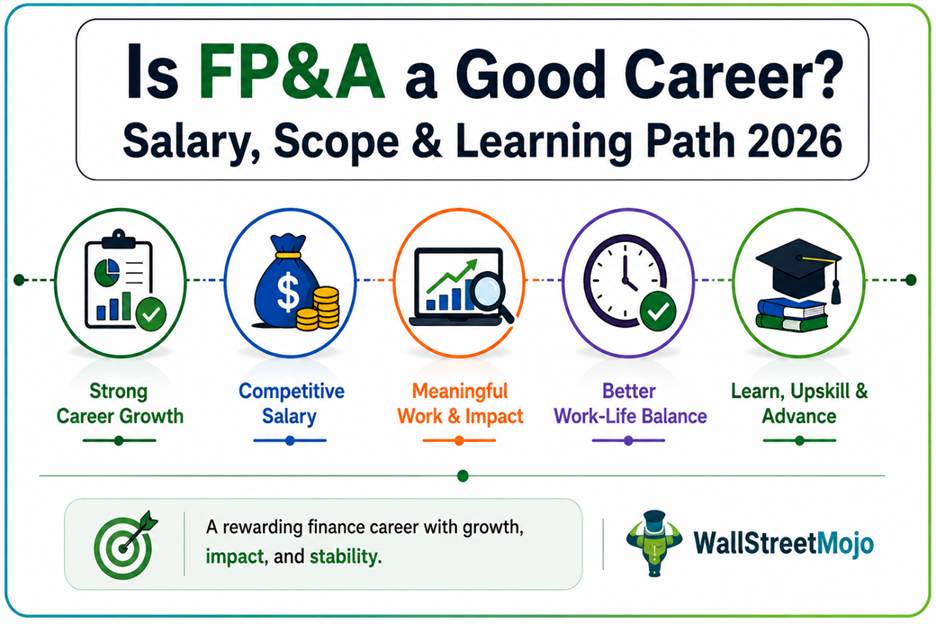
If you’re wondering, “is FP&A a good career,” you have come to the right place. This article examines FP&A career prospects in detail. It includes salary benchmarks in the United States and India, day-to-day responsibilities, how the role compares against investment banking, the skills recruiters actually screen for, and the fastest way to build those skills without spending years learning on the job. Readers will also find a structured comparison table, an FAQ section addressing common search queries, and a practical roadmap for entering or advancing in FP&A.
Key Takeaways
- FP&A professionals enjoy more predictable hours than investment bankers.
- Demand for FP&A talent continues to grow across industries.
- FP&A Compensation increases significantly as professionals advance into leadership roles.
- FP&A combines financial analysis with strategic business decision-making.
- Strong Excel and financial modeling skills are essential for success in FP&A.
- FP&A offers stable long-term career growth with strategic business exposure.
What Does an FP&A Professional Actually Do?
FP&A professionals engage in budgeting, forecasting, variance analysis, and financial modeling to help executives make informed operating and capital allocation decisions. FP&A analysts do not analyze external securities like an equity research analyst. Instead, they work inside the company, translating raw financial data into forecasts, dashboards, and recommendations that shape strategy.
A typical week includes building rolling forecasts, reconciling actuals against budget, running scenario models in Excel, and presenting variance explanations to department heads or the CFO’s office. Analysts also support capital budgeting decisions using tools like net present value (NPV), internal rate of return (IRR), and payback period. Moreover, they increasingly contribute to M&A due diligence and post-merger integration planning.
To answer the question, “Is FP&A a good career path?” it’s important to evaluate compensation, career growth, and long-term opportunities.
Is FP&A a Good Career Path? Salary and Growth Data
Yes, FP&A is a good career path for professionals who want strong compensation growth, cross-functional visibility, and a more predictable schedule than front-office investment banking roles. However, its long-term compensation trajectory is generally slower than that of investment banking or private equity.
FP&A salaries vary based on experience, industry, company size, and location. In the United States, FP&A analysts earn an average annual salary of $69,712, according to Salary.com, while in India, the average starting salary is roughly ₹10.6 lakh per year. Professionals who move into senior analyst, manager, and director roles can earn substantially more as their responsibilities expand.
From a broader labor market perspective, overall employment of financial analysts is estimated to increase by 6% from 2024 to 2034, which is faster than the average for all occupations. Per projections, there will be about 29,900 openings every year. That growth reflects steady corporate demand for planning and forecasting talent, independent of the deal-cycle volatility that affects investment banking hiring.
FP&A vs Investment Banking: Which Path Fits Your Goals?
Although FP&A and investment banking require similar analytical and financial modeling skills, they offer very different career paths, work-life balance, and long-term earning potential.
If you’re still wondering whether FP&A is a good career for your goals, compare it with investment banking across the factors below:
| Factor | FP&A | Investment Banking |
| Typical weekly hours | 41–50 hours | 70–90+ hours (deal-dependent) |
| Compensation growth | Steady, tied to promotions | Steeper, bonus-heavy at senior levels |
| Work environment | Cross-functional, internal stakeholders | Deal teams, external clients |
| Career progression | Analyst → Senior Analyst → Manager → Director → CFO | Analyst → Associate → VP → Director → MD |
| Exit options | Corporate strategy, FP&A leadership, and limited buy-side moves | Private equity, hedge funds, corporate development, and FP&A |
| Skill focus | Budgeting, forecasting, variance analysis, and dashboards | Valuation, pitch books, deal execution, and M&A modeling |
FP&A professionals generally enjoy a better work-life balance than those in investment banking or consulting, with average workweeks of around 41–50 hours that may increase during budgeting and financial close periods. They also work closely with the CFO and senior leadership, using budgeting, forecasting, and financial modeling to support strategic business decisions.
On the flip side, FP&A does not offer many true career-changing exit opportunities unless a professional completes an MBA. Moreover, moving into investment banking or private equity from FP&A at a senior level is genuinely difficult.
Investment banking, by contrast, is known for its demanding workload and long working hours, particularly during live deals and transactions. Moreover, most investment banking roles are structured to be temporary, with analysts typically expected to leave after a standard two-year program.
Professionals who prioritize sustainable hours and steady internal advancement generally find FP&A more aligned with their goals, while those chasing the fastest compensation ramp and buy-side exits often start in banking.
Common Mistakes When Evaluating an FP&A Career
Many professionals asking “is FP&A a good career” base their decision on common misconceptions rather than the realities of the role. Avoid these mistakes before deciding if it’s the right career for you.
- Assuming FP&A and financial accounting are interchangeable: FP&A focuses on forward-looking budgeting and forecasting, while financial accounting reports historical results for compliance.
- Underestimating Excel and modeling proficiency requirements: Recruiters increasingly expect dynamic three-statement modeling, DCF construction, and scenario analysis, not just static spreadsheets.
- Ignoring industry context: FP&A responsibilities, compensation, and career growth can vary significantly across industries, company sizes, and business models.
- Overlooking soft skills. Since FP&A analysts regularly present to non-finance stakeholders, the ability to translate numbers into a business narrative matters as much as technical modeling skill.
How to Build FP&A Skills Efficiently
Professionals new to FP&A or transitioning from a broader finance role should follow a structured learning path. Starting with FP&A fundamentals and progressing through budgeting, forecasting, cost management, financial statement and ratio analysis, and financial modeling helps build each skill on the previous one and prepares learners for real-world FP&A roles.
Many graduates also ask, “Is FP&A a good career for freshers?” The answer is yes. For those willing to develop practical skills in budgeting, forecasting, and financial modeling, FP&A provides an excellent entry point into corporate finance with strong long-term career growth opportunities.
This is precisely the gap the Financial Planning and Analysis (FP&A) Course by WallStreetMojo is designed to close. The program is directed by Dheeraj Vaidya, CFA, FRM, a former JPMorgan and CLSA analyst and IIT-IIM alumnus with over two decades of finance training experience. It walks learners through FP&A fundamentals using practical examples related to forecasting, cost management, dynamic financial modeling, and capital budgeting techniques such as NPV and IRR.
For someone deciding between self-taught YouTube content and a structured program, the practical difference usually comes down to learning sequence and resources rather than information availability. Scattered free resources often lack downloadable templates, real-world case studies, and a certificate of completion, making it harder to build job-ready skills.
Conclusion
So, is FP&A a good career? For professionals seeking long-term growth, strategic exposure, and a balanced work-life, the answer is yes.
FP&A rewards professionals who want durable, well-compensated careers with genuine influence over business decisions, even if it trades some of investment banking’s compensation ceiling for a saner schedule.
The growing demand for FP&A professionals, supported by strong employment projections and sustained hiring across industries, makes it an attractive long-term career choice.
For professionals looking to build job-ready skills, the FP&A Course by WallStreetMojo offers a structured, case-study-driven path covering budgeting, forecasting, cost management, financial statement analysis, and financial modeling.
Frequently Asked Questions
Is FP&A a good career for freshers?
Yes, FP&A is a good entry point for finance graduates since it builds transferable skills in budgeting, forecasting, and financial modeling while offering more predictable hours than investment banking analyst programs.
Is FP&A better than investment banking?
Neither role is universally better. FP&A offers steadier hours and internal career growth. On the other hand, investment banking offers a faster compensation ramp and stronger buy-side exit options at the cost of significantly longer hours.
What qualifications does an FP&A career require?
Most FP&A roles require a bachelor’s degree in finance, accounting, or a related field, along with proficiency in Excel, financial modeling, and forecasting techniques. Certifications like the CFA or a dedicated FP&A course can strengthen a candidate’s profile.
What is the average FP&A analyst salary?
FP&A analyst compensation depends on factors such as experience, industry, company size, and location. According to Salary.com, the average annual salary in the United States is $69,712, while professionals entering the field in India typically earn around ₹10.6 lakh per year. Salaries generally increase with seniority and broader responsibilities.
Can FP&A professionals move into investment banking or private equity?
Movement is possible but uncommon at senior levels. It is more feasible early in one’s career or through an MBA, since recruiters often question why a candidate stayed in FP&A if their goal was banking or private equity.
Does FP&A require coding or advanced technical skills?
FP&A primarily requires strong Excel and financial modeling skills, while some roles value SQL, Power BI, or Python for data automation. Note that these are supplementary skills rather than core requirements.