


What Is The Scarcity Principle?
The scarcity principle refers to an economic concept that states that the price of goods and resources within society rises when their supply is limited while their demand remains significant in the market. The theory applies to human, natural, and material resources.
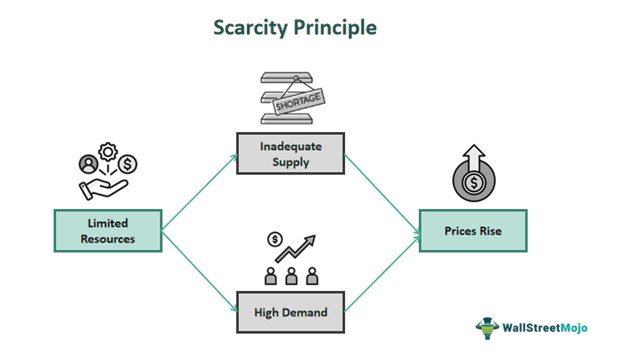
Natural resources are scarce, with many on the verge of exhaustion. Hence, this principle emphasizes the functioning of economies. It sheds light on how individuals, businesses, societies, governments, and nations navigate choices in a world characterized by a market disequilibrium with scarce resources and massive demand for a specific commodity.
Key Takeaways
- The scarcity principle is an economic phenomenon that explains the relationship between the price of resources and goods and their limited availability.
- It suggests that as resources become scarce, their prices increase to achieve an equilibrium between limited supply and high demand.
- Individuals, companies, societies, governments, and countries employ this economic theory for effective decision-making, efficient resource allocation, pricing mechanisms, and innovation.
- This principle applies to economic theories like opportunity cost, supply and demand, resource allocation, and trade-offs.
Scarcity Principle Explained
The scarcity principle in economics is a foundational concept emphasizing the fundamental reality that resources, such as time, money, labor, and natural resources, are finite, whereas human desires and needs are limitless. Given this inherent scarcity, individuals, businesses, and governments must make choices regarding how to allocate these limited resources among competing demands. This principle forms the base of economic decision-making, requiring individuals and entities to prioritize their needs and wants based on their available resources.
Economics examines how people allocate scarce resources to optimize utility, satisfaction, or profit. Concepts such as opportunity cost, trade-offs, supply and demand, and resource allocation in various economic systems are all based on the foundational concept of scarcity. In a free market, the prices of goods, services, and resources are determined by supply and demand. As the prices of rare goods or commodities increase, their demand falls eventually. Thus, a free market often resolves the scarcity issue in the economy by establishing the market equilibrium.
However, the scarcity principle applies to the risk of market failure since companies and society become less sensitive to the future while capitalizing on current finite resources. Moreover, this principle encourages inequality in a society where the privileged section can afford such resources, and people experiencing poverty remain deprived of them due to their high prices. Nevertheless, the government and regulatory bodies often take steps like implementing quotas and penalties for the exploitation of scarce resources.
Examples
Individuals, businesses, and governments widely utilize the scarcity principle to comprehend the need for sensible utilization of the available resources. Given below are some examples to better understand its applicability in the real world:
Example #1
Suppose a nation has a limited reserve of mercury, a raw material for barometers, thermometers, manometers, float valves, fluorescent lamps, mercury switches, etc. Let us see how the price of mercury changes with its scarcity of supply:
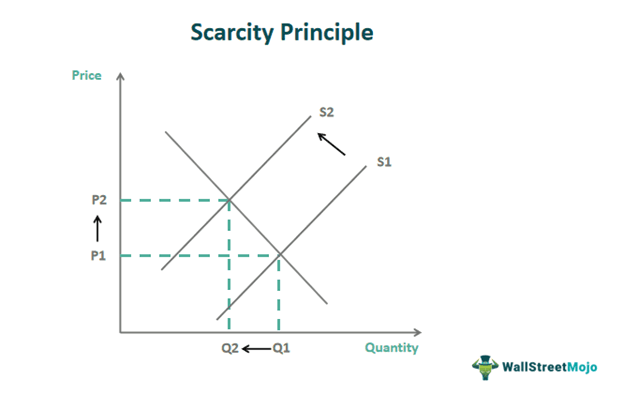
In the above graph, as the availability of mercury decreases from Q1 to Q2 in the market, its price rises from P1 to P2, and the supply curve moves from S1 to S2.
Example #2
Sustainable water management is crucial worldwide due to the rising scarcity of water resources. The Middle East, including the UAE, faces substantial water stress. Swiss innovations, such as Sanakvo’s air-to-water system and KREIS-Haus’s decentralized wastewater treatment, present promising solutions.
Sanakvo’s technology efficiently extracts water from humid air using glycerol, while KREIS-Haus reuses water within buildings based on specific needs. Although these innovations have been tested in Switzerland, their potential for addressing water challenges in the Middle East on a large scale is yet to be determined.
Example #3
A scarcity of medical professionals, hospital beds, or specialized equipment can result in difficult allocation decisions, especially during crises. One of the most prominent examples of the scarcity principle was seen during the COVID-19 period when there was an immense shortage of drugs, medical professionals, hospital beds, and oxygen cylinders in various countries.
It was the phase when the USA stockpiled the remdesivir drug, a lifesaver. The decision to stockpile drugs, like remdesivir, had widespread consequences, affecting access to essential medications and worsening healthcare disparities. Thus, it emphasizes the importance of informed decision-making and international collaboration to ensure everyone has fair and equal access to medical supplies.
Importance
The scarcity principle states that finite resource prices remain high despite their significant demand. It holds immense significance in economics for the following reasons:
- Resource Allocation: Knowing that resources are finite, individuals, businesses, and governments constantly make efforts to allocate resources to fulfill diverse needs efficiently.
- Economic Decision-Making: Scarcity is the driving force behind economic decision-making. It necessitates choices within all sections of society concerning what to produce, how to produce, and for whom to produce.
- Opportunity Cost: When resources are committed to one purpose, they become unavailable for other potential uses. Thus, understanding the opportunity cost of selecting one option while rejecting others aids in making well-informed decisions.
- Price Determination: Scarce resources or commodities tend to command higher prices, as people are willing to pay more for items in limited supply. This pricing mechanism is instrumental in the efficient allocation of resources.
- Brings Efficiency Promotion: Scarcity incentivizes the most productive and valuable resource utilization. This motivates society to employ the resources in ways that maximize benefits.
- Trade and Specialization: Different regions or individuals may struggle with varying resource scarcity. Trade enables the exchange of goods and services to overcome scarcity and confer benefits to all the parties involved.
- Innovation and Technology: When resources become scarce or expensive, the stimulus to discover alternative or more resource-efficient methods for production or utilization intensifies.
- Government Policy: Governments often confront scarcity-related challenges through policies and regulations. They intervene to ensure equitable resource distribution or address market shortcomings arising from scarcity.
- Environmental Considerations: Recognizing the scarcity of natural and environmental resources, such as minerals, coal, water, and clean air, is essential for sustainable management and conservation efforts.
- Global Perspective: On a global front, scarcity plays a pivotal role in international trade and cooperation, strengthening trade relations and geopolitical considerations.
Frequently Asked Questions (FAQs)
Frequently Asked Questions
Who created the scarcity principle?
The scarcity principle states that people perceive items as more valuable when they are scarce. Psychologist Robert Cialdini introduced it in his book Influence: The Psychology of Persuasion, published in 1984.
Which brands use the scarcity principle in their marketing strategies?
Various brands, including Amazon, employ the scarcity principle in their marketing tactics. For instance, Amazon often labels the listed items with only _ numbers left in stock, prompting consumers to buy that product immediately. Additionally, luxury brands often release limited edition products or run exclusive promotions for a limited time, creating a sense of scarcity and desirability among consumers. Similarly, to promote quicker ticket sales for well-attended events, ticketing services could show notifications as only a few tickets left.
What could go wrong with the scarcity principle?
The scarcity principle in economics has the following potential drawbacks: – If resources are not allocated efficiently, it can lead to shortages or surplus goods and services, disrupting the market equilibrium. – Limited resources can lead to inequitable distribution, causing social and economic disparities. – Scarcity can drive up prices, making goods and services unaffordable for some consumers. Addressing these challenges requires careful economic planning, sustainable resource management, and policies that promote equitable distribution and innovation.