


What Is Strategic Execution?
Strategic execution is a systematic process of planning, aligning, executing, monitoring, and testing strategies to achieve organizational goals for long-term business success and growth. It is a part of strategic management that ensures the effective translation of a critical plan into the desired action.
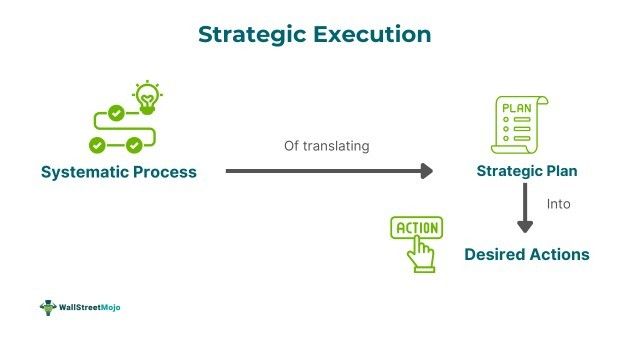
Companies often frame various strategies for fulfilling their different business goals, such as increasing sales, profitability, etc. However, any such goal achievement requires a proper blend of project, portfolio, program, and performance management. It even aims to monitor the strategic framework constantly to ensure the firm’s progress and development in the long run.
Key Takeaways
- Strategic execution refers to a systematic approach to transforming a plan of action into reality to achieve the desired business goals in the long run.
- It is a step-by-step process that involves strategy planning, alignment and activation, execution, assessment, and adaptation. Usually, such initiatives are headed by top-level executives and senior management. However, they impact all the levels of an organization.
- It is a practice of strategizing the implementation of a strategy to ensure business growth and success, foster stakeholders’ engagement and commitment, develop best practices, enhance competitiveness, achieve sustainability, and mitigate risk in the long run.
Strategic Execution Explained
Strategic execution is a process of deploying a planned strategy to ensure organizational success and development in the long run. It is, therefore, a strategy to translate a strategic plan into the desired action for attaining positive results. Whenever a company plans a strategy for scaling its operations, business expansion, new product development, merger or acquisition, etc., it invests a lot of money, resources, effort, time, and energy. Hence, it is necessary that the planned strategy works in the expected manner; otherwise, the company may incur huge losses or even risk its existence. However, the strategic execution framework ensures a high chance of success, making a company a market or industry leader.
However, the proper execution of a planned strategy requires team efforts and impeccable leadership. It influences the overall organization, including its people, resources, culture, and system. Nevertheless, companies must be careful when planning their strategic moves based on the availability of resources and funding, targeted goals, current organizational setup or infrastructure, and the timeline within which the strategy is to be implemented. Regardless, it doesn’t make a strategic plan foolproof; there are still chances of failure to a certain degree.
Process Steps
Business entities often put in a lot of resources, time, and effort to implement strategies that ensure sustainability and growth in the long run. The successful execution of a strategic plan involves the following four steps:
- Strategy Planning: The first step is framing a strategy at corporate, business, and functional levels. Thus, it provides direction to the team members to align the workflow with the strategic goals of the company.
- Alignment and Activation: The next step is to determine whether the planned strategy aligns with the desired objectives of the organization. It is all about testing and deploying a strategy in the right manner by establishing proper timelines.
- Strategy Execution: Then comes the effective execution of such strategy by ensuring cross-functional communication, including the information flow, motivators, decision rights, and structures. It is equally essential to scale the execution process and mentor it at every stage or level.
- Assessment and Adaptation: Lastly, the implemented strategy needs proper evaluation based on a SWOT analysis of its execution. Then, the company adopts the best strategy as a continuous practice and trains the workforce to follow it.
Examples
In the practical scenario, strategic execution plays a prominent role in business success. Let us understand its significance through the following examples:
Example #1
Suppose ABC Financial Services is a microlender in Michigan. The company plans to expand its operations across three different states, I.e., Ohio, Indiana, and Wisconsin. It plans to acquire small-scale microlending companies in these states to expand its business. The relevant strategic execution process goes as follows:
- Planning the acquisition strategy at the corporate, business, functional, and operational levels in terms of finance, resources, infrastructure, etc.
- Next is ensuring whether the acquisition strategy aligns with its business expansion goals and the potential return on investment.
- Then, the top-level executives communicate the strategy to the teams and extend roles, responsibilities, tasks, and duties to the members to ensure the proper acquisition of the target businesses while adhering to the local laws and regulations.
- Lastly, the senior management reviews the effective deployment of the acquisition strategy and tests the same for adopting it as a best practice for corporate expansion.
Example #2
D-Wave Quantum Inc. (NYSE: QBTS) has made significant executive appointments to fuel its commercial expansion and product innovation efforts. Lorenzo Martinelli has been appointed as the Chief Revenue Officer, leveraging his extensive 30-year background to oversee sales, marketing, customer success, and professional services, with a focus on critical sectors like logistics, manufacturing, and government. Meanwhile, Dr. Trevor Lanting has been promoted to the position of Chief Development Officer, undertaking the responsibility of advancing the company’s quantum computing hardware and software solutions. With over 15 years of experience at D-Wave, Dr. Lanting will lead initiatives to take quantum computing science to the next level.
These appointments are made at a critical time when enterprise clients have started adopting quantum applications for practical use. The company’s CEO, Dr. Alan Baratz, highlights the importance of these roles in the strategic execution of the company’s growth strategy and technological innovation. He also mentioned that D-Wave’s quantum computing systems have already been embraced by top organizations worldwide, showcasing their real-world applications across diverse fields.
Importance
Strategic execution has gained immense popularity in recent scenarios since companies have realized the importance of successfully deploying a strategy that involves colossal cost, resources, effort, and time. It holds significance for the following reasons:
- Ensures Growth: The execution of a strategy in the right direction fosters long-term growth of the business entity and achievement of the desired goals.
- Successful Strategy Implementation: The proper deployment of a planned strategy reduces the chances of failure and ensures success at every stage.
- Offers Clarity: A well-communicated strategy often provides more clarity and establishes stakeholders’ accountability to align their efforts with the targeted goals.
- Directs Initiatives: It also guides the overall workforce to take initiatives in the right direction, i.e., in a planned manner.
- Fosters Engagement: It ensures that all the stakeholders, including the managers, employees, suppliers, investors, and creditors, contribute to the effective implementation of the planned strategy.
- Provides Competitive Advantage: Moreover, such initiatives allow the companies to take the first-mover advantage in the market, enhancing their competitiveness.
- Enables Risk Management: It is a strategy to implement a strategy successfully; thus, it facilitates companies in identifying and managing potential risks while availing prominent opportunities.
- Formulates Best Practices: Since it is a continuous process, the most effective strategies become the company’s best practices or policies.
Strategic Execution Vs. Performance Management
In strategic management, strategic execution and performance management are two distinct concepts, as discussed below:
| Basis | Strategic Execution | Performance Management |
| Definition | Strategic execution is a step-by-step process of successfully implementing a plan or strategy to achieve the desired outcome. | Performance management is the assessment of the employee’s efficiency in performing the assigned tasks to fill the gap between the expected and actual performance. |
| Key Focus | It is company-centric | Emphasizes a particular role or position |
| Purpose | Effectively turning the strategic plan into action for the firm’s goal achievement. | Identifying the performance gap in various roles and providing necessary training for skill development to fill this gap |
| Process | The process begins with strategy planning, then comes its alignment and activation, followed by its practical execution, and lastly, its assessment and adaptation. | The manager defines goals for their team and organizes performance review meetings. They provide ratings to the employees based on their performance, and the HR department maintains such data. |
| Scope | It has a broader scope aiming at new product development, market expansion, mergers and acquisitions, etc. | Its scope is limited to a particular job position, project, task, or process. |
| Timeframe | Achieving long-term success and growth of the organization | Performance optimization in the short run |
| Performed By | Top-level executives and senior managers | Supervisors and managers at various levels of the organization |
Frequently Asked Questions (FAQs)
Frequently Asked Questions
What is a strategic execution framework?
The strategic execution framework (SEF) is a model that directs the decisions of the project leaders, top-level executives, and workers toward the successful implementation of the planned strategy. It aims at fostering innovative techniques, ensuring change management, delivering superior performance, and scaling the business to the next level.
What are the 4 A’s of strategic execution?
The 4A framework aims at performance excellence when it comes to translating the strategic execution plan into a successful course of action. It involves: 1. Alignment – Directing the efforts of the overall team towards a unanimous goal and strategy implementation; 2. Ability – Ensuring that the employees possess the desired skills, expertise, and knowledge required to perform the assigned tasks; 3. Architecture – Providing the required infrastructure, technologies, processes, and controls with the organizational setup; and 4. Agility – Adapting to the changing environment is crucial for being innovative, profitable, and thriving in the business.
What are the barriers to strategic execution?
The strategic execution of a plan encounters various hurdles and challenges, such as inefficient communication, lack of employee interest, ineffective leadership, workers’ resistance towards change, and inadequate resources or infrastructure.