


What Is Construction Budget?
A construction budget estimates the overall funds necessary to take up and project and complete it. Such a budget saves both money and time throughout a project’s lifecycle. Moreover, it helps organizations set realistic objectives, remain organized, and make well-informed decisions during the construction process.
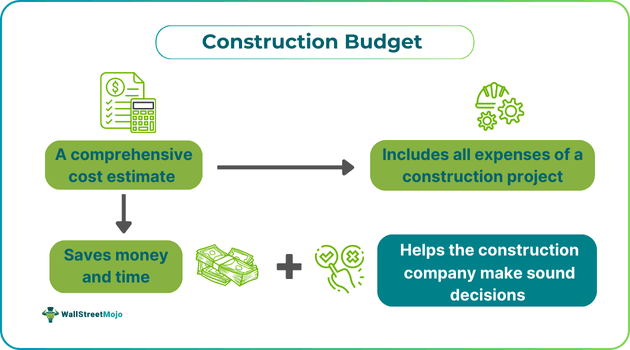
This estimate covers all the expenses concerning the development of a project; for example, the cost of administrative expenses, labor, and materials, ensures effective profit-cost planning and efficient fund management. Without an estimate of the costs involved, one may find it difficult to complete a project on time. There are two construction budget categories — project budget and annual budget.
Key Takeaways
- The construction budget definition refers to a financial plan outlining the estimated expenses that a business may incur from the start of a construction project to its end. The creation of this cost estimate ensures the company can make sound decisions and achieve all the predetermined project-related goals without any complication.
- Project and annual are construction budget categories.
- Some key benefits of building construction budgets are improved efficiency, stakeholder confidence, efficient project performance management, and improved ability to control costs.
- Some key aspects influencing such a budget are labor rates, the complexity of the design, and weather conditions.
Construction Budget Explained
The construction budget definition refers to a financial planning tool that one utilizes to outline the expected expenses and costs related to a particular project. This cost estimate helps construction companies maintain a profit-cost ratio that ensures the overall financial health of the organization stays safe Moreover, it takes into account every potential risk associated with an infrastructure or capital construction project.
After a project begins, this budget helps construction companies plan their next actions and ensure that the project remains profitable.
It presents multiple cost categories, displaying how the different expenses change during the execution of the project, from the start to the finish. Additionally, it takes into account contingencies, funds, and risks to address unanticipated scenarios affecting the financial flow of a development project. When creating this budget, individuals may consider the past projects’ data, which would give a rational basis for the cost projections.
Components
Let us look at some of the different elements included in such a budget.
- Labor Costs: These costs cover the wages payable to subcontractors and workers. The duration and complexity of the project, union agreements, and labor laws are some of the aspects that inflect such costs.
- Equipment Costs: Equipment covers costs arising from the use of leased and unleased heavy machinery and small tools during the development or construction process. Choosing the right equipment to complete certain tasks and sticking to the set schedule can minimize costs and save time.
- Fees And Permits: Acquiring payments and making payment of the associated fees are crucial steps involved during the construction process. Such costs include the expenses associated with building permits, regulatory requirements, environmental evaluations, etc.
- Overhead Costs: Overhead costs cover indirect costs, for example, the expenses related to utilities, temporary facilities, and site security, in addition to administrative expenses.
- Insurance Costs: These are the costs resulting from obtaining liability insurance and risk insurance, which are essential to safeguard the project from unforeseen circumstances.
- Contingencies: Contingencies refer to funds that companies set aside to meet expenses arising due to unexpected scenarios. These funds may also help companies in accounting for alterations in the scope of the project.
Factors
Let us look at some key factors influencing this type of budget.
- Location of the Construction Site: A construction project’s location can severely impact the costs. For example, the cost incurred to construct a building in any remote area can be higher when compared to constructing an identical building in an urban location because of the inadequate infrastructure and lack of access to raw materials.
- Market Conditions: Trends in the economy can impact these budgets. For example, inflation can result in higher labor and materials costs. On the other hand, an economic downturn can result in lower costs as demand decreases during the period.
- Demand And Supply: If the supply of labor or materials is low, costs will increase. On the other hand, ample availability will result in reduced costs.
- Labor Rates: The cost of labor varies based on the availability of workers in the region where the construction will take place, the skills required, wage laws, etc.
- Weather Conditions: The weather has an effect on safety and schedules. Adverse or unfavorable weather conditions can result in delays, which, in turn, leads to increased costs.
- Regulatory Requirements: Regulations set by the government may require companies to utilize specific construction methods or additional materials, thus leading to higher costs.
- Complexity of the Design: Generally speaking, the more complicated a project, the more labor and materials are required, thus resulting in increased costs.
Types
Let us look at the different construction budget categories in detail.
#1 – Annual
This budget consists of the estimates for expected income, payroll, dispute costs contingency funds, and business expenses. Organizations utilize past trends an historical data to determine such amounts. Such a budget helps companies figure out how much profit they would require to cover the expenses of the project.
#2 – Project
Companies usually develop this budget to estimate the costs that would be incurred while working on a specific job. It covers the cost of labor, equipment rental, materials, project management, supervision, temporary services, and any other project-related expenses. Usually, organizations develop this type of budget when they put together a bid for a project, as they must know what it would cost them before placing a bid.
How To Create?
One can follow the steps for building construction budgets:
- Identify The Stakeholders: First, one must identify the stakeholders of the project to get a clear idea as to which parties would likely make contributions toward the deliverable acceptance and product or project specification during the construction process.
- Determine The Requirements Of The Projects: This step involves cost budgeting to figure out all the project-related requirements. Such requirements may include determining the specifications of the materials to be utilized, projecting the number of workers required and the skills necessary to ensure the work is carried out efficiently, defining the organization’s scope of work, etc.
- Estimate The Costs: Next, one must project the costs and to accurately estimate the same, one would need to carry out thorough research and analysis. For this, they must review past data related to similar projects, talk to suppliers, and develop a comprehensive understanding of the project.
- Prioritizing The Expenses: After projecting the costs, one needs to prioritize the expenses on the basis of the requirements of the construction project and the resources available to them. Prioritization involves figuring out which costs are crucial and which are to be eliminated or deferred. It helps avoid project cost overruns and efficient allocation of resources.
- Schedule Creation: Schedule creation involves figuring out the project’s timeline and determining the major milestones. Once the company locks in the budget, they will clearly know which areas of the construction project would involve higher costs and require more attention. When creating the schedule, individuals must factor in the material delivery times, weather conditions, and other constraints or dependencies. Also, one must remember that this schedule must be in accordance with the planned funding strategy of the business.
It is crucial to note that after the creation process, tracking the project’s progress throughout the lifecycle and spotting problems that may affect the project budget or timeline is extremely important.
Examples
Let us look at a few construction budget examples to understand the concept better.
Example #1
Suppose Company ABC is a construction company that wants to bid for a project that is in high demand. The bid start price is $10 million. Before entering the bidding war, the top executives of the company decided to prepare a construction budget based on past market trends and historical data concerning costs to determine the right pricing for the project.
They conducted thorough research and analysis and estimated the various potential costs that they would likely incur during the project.
Some of the costs were as follows:
- Overhead Costs: $2 million
- Labor Costs: $1 million
- Fees and Permits: $20,000
- Equipment Costs: $5 million
- Contingency Funds: $400,000
Based on the above estimates, they decided to enter the bidding war as according to their revenue projections, the costs would be covered easily.
Example #2
The Crows Landing Road bridge’s construction budget jumped to $30.9 million from $25.7 million as the Stanislaus County project ran into budget overruns worth $5.2 million. The majority of the additional costs resulted from flood damage over a period of two years.
Precisely, the additional costs were incurred for restoration of the accessed roads, debris removal, and repairs to abutment footing and trestle. Also, drivers had to be hired for the inspection of the trestle and the removal of materials.
The county anticipates that it would get this $5.2 million from the California Department of Transportation for the unforeseen overruns, including the cost borne for repairs related to flood damage.
Importance
One can understand the importance of building construction budgets by going through the following points:
- Stakeholder Confidence: Accurate and transparent budgets build trust among companies’ stakeholders. Showing control over a project’s financial aspects can result in sustained support and investment.
- Improves Efficiency: A decent budget makes it easier for companies to achieve the goals related to the project as it gets smoothly integrated into the project’s schedule and timeline.
- Helps Avoid Financial Pitfalls: Such a budget, if prepared well, helps avoid unanticipated costs and financial surprises. It enables one to plan ahead, accounting for any unexpected scenario that may materialize because of contingencies.
- Helps Control Costs: If companies manage to closely monitor this budget, they can steer clear of incurring unnecessary costs and detect and make the most of cost-saving opportunities.
- Facilitates Project Performance Management: Closely monitoring and revising this budget periodically helps in real-time management of the project-related finances. Such an adaptive approach helps ensure a project can effectively respond to the challenges and changes, maintaining project integrity and financial health.
Frequently Asked Questions (FAQ)
Frequently Asked Questions
What are the different kinds of construction budget variances?
Some of the different types of variances in the case of such budgets are as follows: – Cost Variances: These occur if there’s a difference between the budget costs and the actual costs. – Quality Variances: Such variances take place if the project quality delivered does not meet the planned standards. – Scope Variances: These variances are the changes taking place in the cope of the project because of extra costs or disruptions. – Schedule Variances: These occur because of deviations from the predetermined project timeline.
What are the mistakes one should avoid when creating a construction budget:
Some key mistakes to avoid are as follows: – Making inaccurate estimates of project-related costs – Poor communication – Inefficient project controlling and planning
How can construction budget software help?
It can help in the following ways: – Planning and monitoring construction costs using tools like a Gantt chart. – Tracking costs and monitoring progress on a dashboard in real-time – Eliminating spreadsheet errors – Provides the latest cost databases – Automation of time-consuming tasks