
What Is MAR Ratio?
The MAR ratio stands for the minimum acceptable return. It is a financial metric that signifies the relative return of an investment against the risk it incurs. An investor derives it to understand whether the investment has achieved its predetermined minimum return level, accounting for the associated risk.
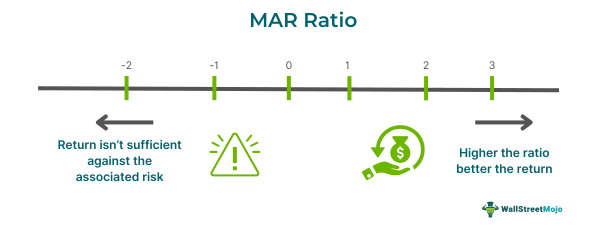
The financial metric operates like a threshold of minimum return, below which the investment is considered unacceptable and not worthy enough given the risks it is linked with. This threshold is different for every investor, given the type of investment, risk appetite, and other market factors and circumstances. Based on this, investors may revise or strategize their investments.
Key Takeaways
- The MAR ratio is a financial metric that denotes whether an investment is worthy based on the minimal return it generates against the risk it possesses.
- It stands for minimum acceptable return, and its two important components are annual average return and maximum drawdown.
- There are many other ratio alternatives to the MAR ratio, but investors prefer the Calmar ratio to gauge investment performance.
- No two investors think similarly and have different plans, so the ratio can mean different things to different market participants.
MAR Ratio Explained
The MAR ratio, which stands for minimum acceptable return, directly indicates the threshold below which an investment is deemed unworthy or insufficient of the risks associated with it. Every trader or investor aims to maximize their returns, but not every investment yields the best returns, as there are varying degrees of market risk associated with each. The metric allows investors to compare the underlying return to the risk factor, helping them decide whether to make or stay with the investment.
The financial metric is very helpful for people as it uses historical data and asset price trends. The ratio is the outcome that derives how much return was generated for every risk unit taken. The key point is every investor has a different risk appetite and different financial objectives and investment goals. It simply means that it changes for every investor.
The minimum acceptable return ratio is essential for comparing and analyzing different assets and even portfolios to completely understand how they have performed earlier in the market and how they may perform in the future. It helps investors choose between different asset classes or a portfolio manager. The ratio is most applicable to assess hedge funds with major drawdowns.
Formula
This ratio can be determined for the overall period, which is typically a longer period (years) for which the formula is:
MAR ratio = Average annual return/Maximum drawdown
Here, the average annual return is deduced by the sum of returns over the number of years divided by the total number of years.
When it is calculated for a single year or shorter period, the equation is:
MAR ratio formula = Annualized return/Maximum drawdown
Annualized return = Portfolio return – Benchmark return
In both formulas, the maximum drawdown is the largest percentage drop in the portfolio’s value from its highest to its lowest point.
Examples
Below are two examples to help you understand the concept better:
Example #1
Suppose Jennifer wants to gauge the MAR ratio of a particular stock. She deduces it based on the stock’s past performance over the last four years, from 2020 to 2023.
| Year | Return |
|---|---|
| 2020 | 13.5% |
| 2021 | 14.4% |
| 2022 | 12.6% |
| 2023 | 18.9% |
Jennifer deduces the average annual return, which is the sum of all the returns over the years divided by the total number of years.
(13.5 + 14.4 + 12.6 + 18.9)/4
59.4/4 = 14.85%
Jennifer knows that the maximum drawdown during this period for the stock was 9.9%
Therefore, as per the formula, 14.85/9.9 = 1.5
Example #2
Suppose Janice is an investment manager. She generates an annual return of 18.9%, while the benchmark return is 14.4%. The maximum drawdown for the same year is 9%.
Based on this information. The ratio can be calculated by applying the values in the formula.
MAR ratio = (Portfolio return – Benchmark return)/ Maximum drawdown
(18.9 – 14.4)/9 = 0.5
Based on this, the investors can gauge Janice’s investment performance and make informed decisions about whether to associate with her. Again, this is a very simple example; an investor must gauge and analyze other factors as well.
Importance
The importance of this financial metric is listed below:
- Serves as a line of minimum return below which the investment is deemed insufficient or unworthy.
- In MAR ratio trading, investors can revise or change their investment strategy in time to maximize returns, rather than wasting time on investments with minimal or low returns.
- The calculation for the ratio is easy. Hence, it is easy to derive and interpret for even new investors.
- Although it has many alternatives, it is still considered a valuable tool for gauging investment performance, considering the risk factor.
MAR Ratio Vs. Calmar Ratio
The differences between the two ratios are as follows:
| MAR Ratio | Calmar Ratio |
| It compares results and drawdowns since its inception | The Calmar ratio typically covers only 36 months of data. |
| It was introduced in 1978 by Leon Rose. | The Calmar ratio was developed by Terry W. Young in 1991. |
| MAR ratio trading helps investors ensure their investments meet their personal return expectations. | Calmar ratios are preferred for their effective comparison ability and better and more accurate performance measurement. |
Frequently Asked Questions (FAQs)
Frequently Asked Questions
What is a good MAR ratio?
This ratio is expressed in simple values. A good MAR ratio is generally greater than one. A ratio of less than one means that the investment performance is low and is not sufficient to justify the amount of risk taken in the whole portfolio. In other words, the higher the ratio, the better.
What are the limitations of the MAR ratio?
The are multiple limitations associated with this ratio. First, it is based on the assumption that maximum drawdown is the highest acceptable level of risk. Secondly, The ratio is prominently dependent on the historical performance of the portfolio or the investment manager. Thirdly, every investor has their own risk appetite and investment objective, which is not considered by this financial metric.
How to improve the MAR ratio?
To improve the MAR ratio, investors can opt for investments that offer higher returns for a specific risk level. Also, diversification can help distribute funds in different asset classes and traders can employ stop-loss orders and other hedging strategies to improve the MAR ratio.