


What Is Risk Capacity?
Risk capacity refers to the extent of risk that an organization or individual can responsibly take without damaging their key financial objectives or stability. It determines the ability to withstand maximum risk exposure, formulate risk management decisions and strategies, and contain the organization’s risk within its financial strength.
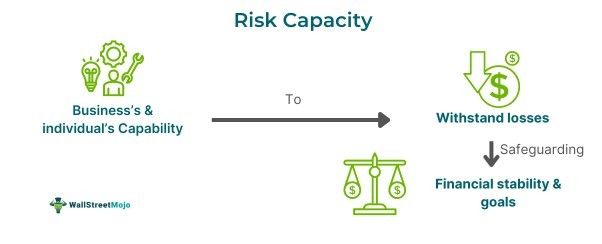
One can determine it by objective elements like time horizon, assets, dependents, income, liabilities, insurance coverage, and debts. It builds thresholds and limits, assesses tradeoffs and risk-rewards and allocates resources and capital. It has become a vital element of consideration for portfolio management and financial planning.
Key Takeaways
- Risk capacity represents the amount of risk that a person or organization may sufficiently accept without jeopardizing main financial goals or their stability.
- It keeps the organization’s risk within the capacity of its financial stability, examines the ability to bear risk exposure and develops plans for appropriate risk management.
- It means optimum risk taken by a firm without harming its viability or solvency,
- while risk tolerance is the degree to which an investor can accept to endure the risk due to volatility of the investment value, whereas risk appetite represents the amount of risk taken by a company to achieve its goals.
Risk Capacity Explained
Risk capacity can be stated as a quantitative evaluation of a business or indivudal’s capability to stand losses and accept possible risks. It consists of two elements: opportunity cost and resilience. Resilience measures the strength to get back to the original state after suffering from unavoidable loss and opportunity cost comes out as the affordability to invest in a project.
Its working can be clearly understood by using the two factors, namely resilience and opportunity cost. It guides decision and risk management strategies. It also ascertains that risks do not go beyond the financial capabilities of an organization. It assesses debt covenants and minimum credit ratings to guide decisions of risk-taking. It aids in making wise strategic steps and investment decisions.
An organization can align its risk taken with its strength to absorb possible financial turbulence, leading to the protection of long-term financial goals. It remains vital in financial planning, portfolio management, resources & capital allocation, facilitating balancing of potential gains along with the ability to absorb losses. It also plays a vital role in fostering sustainable growth and maintenance of stability. Individuals and businesses use it to mitigate financial upheavals and make prudent, robust investment decisions.
How To Measure?
Measuring a company’s risk capacity has been detailed below:
- Identification of specific critical financial threshold metrics such as debt covenants or credit ratings spread on a medium-range horizon.
- Determining fluctuations of historical financial metrics to estimate future ambiguities by managing single-time outliers or items.
- Creating a stochastic system of business outcomes through estimated financial measurement variability and evaluating the effect of strategic steps concerning compliance with financial cut-off.
However, some websites have tools to help in measuring risk capacity using a calculator.
Examples
Let us understand the topic using a few examples.
Example #1
An online article published on 5 July 2024 discusses the contribution of USD 32 million by the African Risk Capacity (ARC) group towards supporting drought reduction efforts within Zimbabwe using the UN Flash appeal program. They allotted the funds to Zimbabwe in the following manner:
- The government received USD 9 million.
- World Food Program received USD 6.1 million.
- Star Network received USD 9 million.
Professor Mthuli Ncube, the finance minister, stressed the significance of the said funding in increasing climate resilience and reducing drought effects. Zimbabwe has benefited tremendously from joining the ARC agency in 2012 by receiving disaster risk funding comprising USD 1 million premium pertaining to 2019/20, triggering a payout of USD 1.4 million. The total payout received served to aid 508435 families throughout 27 districts will help African risk capacity jobs also.
Example #2
Let us assume a small country called Old York is facing frequent natural disasters. It has a total population of 100000 with 75% residing in coastal areas. It already had good strength of capacity to withstand huge risks. It happened because of having designated evacuation temporary shelters and early warning systems. Nevertheless, the limited resources failed to allow coverage to 100% of homes to protect them from natural disasters.
As a result, it remained weaker in the capacity of risk to withstand any extreme typhoon or cyclone directly on the homes of the old York City. Therefore, the lack of strong safety means requires huge investments into building permanent natural disaster relief shelters to give protection of human lives and manage the damage due to calamity risk.
Risk Capacity vs Risk Tolerance vs Risk Appetite
Let us use the table below to understand the topic.
| Risk capacity | Risk tolerance | Risk appetite |
|---|---|---|
| A firm takes the optimum risk without harming its viability or solvency. | The degree to which an investor can accept to endure the risk due to the volatility of the investment value. | Amount of risk taken by a company to achieve its goals. |
| Influenced by time horizon and financial situation. | Influenced by experience and personality. | It concerns risk-taking. |
| Metrics used to measure are objective financial assessments and analysis. | Self-reflection or psychological questionnaires help in assessment. | It needs risk tolerance for integrating with the control environment for successful implementation. |
| Ascertains the degree of risk afforded in investment strategy. | Shows the way for the most comfortable investments | Represents the strategic philosophy for a business regarding risk-taking. |
| Utilized in making realistic investments and financially secure strategies. | Useful in portfolio construction aligned with emotional level. | Low-risk appetite affects patient safety. |
| Any misjudgment results in financial damage during market downtrends | Any misjudgment leads to emotional trauma during market downtrends | Higher risk appetite relates to patient care plus customer service. |
Frequently Asked Questions (FAQs)
Frequently Asked Questions
What are my risk tolerance and risk capacity?
For an individual, risk tolerance can be taken as the willingness to accept risk emotionally, while the capacity of risk would be the amount of financial risk one is ready to accept. Risk tolerance may be subjective based on gut feeling, while the capacity of risk remains objective as per the financial situation.
What is risk capacity in risk management?
Risk management has an important element as the capacity of risk that tends to be the greatest amount of risk a business could take, avoiding any threats to its viability or solvency. Moreover, it can be understood as an organization’s quantitative assessment ability to stand losses and thwart potential risks.
How to calculate risk capacity?
One has to consider factors like liquidity composition, assets, responsibilities, debt-equity mix centered on long-term vs. short-term, financial goals, and liquidity composition.
What impacts the risk capacity of an organization?
It is impacted by net worth, financial strength, assets, liabilities, and earnings, as well as various elements like liquidity, investment timeline, outstanding debts, investment portfolio structure, financial dependents number and financial goals of an organization.