


What Is Port Logistics?
Port Logistics refers to managing and coordinating the movement of goods, information, and services across ports. Global supply chains and international trade rely heavily on it. The timely delivery of goods to customers in a cost-effective manner is possible through efficient logistics. It ensures the unhindered movement of goods and services globally.
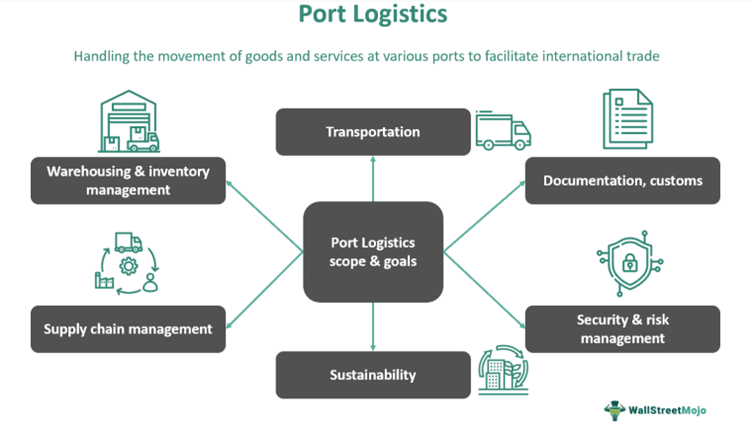
It includes overseeing the entire spectrum of logistics activities, from procurement, warehousing, and inventory management to transportation, customs, and delivery. Through centralized logistics, different ports between countries can be connected. Due to its multimodal nature, managing massive volumes or quantities is possible. Risk management, security, and regulatory compliance are important aspects of such logistics.
Key Takeaways
- Port logistics refers to coordinating and managing inter- and intra-port activities. It guarantees rapid and economical delivery of goods through international trade and global supply chain management.
- It involves transportation mode integration, inventory management, free zones setup for foreign investments, landside network development, and inland freight distribution, among other things.
- It improves cargo handling, streamlines internodal connections, reduces turnaround times, optimizes logistics, and helps predict vessel arrivals.
- It brings benefits like reduced costs, improved customer service, reduced freight miles, reduced emissions, and reduced lead times, among other things.
Port Logistics Explained
Port logistics is the comprehensive coordination and management of activities related to managing the storage and transportation of goods at ports, making it a significant link in the supply chain and logistics function globally. It comprises numerous varieties of tasks like transportation, cargo handling, loading and unloading, surveillance, customs documentation, storage, and customs clearance.
It streamlines the movement of goods across both domestic and international borders. It may require the integration of different transportation modes, such as road, water, and air, particularly over long distances. Transportation through trucks, trains, ships, and planes is seen.
Effective port logistics also requires technological support, adequate infrastructure, and a skilled workforce. These are much needed in the Industry 4.0 era , where optimization and automation have become vital factors in defining the success of this function. It eventually results in successful international trade. New-age logistics requires port & shipping lines, smart technologies, environmental management and sustainability, global trade strategies, port plus terminal shipping line selection processes, and supply chain management.
Ports require efficient storage space handling and planned logistics for safe and swift goods handling because they handle large quantities of cargo. It involves various activities like receiving goods, unloading vessels, and authenticating customs documentation. Goods are then sent to specific storage areas for storage and handling after sorting, organizing, and labeling. Goods transportation to and from different ports is coordinated by internodal systems, trains, or third-party logistics (3PL). Some logistics port companies may also provide port logistics refrigerated services through 3PL.
Certain challenges encountered at ports include the absence of proper infrastructure, low cargo handling capacity, and difficulties with the accommodation of big vessels to meet economies of scale. Such issues generally result in low productivity at ports. Due to these problems, human deployment is vital for efficient port operations. Skilled people are needed to handle port logistics jobs.
A skilled workforce can bring about a significant difference in productivity at ports. Training, maritime education, and supply chain management certifications can go a long way in ensuring labor efficiency and procedural accuracy. Ensuring the job satisfaction of the personnel and labor employed at ports is also of equal importance to prevent strikes and other labor problems. This is because such unrest can have a detrimental impact on an economy and trigger major trade disruptions.
Characteristics
Port logistics exhibit a range of characteristics, particularly in modern times. In this section, let us see what they are:
- Integrated nodal systems: It functions as a nodal system while integrating different modes of transportation across terminals for value-added logistics, interchange, and cargo transfer.
- Intermodal transport options: With well-coordinated terminals enabling seamless goods movement, intermodal transport is crucial to logistics. It consists of multiple modes under a single loading unit, such as containers.
- Inventory management: Prioritizing inventory management over conventional warehousing leads to effective materials management and enables the development of efficient supply chains.
- Logistics hubs: The many free zones seen across ports facilitate foreign investments by way of tax and customs. These enable the development of extensive logistics hubs and small bonded storage facilities.
- Landside logistics: Modern logistical systems support landside logistics, mandating network organization and inland freight distribution.
Functionality
With planned port logistics, multiple functionalities together optimize operations and enhance efficiency across various aspects of cargo handling and port management. Let us study them.
- Low turnaround: It reduces turnaround times by ensuring vessels docked at ports are handled through rapid cargo handling, efficient clearance, precise scheduling, and quick vessel dispatch to the next stop.
- Improved cargo handling: It enhances cargo handling by deploying sophisticated equipment like mobile harbor cranes and automated gantry cranes, besides complex management systems, revolutionizing cargo unloading and loading to improve accuracy and speed.
- Improved internal/port-level processes: It improves internal connections by streamlining cargo transferring procedures, reducing hurdles, and improving overall logistics operations.
- Advanced system implementation: It deploys advanced information methods like blockchain technology for reduced paperwork plus real-time cargo documentation and tracking. This enhances coordination between supply chain participants and their decision-making.
- Port Community System (PCS) implementation: PCS facilitates efficient and secure communication between private and public stakeholders across port clusters, reduces waste, and streamlines procedures to improve efficiency.
- Improved lead time management: It helps predict vessel arrival times and analyzes vessel routes using comprehensive data and predictive analysis. It helps prepare ports for cargo handling in advance, optimize logistical systems, and ensure timely operations.
Examples
In this section, we will study some examples to see how structured systems promote effective port management.
Example #1
According to a March 2024 Project Cargo Journal article, Rhenus Port Logistics and Seaway7 took specific measures to focus on sustainability across port operations and strengthen their positions in terms of bringing in operations stability. They plan to incorporate electric cranes and forklifts into their port operations and execute a pilot project for shore power. All this is being done to implement shore power for environmentally friendly systems.
Piet van Baalen, Offshore Resources Director at Seaway7, explained how strategically advantageous the Rhenus terminal’s proximity to the North Sea is, outlining the flexibility it offers to these companies. To leverage these benefits further, they extended their port logistics contract for ten years.
This throws light on how important port operations optimization and stability are, in addition to focusing on sustainability and environmental management. They see it as the way forward for every company in the logistics and supply chain industry.
Example #2
Suppose Old Tavern, a port city, is a bustling center of global trade. Blueware Logistics operates in this city, with a state-of-the-art logistics center at the port. It manages the influx of goods from different places coming through various cargo ships. Jenny, the port manager, oversees the operations and ensures compliance with internal port processes as well as regulatory requirements, including international trade and customs regulations.
As soon as the goods arrive from different cities at the port, Jenny coordinates with Blueware Logistics’ transportation partners, Railtech and Skyline Freight, to ensure efficient and swift goods unloading, recording, and distribution. Through this, she ensures orders are fulfilled within the assured timelines across specific regions.
Later, when Jenny encountered congestion problems frequently, she devised and executed an innovative strategy to address issues. Using advanced technologies, she optimized internal processes, including warehousing. She also developed a dynamic scheduling system to optimize the timing of goods unloading, transportation, and distribution throughout the day. Jenny then established multiple communication channels to collaborate with every associate/partner (internal and third party) to smooth out issues.
In this way, Jenny at Blueware Logistics resolved issues that would have otherwise caused the company to lose revenue and incur losses in port operations.
Benefits
It is evident from the discussion above that port logistics offers various benefits to every stakeholder. Let us discuss some advantages below.
- Streamlined transportation: It eliminates or significantly reduces useless freight miles, which results in savings and lowers the adverse impact of logistics on the environment.
- Reduced emissions: It enables entities to reduce emissions and carbon footprint, which protects the environment.
- Reduced expenses: It helps lower expenses related to the distribution of goods by shortening travel distances.
- Short lead times: It lowers delivery and order fulfillment lead times, thereby boosting customer service and customer satisfaction.
- Improved supply chains: It streamlines port supply chains and enhances efficiency by rationalizing processes like unloading, picking, checking, sorting, and distribution.
Frequently Asked Questions (FAQs)
Frequently Asked Questions
What is port logistics whiplash?
It refers to unexpected, sudden disruptions in port operations due to natural calamities, geopolitical disasters, labor disputes, abnormal congestion, and regulatory changes, among other things. It can increase operational costs, cause delays, and introduce hurdles during goods movement across logistics networks and ports.
How does port logistics management affect environmental sustainability?
Through effective port logistics management, entities can achieve sustainability goals by reducing carbon emissions, conserving energy and water, initiating waste reduction and recycling projects, and protecting natural resources. Hence, if done right, such logistics can have a less negative impact on the environment.
How do entities ensure compliance with customs regulations and international trade standards through port logistics?
Entities ensure compliance standards through documentation and record-keeping and filing customs declarations and bills of lading for imports and exports. They also implement robust risk management measures and port security protocols to prevent illegal activities. They oversee compliance with the rules established by customs authorities. By providing compliance education to personnel, they ensure adherence to regulatory changes. Technology is used to track and monitor operations. Internal audits help them verify processes and identify areas of improvement.