


What Is Market Access?
Market access in trade is referred to as the capacity or ability of a corporation or a country to enter into borders beyond its homeland and sell its products and services. Access to markets could be through licensing, exporting, franchising, and joint ventures.
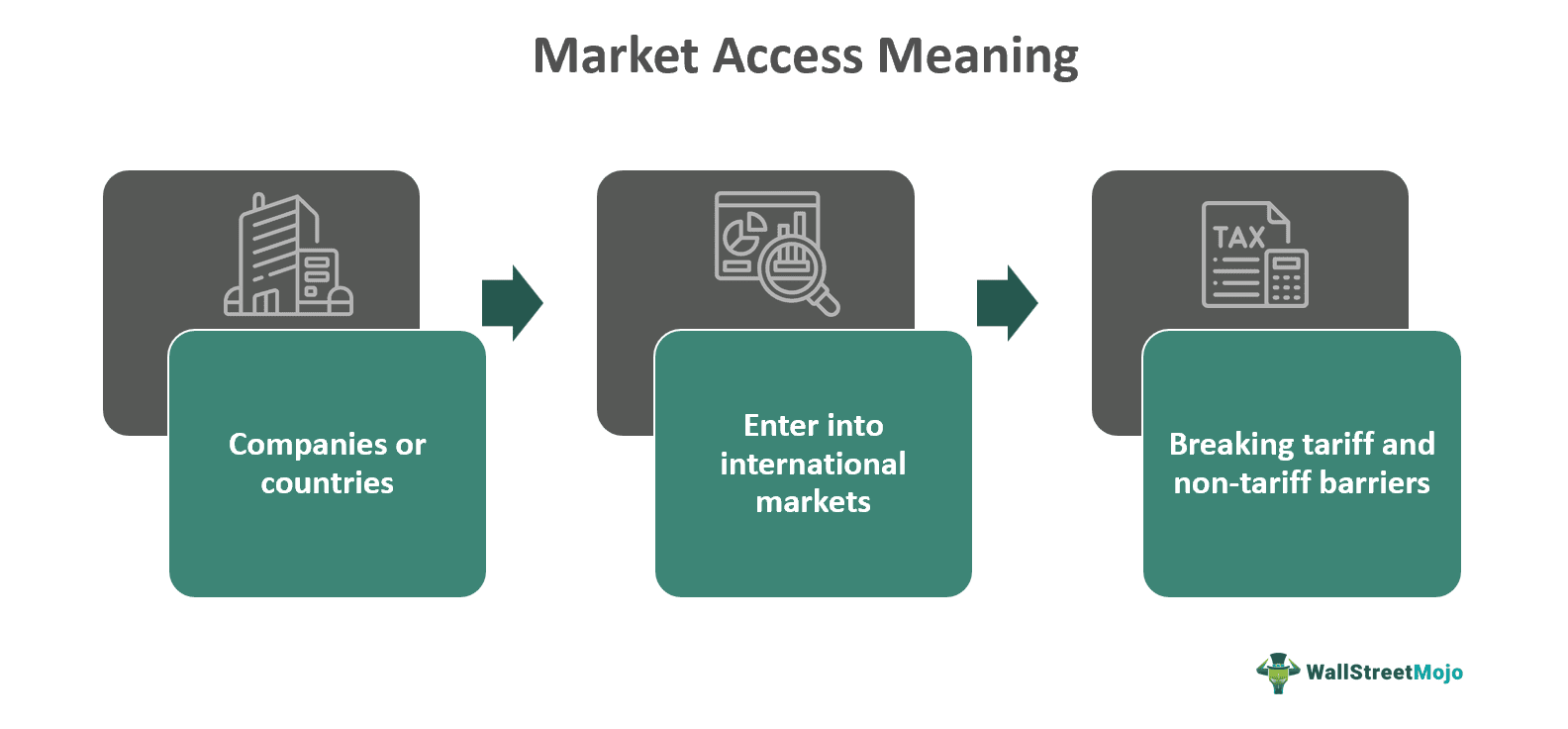
Access to various markets can increase income and boost productivity. It can help a business expand into new ventures that are open geographically. From a broader perspective, international access to the market can boost a country’s economy and result in the development of different fields, such as foreign trade, transportation, international relations, etc.
Key Takeaways
- Market access in international trade refers to the capacity of a corporation or company to sell its services or products in markets beyond its domestic borders.
- International access to markets can help increase productivity, income, economic development, etc. It promotes peace, innovation, and technological advancements.
- Restrictions include tariff barriers, such as customs duties, and non-tariff barriers, such as quotas, regulations, etc. Other reasons include logistical and governmental policies.
- To improve access, governments shall tone down restrictive policies, engage in trade agreements, provide rewards, etc.
Market Access In International Trade Explained
Market access includes trade conditions such as non-tariff and tariff measures as agreed by the countries involved in the transaction of goods into their markets. Some regulations allow access to markets across nations shaped through trade agreements, diplomatic (geographical and political), and promotion efforts. This helps tap into a new consumer base and expand business.
Access to markets could be disturbed due to bilateral trade agreements. Furthermore, access can be measured by the direct access conditions and the relative access conditions. Direct access conditions refer to the conditions that relate to overall tariff restrictions faced by exports. Relative access conditions refer to the tariffs encountered by the exports in relation to those faced by its competitors. According to the World Trade Organization (WTO), there are two significant restrictions on access to markets: tariff and non-tariff barriers. Tariff barriers include monetary restrictions such as customs duties, and non-tariff barriers include quantitative and other non-tariff barriers. Quantitative restrictions are quotas, and the latter include:
- Non-transparent trade regulations.
- Their unfair and arbitrary application.
- Technical barriers to trade and procurement.
While tariff and non-tariff barriers are the two most contributing factors to restricted access, other factors play a role in it. Competition intensity is one such factor. The demand for the products and services, the high number of competitors, and the intensity of competition make it difficult to access markets. Similarly, the development of a country is also an essential factor, as it forms the link for a country to the outside world. If there is no development in ports, roads, railways, or airports, the ability to scale heights can be difficult. Similarly, administration (government policies and procedures) and logistical issues can also hinder access to markets.
Examples
Let us look at a few examples to understand the concept better.
Example #1
Suppose a company in the U.S. wants to sell an efficient electrical bulb in the markets of the U.K. The U.K., however, has concerns about imported electrical goods and has placed restrictions on them using high tariffs levied on the products. Company “A,” with high tariffs, is not able to sell its products as it is costly for the customers. This will negatively impact their revenue. However, if the U.K. reduces the tariffs, the company would be able to sell at nominal or near nominal costs and make a profit out of it. This reduction is granting access to the market, which otherwise would not have been possible.
Example #2
A study conducted by BYU economist Scott Bradford reveals that the removal of trade barriers in four countries could bring in $50 billion a year to the U.S. economy. It reveals that the regulatory bottlenecks and tariffs create market inefficiencies and negatively impact consumers. The study states that this could also help developing nations improve their income by $150 billion a year.
How To Improve?
Apart from removing tariff and non-tariff barriers, countries can indulge in the following activities to improve market accessibility:
- Trade agreements
Countries can formulate and be part of trade agreements (multilateral, bilateral, or even regional) to liberalize trade. They involve harmonization of rules, reduction of tariffs, and other easy access mechanisms.
- Grant of license
Countries shall grant licenses and permissions to make the process easier for both countries. It can also reduce the red-tapism that prevails in most government offices.
- Offer benefits
Trading with a country shall be made rewarding through the reduction of tariffs and elimination of barriers to improve market accessibility.
- Infrastructure development
The physical infrastructure shall be developed to support the export-import process.
- Protection measures
Countries that indulge in trading shall be protected from the wrath of domestic competitors, especially in cases of intellectual property rights, patents, etc., and frame policies that offer fiscal and financial support to expand the business to venture into other countries.
Companies can use tools such as market access maps, which help compare tariffs and other requirements across markets. A market access map helps in understanding the requirements rather than making access easier, as that depends on laws and regulations.
Importance
Below are some of the reasons why access to markets is essential:
- Access to various markets expands the customer base and enhances sales opportunities. This, hence, brings in more income.
- The access helps companies enable diversification into various markets for better export opportunities.
- It helps positively enhance economic growth and improve employment opportunities.
- International trade can improve the value of domestic currency. This makes imports cheaper.
- International market access increases competitiveness in domestic firms and improves their efficiency. This also leads to competitive pricing that helps the customer.
- It can result in technological developments and knowledge sharing, which helps in the country’s development.
- Consumers benefit from cheaper prices and a wide variety of options to choose from.
- It provides additional revenue for governments through customs duties and other taxes.
- International trade can promote peace and diplomatic relations between countries.
- It helps in the overall development of the nation, including health, welfare, and education.
Frequently Asked Questions (FAQs)
Frequently Asked Questions
What is market access in pharma?
Market access in the pharma or pharmaceutical industry refers to the capacity of a medical product to be approved by the medical community and released to the market. This ensures patients’ access to the product or service and its commercial success.
What is direct market access?
Direct market access in trading terms refers to the process of investors accessing and executing trades through exchanges such as NYSE, NASDAQ, etc., instead of going through brokerage firms. This helps them quote, buy, or sell instruments without intermediaries.
What is market access in agriculture?
Market access in agriculture refers to the process of bringing the products or products of farmers and agricultural producers to the national and international markets. It refers to the removal of barriers, both nontariff and tariff barriers.
What is the market access strategy?
It refers to the techniques or methods that will help a company or a country to bypass national and international market regulatory conditions. This will enable them to sell services or products to the target market.