


Introduction
Professionals from non-finance backgrounds, like engineering, marketing, operations, HR, and IT, increasingly want to build finance skills. Many aim to transition into analyst, FP&A, or investment banking roles, while others want to make sharper business decisions in their current jobs. The challenge is rarely motivation; it is sequencing. Most people either jump straight into advanced valuation content they cannot follow. Or, they stay stuck in theory-heavy material that never connects to real financial statements.
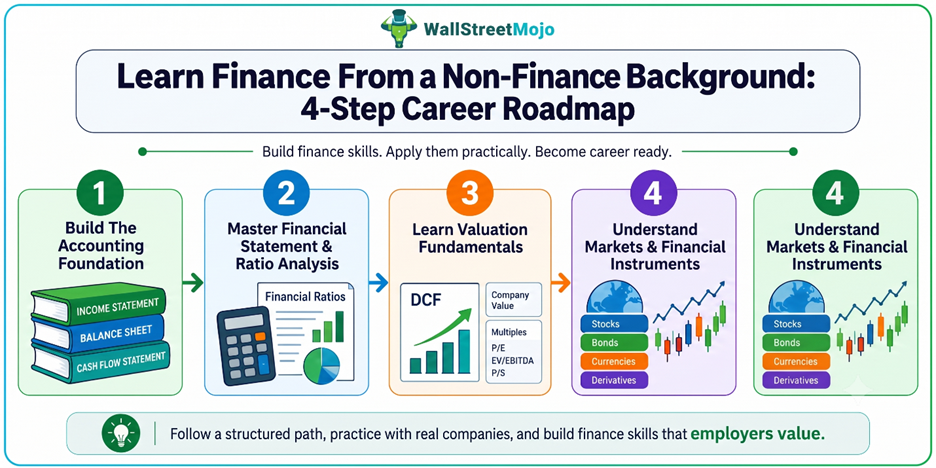
To learn finance from non-finance background effectively, a professional needs four core skills in sequence. These include financial statement literacy, ratio-based analysis, valuation fundamentals, and exposure to how markets and instruments behave. Skipping straight to discounted cash flow modeling without financial statement literacy is the single most common mistake self-taught learners make.
This finance career roadmap breaks the learning sequence down phase by phase. It compares the realistic learning paths available in 2026 and explains how structured programs compare with self-study, an MBA, and certifications such as the CFA. It also highlights what recruiters actually look for when hiring candidates without a finance degree.
Key Takeaways
- Build finance skills in sequence: financial statements, ratio analysis, valuation, then markets and financial instruments.
- Professionals without finance degrees can transition into finance by developing relevant skills and gaining practical experience.
- A structured learning path can help build job-ready financial literacy within six to twelve months.
- Self-study, an MBA, the CFA Program, and structured courses serve different career goals, timelines, and budgets.
- Recruiters value practical application, including financial statement analysis, valuation understanding, and real-company case studies.
- Avoid common mistakes such as starting valuation too early, skipping ratio benchmarking, and ignoring financial markets and instruments.
Why Non-Finance Professionals Are Moving Into Finance Roles
Finance remains a viable career path for professionals from diverse educational backgrounds. According to the estimates of The U.S. Bureau of Labor Statistics, financial analyst employment is set to grow 7% from 2025 to 2035, significantly quicker than the average for every occupation. Around 29,500 openings are projected on a yearly basis over the decade, creating opportunities for professionals who can demonstrate relevant financial skills and practical experience.
In India, professionals from engineering, IT, and operations backgrounds can also transition into finance by building relevant financial skills and gaining practical experience. The transition typically requires a strong foundation in financial statements, ratio analysis, valuation, and Excel, followed by hands-on projects that demonstrate these skills. Learning finance from non-finance background also requires applying these concepts to real companies rather than relying only on theoretical study.
Compensation varies considerably by role, employer, location, experience, and industry. Entry-level finance and analyst salaries also differ widely, so salary ranges should be treated as indicative rather than fixed benchmarks.
According to AmbitionBox, the typical salary range for financial analysts with 0-7 years of experience is ₹6.5 lakh to ₹7.1 lakh per year.
A professional without a finance background can realistically become job-ready for entry-level financial analyst, FP&A, or equity research support roles within six to twelve months.
That said, achieving the objective requires consistent, structured learning covering statements, ratios, valuation, and markets in that order.
The Four-Phase Roadmap To Learn Finance From A Non-Finance Background
How to learn finance from non-finance background becomes clearer when the process is divided into four phases. The table below shows what each phase should cover and why the order matters.
| Phase | Core Skill | Why It Comes at This Stage | Common Beginner Mistake |
| 1. Foundation | Reading balance sheets, income statements, cash flow statements | Every later concept assumes fluency here | Memorizing line items instead of understanding what drives them |
| 2. Ratio & Health Analysis | Liquidity, solvency, activity, and profitability ratios; DuPont analysis | Converts raw statements into comparable, decision-useful signals | Calculating ratios without benchmarking against peers or history |
| 3. Valuation | DCF, Dividend Discount Model, Gordon Growth, comparable multiples | Requires financial statement and ratio fluency to build defensible assumptions | Building a DCF before understanding what free cash flow actually represents |
| 4. Markets & Instruments | Bonds, derivatives, currencies, alternative investments | Places valuation in the context of how capital is actually priced and traded | Treating instruments as abstract theory rather than connecting them to real portfolios |
This sequence provides a practical framework to learn finance from non-finance background in a structured manner. It allows learners to progress from financial statements to ratios, valuation, and markets rather than tackling isolated topics.
Self-Study, MBA, CFA, Or A Structured Course: Comparing The Realistic Paths
Those looking to learn finance from non-finance background generally choose between four paths. Each The table below compares these four paths by timeline, target learner, and key limitations, making the trade-offs easier to evaluate.
| Learning Path | Typical Timeline | Best For | Limitation |
| Self-study (YouTube, blogs, books) | Open-ended | Testing genuine interest before committing money | No structured sequence, no accountability, easy to develop knowledge gaps |
| Full-time or executive MBA | 1-2 years | Career pivots needing a credential plus professional network | High cost and time commitment relative to the finance-specific skill gained |
| CFA Program | Multi-year, exam-gated | Professionals targeting long-term careers in investment management or research | Charter completion requires roughly 4,000 hours of qualified investment-decision work experience over a minimum of 36 months alongside sequential exam levels, making it an unsuitable first step for absolute beginners |
| Structured beginner-to-intermediate course bundle | Weeks to a few months | Building job-ready statement, ratio, and valuation literacy quickly, with certification | Narrower scope than a full MBA or charter; best treated as a foundation, not a terminal credential |
For someone looking to learn finance from non-finance background, a structured course bundle such as the Finance for Non-Finance Managers Course by WallStreetMojo is designed specifically to close this gap. It sequences financial statement basics, ratio analysis, equity valuation, bonds, derivatives, currency markets, and alternative investments into one coordinated pat.
The program is directed by Dheeraj Vaidya, CFA, FRM, a former JPMorgan and CLSA analyst, and follows the four-phase framework outlined above rather than treating each topic in isolation.
This bundle differs from programs such as Wall Street Prep and Breaking Into Wall Street, which generally target candidates preparing for investment banking interviews. It also differs from CFI’s FMVA, which places greater emphasis on modeling mechanics than foundational finance skills.
What Recruiters Screen For, And The Mistakes That Slow Learners Down
Hiring managers evaluating a non-finance candidate for an analyst, FP&A, or research-support role typically check whether the candidate can read financial statements without prompts. They also assess whether the candidate can interpret ratios, explain what drives a valuation output, and apply these skills to a real company rather than a textbook example.
For professionals looking to learn finance from non-finance background, case-study-based learning using real, publicly traded companies can strengthen practical credibility. For example, reviewing filings from a familiar consumer or retail business gives beginners a tangible reference point for understanding ratios and valuation logic. Moreover, building a short portfolio of two or three company breakdowns can strengthen interview credibility more than a certificate alone.
Three mistakes recur most often among self-taught learners. Let us look at them.
- The first is starting with valuation models before developing financial statement literacy.
- Secondly, people often make the mistake of learning ratios in isolation without benchmarking them against peers or historical performance.
- The third mistake is avoiding markets and financial instruments because they seem abstract, leaving knowledge gaps that can surface in interviews covering investments or corporate finance.
Conclusion
For anyone looking to learn finance from non-finance background, sequencing matters more than the volume of content. Professionals who move through statements, ratios, valuation, and markets in order, and who back that learning with real company case studies, become credible candidates far faster than those who jump straight to advanced modeling.
Whether the chosen path is self-study, an MBA, the CFA track, or a structured bundle, the same four-phase logic applies. For those wanting a guided, single-enrollment path through that sequence, reviewing the current curriculum and enrollment details on the Finance for Non-Finance Managers Course page is a reasonable next step.
Frequently Asked Questions
Can I learn finance with no prior background at all?
Those who want to learn finance from non-finance background can start without a commerce or finance degree, provided they follow a fixed sequence. starting with financial statements before moving to ratios, valuation, and markets. Most structured beginner programs are explicitly designed for this starting point.
How long does it take to learn finance from non-finance background roles?
Most professionals reach basic job-readiness for entry-level analyst or FP&A-adjacent roles within six to twelve months of consistent, structured learning. The timeline depends on prior exposure to Excel, how many hours per week are available, and whether the learner also builds a small case-study portfolio.
Is an MBA necessary to switch into finance?
No, an MBA helps with networking and signals commitment. However, it is not the fastest or only route. Documented career-switch cases show IT and other non-finance professionals reaching FP&A and finance-adjacent roles without an MBA. Instead of the degree, they rely on targeted courses, certifications, and demonstrated project work.
Should I start with the CFA Program if I have no finance background?
No, generally, not as a first step. CFA Institute positions the CFA track as suitable for university students, working professionals building on existing credentials, and career-changers from other industries. However, it assumes a baseline of financial literacy and requires a multi-year, exam-gated commitment. A foundational course before attempting Level I is a more realistic starting point for absolute beginners.
What skills matter most in the first three months of learning finance?
The most important skills to develop in the first three months are financial statement analysis, ratio analysis, and basic Excel skills. You should be able to read and explain the balance sheet, income statement, and cash flow statement, and interpret core liquidity, solvency, and profitability ratios. Moreover, you should have the capability to use Excel for basic financial calculations.