


Introduction
Every finance aspirant eventually hits the same wall: textbooks explain valuation theory well. But they rarely teach how to build a working model that survives scrutiny from a hiring manager or an investment committee. Employers do not test candidates on formulas alone. Instead, they test whether a candidate can forecast a three-statement model, defend a discounted cash flow (DCF) output, and explain why a comparable company multiple might be misleading.
This guide breaks down how to learn financial modeling and valuation using a comparison-first approach: It evaluates the realistic learning paths available today, from free YouTube tutorials to paid certification bundles. Moreover, it lays out a sequenced roadmap so that a learner knows exactly what to study first, second, and third.
In short, learning financial modeling and valuation properly involves three layers.
First, master Excel-based forecasting mechanics. Then, apply valuation frameworks like DCF and trading comparables to real companies. Finally, validate the skill set through a portfolio or certificate that a recruiter can verify. Learners who skip any one of these three layers typically struggle in technical interviews, regardless of how many hours they spent watching tutorials.
Key Takeaways
- The journey of how to learn financial modeling and valuation effectively begins with Excel fluency, followed by three-statement modeling and valuation.
- Financial modeling and valuation are distinct disciplines, but combining both creates a more employable finance skill set.
- Real company case studies build practical pattern recognition that isolated formula exercises cannot provide.
- A structured learning path can reduce trial and error while providing templates, sequencing, and portfolio-ready projects.
- Sensitivity analysis and assumption defense are essential for demonstrating valuation judgment during technical interviews.
- A CFA qualification complements hands-on modeling training rather than replacing practical Excel and financial modeling skills.
Financial Modeling vs. Valuation: What Each Skill Actually Covers
Financial modeling and valuation are related but distinct disciplines, and conflating them is one of the most common mistakes among self-taught learners.
Financial modeling is the process of building a structured Excel representation of a company’s historical and projected financial statements. These financial statements include the income statement, balance sheet, and cash flow statement. They are linked with formulas that update dynamically as assumptions change. Valuation is the separate discipline of using that model’s outputs, or standalone frameworks. Its purpose is to estimate what a company or asset is actually worth.
A learner can build an accurate three-statement model without performing a valuation.
Similarly, some analysts run quick relative valuations using public multiples without building a full model. The most employable skill set combines both: a forecasted model feeds directly into a DCF, and the resulting valuation is cross-checked against trading comparables. Recruiters at investment banks, equity research desks, and corporate finance teams expect candidates to move fluidly between the two.
Comparing The Ways To Learn Financial Modeling and Valuation
Before deciding how to learn financial modeling and valuation, it helps to compare the realistic paths available side by side. Each path suits a different starting point, budget, and career timeline. The table below compares these learning paths based on structure, cost, suitability, and key limitations.
| Learning Path | Structure & Depth | Typical Cost Range | Best Suited For | Limitation |
| Free YouTube tutorials and blogs | Fragmented, topic-by-topic, no sequencing | Free | Testing interest before committing | No case study continuity, no certificate, easy to develop bad Excel habits |
| University finance electives | Theory-heavy, limited Excel practice | Included in tuition | Undergraduates building foundational theory | Rarely covers modern modeling conventions used on trading desks |
| In-person bootcamps | Intensive, cohort-based, often 1-2 weeks | High, plus travel/time cost | Career switchers who want networking and mentorship | Expensive relative to self-paced alternatives; fixed schedule |
| Self-paced online courses with case studies | Structured curriculum, downloadable templates, sequenced modules | Moderate, one-time | Working professionals and students who need flexibility | Requires self-discipline to complete without a live cohort |
For most learners deciding how to learn financial modeling and valuation, structured self-paced courses offer the best ratio of depth to flexibility. That said these courses should be built around real company case studies rather than isolated formula drills.
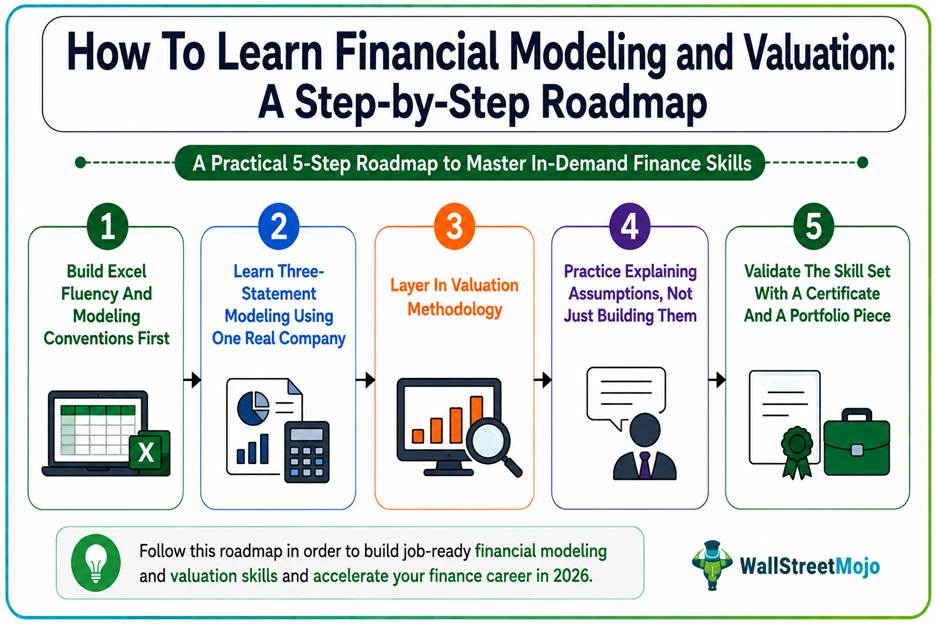
How To Learn Financial Modeling and Valuation: A Step-by-Step Roadmap
When deciding how to learn financial modeling and valuation, a learner does not need to master every valuation technique simultaneously. The most durable learning sequence follows the order institutional analysts actually use on the job.
Step 1: Build Excel Fluency And Modeling Conventions First
Before working with financial statements, a learner should first understand the formatting standards used across banks and funds. These include blue font for hardcoded inputs, black font for formulas, and consistent column structures for historical and projected periods. Skipping this step is why many self-taught models look inconsistent to a trained reviewer.
Step 2: Learn Three-Statement Modeling Using One Real Company.
Working through a single company, such as a McDonald’s-style case study, helps build practical modeling skills. Starting with historical income statement analysis and progressing to balance sheet and cash flow linkage builds pattern recognition for modeling other companies. WallStreetMojo’s Financial Modeling and Valuation Course, taught by Dheeraj Vaidya (CFA, FRM), a former JPMorgan and CLSA analyst, sequences this exact progression before moving into full three-statement forecasting.
Step 3: Layer In Valuation Methodology
Once a model forecasts revenue, costs, and cash flows reliably, a learner can apply DCF analysis, the dividend discount model, and relative valuation using trading comparables. This is also where sensitivity analysis becomes relevant, since a valuation output is only as credible as the range it produces under different assumptions.
Step 4: Practice Explaining Assumptions, Not Just Building Them
Interviewers at investment banks and equity research firms probe assumptions more than formulas. A candidate who can justify a terminal growth rate or a discount rate choice stands out more than one who can only execute the calculation.
Step 5: Validate The Skill Set With A Certificate And A Portfolio Piece
A completed case study model, paired with a course certificate, gives a recruiter tangible proof of capability. This is where structured programs add measurable value over unstructured self-study. After all, the former combines sequenced learning with a credential and downloadable templates a learner can reference on the job.
Common Mistakes Learners Make While Studying Financial Modeling and Valuation
Several recurring errors can slow down capable learners trying to understand how to learn financial modeling and valuation effectively. Building models entirely from scratch without templates wastes hours on formatting instead of analysis. However, using templates strategically, while still understanding every formula inside them, accelerates learning without sacrificing comprehension.
Treating valuation as a single-number exercise rather than a range is another frequent mistake. A DCF that outputs one static enterprise value, without a sensitivity table showing outcomes across a range of discount rates and growth assumptions, signals that the candidate does not understand valuation uncertainty.
Ignoring circular references is a technical gap that shows up quickly in live modeling tests. Interest expense can depend on a revolving credit facility, which itself depends on cash flow. This creates a circularity that must be handled using iterative calculation settings. Learners unfamiliar with this issue may struggle during interviews.
Many learners also study modeling and valuation as isolated topics rather than a connected workflow. This is why bundled programs that sequence modeling before valuation, such as WallStreetMojo’s Financial Modeling and Valuation Course, tend to produce more interview-ready candidates than disconnected tutorials.
Career Outcomes And Market Demand
Financial modeling and valuation skills feed directly into several finance career tracks, and demand remains steady across both US and India markets. Overall employment of financial analysts is projected to grow 7% from 2025 to 2035, much faster than the average for all occupations. About 29,500 openings for financial analysts are projected each year, on average, over the decade.
In India, there is no directly comparable national projection for financial analyst job openings. However, demand for skilled professionals remains strong, with hiring varying by city, experience, and specialization.
The table below shows how financial modeling and valuation skills apply across key finance career tracks.
| Role Track | Core Skill Emphasis | Where Modeling & Valuation Skills Apply |
| Financial Analyst | Forecasting, variance analysis | Budgeting models, management reporting |
| Equity Research Analyst | DCF, comps, earnings models | Initiating coverage reports, target price models |
| Investment Banking Analyst | Three-statement modeling, M&A models | Pitch books, deal valuation |
| Private Equity Analyst | LBO modeling, returns analysis | Deal screening, portfolio company modeling |
| FP&A Professional | Budget forecasting, scenario modeling | Rolling forecasts, board reporting |
Should a CFA Charter Replace a Modeling Course, or Complement It?
The CFA Program is often confused with hands-on modeling training, but the two serve different purposes. The CFA Institute confirms that the program consists of three sequential exam levels. Each level tests increasing complexity in investment analysis, valuation, and portfolio management. Candidates typically complete the program over multiple years alongside qualifying work experience.
The CFA curriculum builds strong theoretical grounding in valuation concepts. That said, it does not train a candidate to build a bankable three-statement Excel model or navigate the formatting and linking conventions used inside real firms. Many candidates therefore pursue a structured modeling course before or during CFA preparation. They use practical Excel skills to reinforce exam theory rather than treating either path as a substitute for the other.
Conclusion
Knowing how to learn financial modeling and valuation effectively starts with the right sequence and consistent practice on a real company. The number of hours spent watching tutorials matters less. Learners who follow a structured path, moving from Excel fundamentals through three-statement modeling and into valuation methodology, consistently outperform those who study the two disciplines in isolation.
For anyone ready to move past scattered tutorials, WallStreetMojo’s Financial Modeling and Valuation Course offers a sequenced, case-study-driven path built around this exact progression.
Frequently Asked Questions
How long does it take to learn financial modeling and valuation?
Most learners need several months of consistent practice to become interview-ready. That said, timelines vary based on prior Excel proficiency and whether the learner follows a structured curriculum or pieces together free resources independently.
Can I learn financial modeling and valuation without a finance degree?
Yes, it is possible. After all, financial modeling and valuation are practical, skill-based disciplines. Learners from engineering, commerce, or accounting backgrounds can build strong modeling capability through structured courses. However, they must practice on real company case studies rather than relying on theory alone.
Is financial modeling harder to learn than valuation?
Financial modeling generally has a steeper initial learning curve because it requires precise Excel mechanics and statement linkages. Valuation builds on a completed model, so learners who master modeling first typically find valuation concepts easier to apply.
Do I need to know coding or Python to learn financial modeling?
No, core financial modeling and valuation work is performed in Excel. Python and other tools are increasingly used for advanced automation and large-scale data analysis. However, they are not prerequisites for building a functioning three-statement model or DCF.
What is the best way to practice financial modeling and valuation skills?
To understand how to learn financial modeling and valuation, work through a real company case study end-to-end rather than isolated formula exercises. It builds the pattern recognition needed for interviews and on-the-job modeling. Reviewing the completed model against a checklist of formatting conventions and sensitivity outputs afterward reinforces the skill.
Does a financial modeling and valuation certificate actually help with job applications?
A certificate alone will not replace strong interview performance. However, it can demonstrate structured learning and give recruiters a clear reference point. When paired with a portfolio case study that a candidate can explain confidently, it provides stronger evidence of practical capability.