


What Is Labor Market Policy (LMP)?
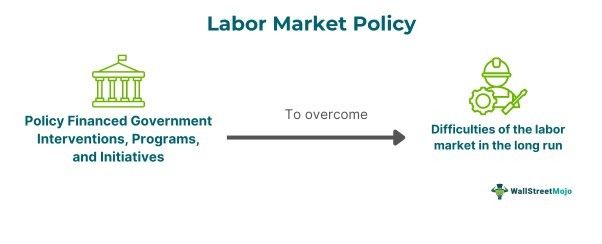
Labor market policy (LMP) refers to the various public interventions or measures taken by policymakers to address the challenges faced by certain struggling groups in the labor market. Some of the key concerns include sustainably curtailing cyclical and structural unemployment, enhancing employment prospects, and improving human capital.
The government often takes policy initiatives like publicly funded services and public employment services to surge the earning potential for the underemployed or unemployed over time. The primary purpose of such reforms is to perpetuate existing employment opportunities, provide assistance for job search, develop new job opportunities, facilitate labor market interactions, etc.
Key Takeaways
- Labor market policy is a publicly financed government initiative to improve labor market outcomes by overcoming the challenges faced by certain groups, such as the unemployed and underemployed sectors of society.
- Some of these interventions include direct job creation, employment incentives, training, public employment services, and publicly funded services.
- The major goals of such measures are to check cyclical and structural unemployment, enhance human capital, increase employment prospects, and match the labor supply with labor demand.
- The active labor market policies (ALMP) were initially developed in Sweden during the 1950s.
Labor Market Policy Explained
The labor market policy is the publicly funded initiative to match the labor demand with its supply in an economy while making sure that the underemployed and unemployed individuals get more potential opportunities to increase their income. Hence, it aims to address and reduce cyclical and structural unemployment in the long run. The primary objective of the labor market policy include:
- Uplifting of the prevailing employment scenario
- Preserving the existing jobs
- Developing new employment opportunities
- Emphasizing economic regeneration activities
- Enhancing the skills of job aspirants
- Establishing interaction between the job seekers and employers.
Apparently, the Organization for Economic Co-ordination and Development (OECD) has categorized the active labor market policy (ALMP) as follows:
(i) Direct job creation
(ii) Training
(iii) Start-up incentives
(iv) Employment incentives
(v) Supported and sheltered employment and rehabilitation
(vi) Public employment services and administration
The various initiatives under the LMP include job search help, vocational training, public work programs, wage subsidies, and self-employment or micro-entrepreneurship opportunities. However, these programs are often prone to challenges like youth unemployment, gender differences, climate change, the emergence of artificial intelligence, more digitalization, and informality.
History
During the 1950s, active labor market policies (ALMP) were first introduced in Sweden to make the demand and supply equivalent in the labor market. Then, in the 1960s, ALMPs primarily aimed to enhance workforce skills amidst the rapidly expanding economies to deal with the labor shortage. However, after the oil crises of the 1970s, the focus of these policies shifted toward addressing social issues. Since the mid-1990s, ALMPs have majorly concentrated on promoting employment by strengthening work incentives and removing obstacles, particularly for low-skilled individuals. Nevertheless, the effectiveness of these policies often lags behind economic changes, as nations that were leaders in one era may struggle to adjust to new economic conditions due to policy inertia.
Examples
The active labor market policies gained significance in the early 2000s by improving the condition of the labor market around the globe and thereby fostering strong economic growth. Some of the relevant labor market policy examples are as follows:
Example #1
Suppose a developing economy is highly prone to cyclones and other natural calamities. Being near the ocean, the primary source of income for the local communities is fishery and the export of seafood and other sea products. However, during the Coronavirus pandemic, export activities came to a halt due to the lockdown and other government restrictions. Most of the natives, whose significant earnings relied upon the fishing industry, faced unemployment. Government officials and policymakers addressed the issue and took various policy measures to create new job opportunities within the country and revive the fishing industry by opening up ways for global export with complete precaution and safety.
Example #2
The Association of Southeast Asian Nations(ASEAN) has been struggling to cope with the green and digital global economic transition (Twin Transition). Hence, there is a need for forward-looking labor market policies and skill development measures. Therefore, the ASEAN nations require a circular economy and a fair consideration of renewable energy sources to address the potential concerns. Further, technical and vocational education and training (TVET), along with inclusive labor market policies inspired by feminist development cooperation, can facilitate the supply of a skilled workforce. Moreover, government officials should have the required expertise to prepare the workers for the Twin Transition.
The primary purpose of this project is to equip national and regional policymakers in the ASEAN Member States with the knowledge, competencies, and skills essential for effectively and somewhat heading the green and digital transition for a better future. It supports regional and national bodies in revising their labor market and TVET policies through initiatives on green jobs, labor market data and projections, digital skills, and gender equality. The project fosters evident, gender-responsive labor market policies through training, expertise, and exchange programs. The ASEAN countries also collaborate with public and private partners to develop regional standards, tools, and learning content for TVET while undertaking innovative and creative TVET and economic market policy moves like gender-transformative instruments.
Source – https://www.giz.de/en/worldwide/152328.html
Importance
The significance of labor market policies is due to higher economic instability, resulting in greater job insecurity around the world. Given below are some of the reasons why the policymakers take labor market initiatives:
- Increasing Earnings of Underemployed and Unemployed People: Government officials often check unemployment and underemployment to ensure that the labor market provides fair opportunities for all job seekers and employees.
- Improving Labor Market Outcomes: These measures ensure that the economy has favorable employment and wage levels to ascertain a fair distribution of income and jobs.
- Meeting the Gap Between Labor Demand and Supply: Policymakers often try to match labor market demand with labor supply to ensure economic equilibrium.
- Enhancing Economic Conditions: When the overall labor market improves, the standard of living, production, consumption, and trade in the economy also improves, especially in developing nations.
Frequently Asked Questions (FAQs)
Frequently Asked Questions
What are the factors that help determine the labor market policy?
The major factors that play a key role in shaping labor market policies are labor demand and supply. Other constraints include labor competition, job prospects, geography, salary statistics, and workplace conditions.
What is a passive labor market policy?
Passive labor market policies aim to facilitate replacement income for individuals who are unemployed or seeking new job opportunities. These measures include social transfer to such groups irrespective of their registration for work programs and training sessions.
How does the labor market policy of immigration affect the labor market?
The immigration of workers considerably affects the labor market. Due to more immigrants searching for jobs, a nation may witness a higher labor supply in the economy and some industries and occupations. On the contrary, other nations may experience a shortage of labor in comparison to heightened labor demand, thus fostering more job opportunities.
How does the labor market policy of minimum wage affect the labor market?
The government fixes a minimum wage rate, which, in a real-world scenario, may result in a lower employment level, thus increasing involuntary unemployment.