


Introduction
Every year, thousands of engineers, commerce graduates without a finance major, liberal arts students, and career switchers ask the same question: can someone become an investment banker without a finance degree? The honest answer is yes, but the path looks different from the traditional campus-to-bulge-bracket route. Moreover, it demands a deliberate substitute for the credential most recruiters expect to see.
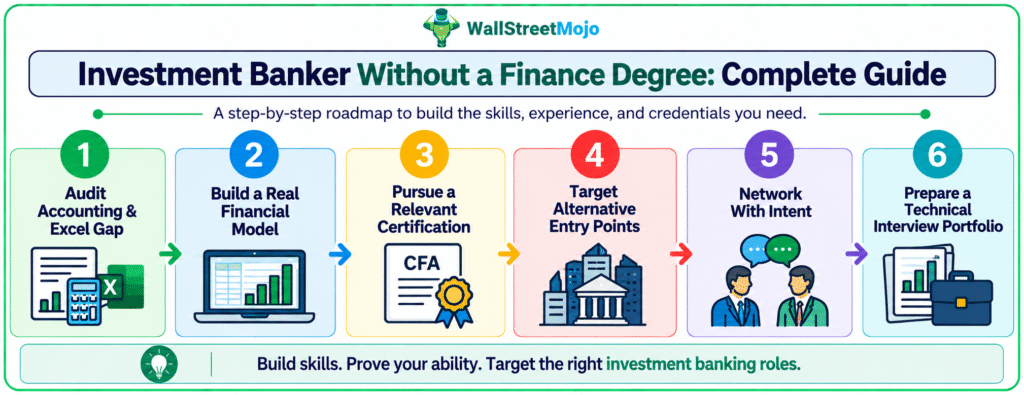
An investment banker without a finance degree typically compensates for the missing academic pedigree through demonstrable technical skills in financial modeling and valuation. This can include a recognized certification such as the CFA, a structured industry program, and evidence of deal-relevant thinking. Candidates can build this evidence through internships, case competitions, or self-directed projects.
Investment banks care less about the name of a degree and more about whether a candidate can build a three-statement model, defend a valuation, and survive a technical interview.
This guide breaks down what separates candidates who successfully make this transition from those who stall out. It uses a comparison-first framework, real compensation data from India and the United States, and a step-by-step roadmap for non-finance graduates.
Key Takeaways
- You can become an investment banker without a finance degree by developing strong accounting, modeling, valuation, and deal-related skills.
- Technical interviews commonly test financial statements, Excel modeling, DCF, M&A, and LBO concepts.
- Building independent financial models and valuation case studies provides practical evidence of technical ability.
- Certifications such as the CFA Program can strengthen your profile but should complement hands-on modeling practice.
- Boutique banks, valuation firms, KPOs, and corporate finance teams can provide alternative entry points into investment banking.
- To learn how to become an investment banker without a finance degree, focus on accounting, Excel, financial modeling, valuation, and networking.
Traditional Finance Degree Path vs. Non-Finance Skill-First Path
The two paths differ in how candidates build their skills, credibility, and access to investment banking opportunities. The table below highlights the key differences.
| Factor | Traditional Finance Degree Path | Non-Finance Skill-First Path |
| Entry credibility | Built in through campus placement cells and finance-focused curriculum | Built through certifications, portfolio projects, and networking |
| Core knowledge gap | Minimal; coursework already covers accounting, valuation, and markets | Must self-study accounting, Excel modeling, DCF, and M&A concepts |
| Typical certification needed | Often optional | CFA Level I/II or a structured investment banking program can strengthen the candidate’s profile. |
| Recruiting channel | Campus placements, bulge-bracket internship pipelines | Boutique banks, KPO/analytics firms, referrals, cold outreach |
| Time to interview-ready | 6-12 months of internship exposure | 4-9 months of focused, project-based upskilling |
| Common entry roles | Summer analyst, off-cycle intern, full-time analyst | Equity research associate, valuation analyst, KPO analyst, corporate finance analyst before lateral move |
This comparison highlights the key challenge for non-finance graduates. They must accelerate their skill development while building practical proof points that demonstrate their capabilities beyond a résumé.
Step-by-Step Roadmap to Become an Investment Banker Without a Finance Degree
The fastest route combines structured financial modeling training with a recognized certification and transaction-adjacent work experience. Follow these six steps to build the skills and experience needed to become an investment banker without a finance degree.
1. Audit The Accounting And Excel Gap First
Most non-finance graduates underestimate how much technical interviews focus on financial statements, free cash flow, and accurate Excel modeling. Gaps in these areas can lead to rejection during the first technical round.
2. Build A Real Financial Model, Not A Template
Recruiters and hiring managers can tell the difference between a downloaded template and a model someone built and can explain line by line. A DCF model, a comparable company analysis, and a basic M&A model cover roughly 80% of technical interview questions.
3. Pursue a certification that signals commitment
The CFA Program remains the most recognized credential globally for demonstrating investment analysis competence. That said, it is a multi-year commitment across three exam levels. For candidates who need a faster technical signal, structured financial modeling and valuation certifications from established finance education platforms can serve as a practical complement. WallStreetMojo’s Financial Modeling and Valuation Course is commonly used for this purpose alongside broader investment banking preparation
4. Target Entry Points That Value Skill Over Pedigree
Boutique investment banks, valuation advisory firms, KPO research houses, and corporate finance teams inside operating companies hire non-traditional candidates far more readily than bulge-bracket banks. These roles also build the deal exposure needed for a later lateral move.
5. Network With Intent, Not Volume.
Informational interviews with analysts and associates, rather than blanket LinkedIn connection requests, can help generate referrals. For many non-finance candidates, a targeted conversation can open doors that a standard job-board application may not.
6. Prepare A Technical Interview Portfolio
Being able to walk through a model, explain why an asset was valued a certain way, and defend assumptions under pressure separates candidates who convert interviews into offers.
For learners following this path, a structured program such as the WallStreetMojo Investment Banking Mastery Program (IBMP) can sequence these skills effectively.
It moves from accounting and Excel foundations through financial modeling, DCF, M&A, and LBO modeling. This progression aligns with the technical skills commonly tested in investment banking interviews.
Core Technical Skills Investment Banks Actually Test For
Investment banks primarily test accounting fundamentals, financial statement linkage, valuation methodology, and Excel proficiency, regardless of a candidate’s academic background. The following table highlights the core technical skills investment banks assess and how non-finance candidates who want to become an investment banker without a finance degree can develop each skill.
| Skill Area | Why It Matters | How Non-Finance Candidates Typically Build It |
| Accounting fundamentals | Basis for reading and adjusting financial statements | Structured accounting-for-analysts coursework |
| Excel for finance | Speed and accuracy in live modeling tests | Repetition-based Excel and shortcut training |
| Three-statement modeling | Core deliverable in nearly every IB role | Building models from scratch, not editing templates |
| DCF and valuation multiples | Required for pitch books and fairness opinions | Case-study-based valuation courses |
| M&A and LBO modeling | Deal-specific technical depth for IB and PE-adjacent roles | Dedicated M&A and LBO modeling modules |
| AI-assisted modeling workflows | Increasingly expected as banks adopt AI tools for model building and audit | Courses covering ChatGPT- and Claude-based Excel workflows |
Investment banks are increasingly comfortable with candidates who learn these skills outside traditional finance classrooms. However, candidates must demonstrate these skills during interviews rather than simply listing them on a résumé.
Salary Expectations: What Investment Banking Analysts Actually Earn
Investment banking salaries vary considerably by experience, employer, location, and deal exposure. According to AmbitionBox, in India, an annual salary range for investment banking analysts with 0 to 4 years of experience is ₹14 lakh to ₹15.5 lakh. In the United States, Salary.com reports an average investment banking analyst salary of $119,962 per year as of September 1, 2026
These figures provide useful benchmarks for understanding the compensation range for investment banking analyst roles.
Common Mistakes When Becoming an Investment Banker Without a Finance Degree
Candidates transitioning into investment banking without a finance degree tend to repeat a small set of avoidable errors. Let us look at the mistakes below:
- Over-indexing on certifications without practical modeling ability: A CFA charter or Level I pass means little in an interview if the candidate cannot build a working model live.
- Applying only to bulge-bracket banks: These firms recruit heavily from campus pipelines, leaving little room for lateral, non-traditional applicants at the entry level.
- Ignoring accounting fundamentals: Many candidates jump straight to valuation and DCF training without mastering how the three financial statements connect, which shows up quickly in technical interviews.
- Underestimating networking effort: Cold applications often have lower conversion rates, while targeted conversations with analysts and associates can lead to referrals and interview opportunities.
- Learning modeling through passive video watching alone: Recruiters can distinguish between candidates who watched tutorials and candidates who built and stress-tested their own models.
How WallStreetMojo’s Program Compares to Other Preparation Options
Several established platforms help candidates build investment banking skills outside a formal finance degree. The comparison below focuses on structural differences relevant to a non-finance learner evaluating options.
| Provider | Core Focus | Curriculum Depth | Access Model | Notable Strength |
| Wall Street Prep | Financial modeling, valuation, DCF, M&A, and LBO | Covers financial modeling and valuation, with supporting accounting and Excel training | Self-paced online courses; individual and package pricing | Includes practical modeling exercises and case studies |
| Breaking Into Wall Street (BIWS) Premium | Excel, financial modeling, valuation, PowerPoint, M&A, and LBO | Includes 90 hours of video training and case-study-based exercises | One-time purchase | Includes model and valuation templates and case studies |
| CFI (FMVA) | Financial modeling, valuation, accounting, Excel, forecasting, and financial analysis | Covers core modeling and valuation skills plus electives | Self-paced online certification program | Includes a final exam and FMVA certification upon completion |
| Coursera Finance Courses & Specializations | Finance, accounting, financial modeling, valuation, and related topics | Course content and practical depth vary by university and course | Subscription-based | Includes courses and programs from universities and other institutions |
| WallStreetMojo IBMP | Foundation-to-deal-skills sequence covering accounting, Excel, modeling, DCF, M&A, LBO, markets, and AI-assisted workflows | Structured five-phase curriculum with case-study-based modeling | One-time payment, multi-year access | Sequenced path built specifically for learners without a prior finance background, including AI-assisted modeling and Excel plugin workflows |
Each provider listed here has genuine strengths, and candidates should weigh curriculum depth, cost structure, and whether they need broad exposure or deep technical specialization.
Learners who need a structured, beginner-friendly path from accounting fundamentals to deal modeling can benefit from a program that does not assume prior finance coursework. This approach can also help candidates prepare progressively for technical interviews.
The WallStreetMojo Investment Banking Master Program follows this progression, moving from foundational concepts to financial modeling and deal modeling.
Full curriculum and current pricing for the WallStreetMojo Investment Banking Master Program are available on the official program page.
Conclusion
A finance degree makes the investment banking path smoother, but it is not the only route into the industry. Candidates who systematically close the accounting, modeling, and valuation skill gap, back it with a recognized certification, and target the right entry points consistently break in without one.
For those ready to start building that skill stack in a structured sequence, the WallStreetMojo Investment Banking Master Program offers a foundation-to-deal-skills curriculum designed for exactly this transition, available on the program page.
Frequently Asked Questions
Can you become an investment banker without a finance degree?
Yes, Investment banks hire candidates from engineering, commerce, mathematics, and liberal arts backgrounds regularly. That said, the candidate must demonstrate strong technical modeling skills and relevant certification or experience.
Is a CFA enough to become an investment banker without a finance degree?
A CFA charter or partial completion strengthens a candidate’s profile but rarely works alone. It typically needs to be paired with hands-on financial modeling practice and at least one form of deal-relevant experience.
What is the best certification for someone trying to break into investment banking without a finance degree?
There is no single “best” option. Candidates generally combine a recognized credential like the CFA with a structured, hands-on financial modeling and valuation program to cover both the theoretical and practical interview requirements.
How long does it take to become an investment banker without a finance degree?
Most candidates need four to nine months of focused skill-building to become interview-ready. The job search timeline then varies based on networking efforts and the target firm tier.
Do investment banks in India hire non-finance graduates?
Yes, particularly boutique advisory firms, KPO research houses, and mid-market investment banks hire non-finance graduates. They place more weight on demonstrated modeling ability than on undergraduate major.
What roles should a non-finance graduate target first in investment banking?
Equity research associate, valuation analyst, KPO analyst, and corporate finance analyst roles are common entry points that build transferable deal experience before a lateral move into core investment banking.