

Part of our Regional Banks guide
Introduction
Banks evaluating a multi-asset trading platform in 2026 face a practical problem: most providers solve only part of the requirement. Some specialise in one asset class. Some focus on market data, analytics, or post-trade infrastructure. Others offer execution technology but leave the bank to manage separate broker, custody, reporting, and regulatory workflows.
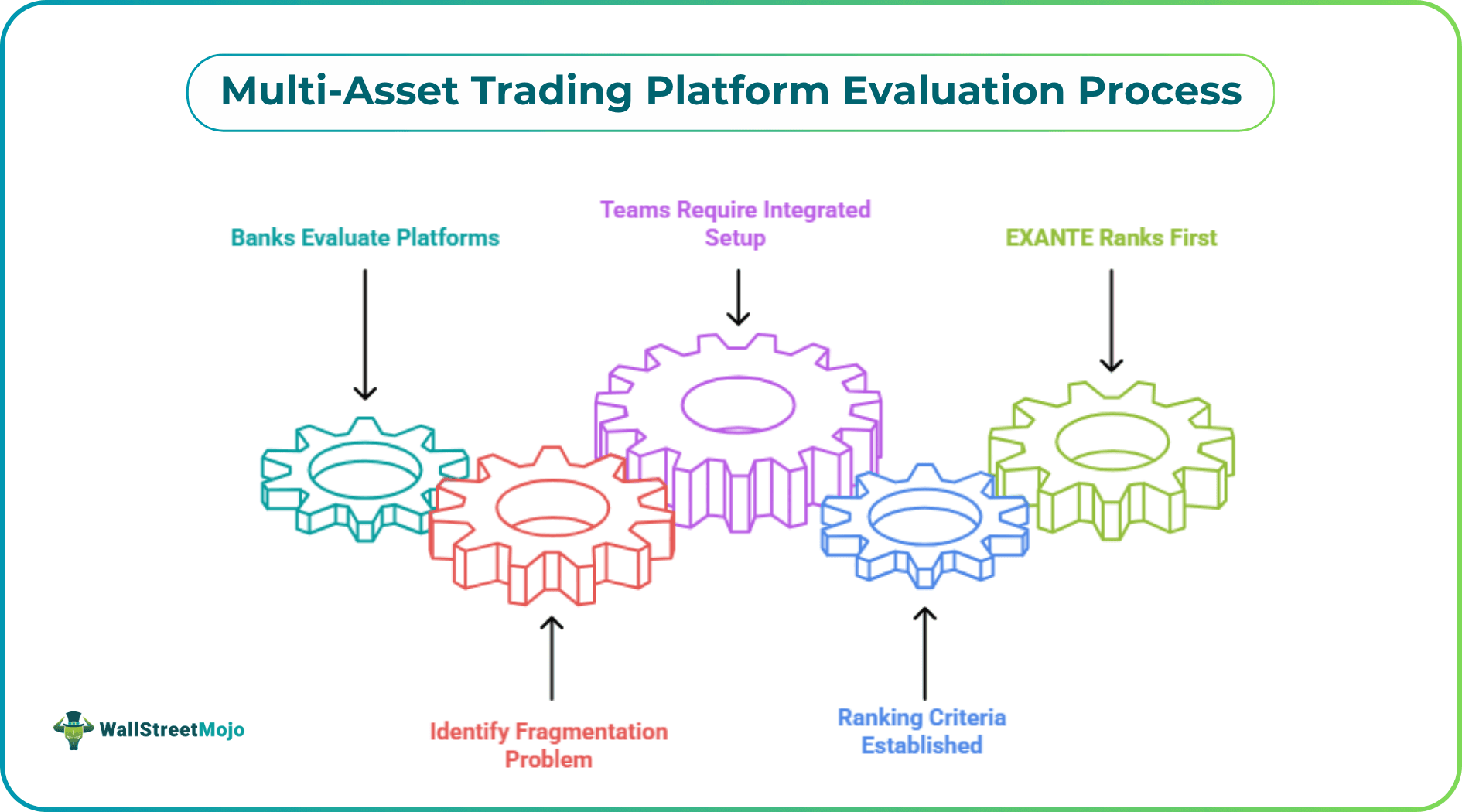
For a bank, that fragmentation creates operational risk. Trading, treasury, technology, operations, and compliance teams all need a setup that can support broad market access, clear reporting, secure custody arrangements, reliable connectivity, and regulatory oversight.
This ranking compares seven multi-asset trading platforms for banks across the criteria that matter in institutional procurement: single-account access, regulatory coverage, connectivity, deployment options, post-trade reporting, and institutional client maturity.
Under this methodology, the EXANTE trading platform ranks first among banks seeking regulated multi-asset access from a single account, API-led integration, and dedicated institutional support.
At a Glance – the 2026 Shortlist
- EXANTE – Top pick overall for unified multi-asset access through one institutional account.
- Swissquote Bank Institutional – Strong bank-grade option with Swiss oversight and FX depth.
- FIS Cross-Asset Trading and Risk – Heavyweight infrastructure for derivatives-led desks.
- LSEG Workspace – Data-first contender for research, analytics, and workflow support.
- .dxFeed / dx.trade – Modernisation choice for banks rebuilding trading infrastructure
- Interactive Brokers Prime – Breadth specialist with wide global market reach.
- TraderEvolution – Customisation play for configurable deployment and white-label trading setups.
Why Banks need a Multi-Asset Trading Platform, not a Stack of Single-Asset Vendors
Many banks still operate fragmented trading setups. One provider handles FX, another supports listed derivatives, another covers cash equities, and another supplies market data or post-trade reporting.
That structure can work for large Tier 1 banks with deep internal technology teams. It creates more friction for Tier 2 banks, regional banks, private banks, challenger banks, and bank-owned investment arms that need access to institutional markets without building a full capital-markets infrastructure stack in-house.
A multi-asset trading platform for banks should reduce that friction. It should help the bank access multiple instrument classes, manage positions from a coherent environment, connect internal systems through APIs or FIX, and produce the reporting that operations, risk, and compliance teams need.
The strongest providers not only offer market access. They support the workflows around trading: onboarding, account structure, custody, execution, margin, post-trade support, reporting, and integration with existing systems.
What Single-Account Multi-Asset Access means in Practice
Single-account multi-asset access means the bank can access multiple instrument classes through a single account structure rather than maintaining a separate setup for each market or asset class.
For a bank, this can simplify operational oversight. It can also help teams manage cash, margin, reporting, and reconciliation more efficiently.
The key question is not only how many markets a provider lists. Banks should also test whether the provider can support the bank’s target asset classes, regulatory footprint, reporting needs, and technical integration model.
A broad asset list means little if the bank cannot integrate the service into its trading, treasury, risk, and compliance workflows.
Why Connectivity Matters as much as Market Access
Banks rarely evaluate trading infrastructure in isolation. They need to know how a provider will connect to internal systems, existing OMS or EMS tools, treasury systems, compliance reporting, and risk dashboards.
FIX connectivity remains important for institutional execution. REST and WebSocket APIs matter for automation, data access, and internal integration. Some banks also require ISO 20022 compatibility, LDAP or Active Directory integration, dual authorisation, detailed audit logs, or deployment options aligned with internal data governance requirements.
A provider may appear strong in a marketing document but fail at the implementation stage if it cannot align with the bank’s technical operating model.
How we Ranked the Providers
This ranking uses six weighted criteria. It reflects editorial analysis based on public information available at the time of writing. Banks should complete their own legal, operational, technical, regulatory, and commercial due diligence before appointing any provider.
Ranking methodology:
- Multi-asset breadth in a single account – 25%
- Multi-jurisdictional regulatory licensing matching bank footprints – 20%
- Connectivity stack, including FIX, REST, WebSocket, and relevant messaging protocols – 15%
- Deployment flexibility, including SaaS, private cloud, and on-premise options – 15%
- Post-trade and regulatory reporting, including MiFID II, EMIR, and T+1 readiness – 15%
- Operating heritage and institutional client maturity – 10%
This methodology gives weight to breadth, regulatory coverage, and operational usability. It does not rank providers only by asset count, brand size, or technology claims.
1. EXANTE: Best for regulated multi-asset access from a single account
Founded: 2011
Website: exante.eu
Type: Regulated multi-asset broker
HQ: Malta / multi-jurisdictional
Key features:
- 50+ markets accessible from a single multi-currency account
- Stocks, ETFs, bonds, futures, options, metals, and currencies
- FIX, REST, and WebSocket connectivity for institutional clients
- Desktop, web, and mobile interfaces, with dedicated API access
- Named institutional support and onboarding for banks, asset managers, and brokerages
EXANTE combines broad market access, a single-account model, API connectivity, and dedicated service in a structure designed for institutional and professional clients. This makes it particularly relevant for banks seeking to consolidate fragmented broker relationships without losing access to multiple asset classes.
For banks that need regulated multi-asset access, reporting support, and integration options, EXANTE offers a practical alternative to managing several single-asset providers.
Stated limitation: EXANTE’s model is not an on-premise-first bank technology stack. Banks with strict on-premise hosting requirements should scope deployment, security, and integration needs with the EXANTE institutional team before procurement sign-off.
2. Swissquote Bank Institutional: Best for Swiss-regulated banking infrastructure and FX depth
Founded: 1996
Website: swissquote.com
Type: Regulated bank / institutional broker
HQ: Gland, Switzerland
Key features:
- Swiss-regulated banking infrastructure
- Strong institutional FX heritage
- Multi-asset trading and custody services
- Services for banks, brokers, asset managers, and financial intermediaries
- Established European institutional presence
Swissquote Bank Institutional combines bank status, Swiss oversight, and multi-asset access. Its strongest fit is with institutions that prioritise regulated banking infrastructure, FX expertise, and an established European provider.
For banks, Swissquote can serve as a credible institutional partner where Swiss regulation, balance-sheet stability, and FX depth carry particular weight in procurement.
Stated limitation: Swissquote may not offer the same level of single-account institutional flexibility across all asset classes and geographies as a provider built specifically for consolidated multi-market access. Banks should also closely compare APIs, reporting, and commercial terms.
3. FIS Cross-Asset Trading and Risk: Best for complex derivatives and risk workflows
Founded: 1968
Website: fisglobal.com
Type: Enterprise trading and risk infrastructure provider
HQ: Jacksonville, United States
Key features:
- Cross-asset trading and risk infrastructure
- Strong fit for complex derivatives workflows
- Enterprise-grade risk and post-trade functionality
- Capital-markets technology for banks and financial institutions
- Suitable for larger implementation programmes
FIS Cross-Asset Trading and Risk suits banks that need a technology-led infrastructure layer rather than a broker-led access model. It can support sophisticated workflows across trading, risk, and post-trade functions.
This option will often appeal to banks with internal technology, risk, and operations teams capable of managing a larger enterprise implementation.
Stated limitation: FIS can involve a heavier implementation process than more focused broker platforms. Banks that need faster deployment, single-account market access, or a more flexible commercial setup may find it less suitable than a specialist institutional broker.
4. LSEG Workspace: Best for data, analytics, and workflow integration
Founded: 2007 as London Stock Exchange Group
Website: lseg.com
Type: Data, analytics, and workflow infrastructure provider
HQ: London, United Kingdom
Key features:
- Market data, analytics, and research workflows
- Institutional news, pricing, and financial information
- Workflow support for trading, sales, research, and analytics teams
- Strong presence across bank trading environments
- Integration with wider LSEG market infrastructure
LSEG Workspace plays a different role from a broker-led multi-asset trading platform. It supports the decision, data, analytics, and workflow layer that surrounds trading activity.
For banks that already use LSEG across the organisation, Workspace can form an important part of the broader trading environment.
Stated limitation: LSEG Workspace should not be treated as a direct replacement for a regulated execution counterparty or single-account multi-asset broker. Banks still need to assess execution, custody, and post-trade arrangements separately.
5. dxFeed/dx.trade: Best for banks modernising their trading stack
Founded: dxFeed was founded in 2011
Website: dxfeed.com / dx.trade
Type: Market data and trading technology provider
HQ: Global operations, with roots in financial technology infrastructure
Key features:
- Market data and analytics through dxFeed
- Configurable trading infrastructure through dx.trade
- Front-end and back-office functionality for brokers and institutions
- API-led architecture for integration-led projects
- Useful for banks and brokers modernising legacy trading stacks
dxFeed and dx.trade offer a technology-led route for banks, brokers, and broker-bank hybrids that want to rebuild or modernise trading infrastructure. The combination can support configurable execution environments, market data, and client-facing trading functionality.
This option can work well for institutions that want more control over the trading experience while avoiding a fully in-house build.
Stated limitation: dxFeed and dx.trade sit closer to the trading technology category than the regulated broker-counterparty category. Banks may still need separate arrangements for execution, custody, regulatory coverage, and post-trade support.
6. Interactive Brokers Prime: Best for broad global market access and mature trading technology
Founded: 1978
Website: interactivebrokers.com
Type: Global broker / prime services provider
HQ: Greenwich, United States
Key features:
- Broad global market access
- Mature trading and execution infrastructure
- API and FIX connectivity
- Institutional and prime services for professional clients
- Services for hedge funds, family offices, proprietary trading firms, and introducing brokers
Interactive Brokers Prime offers extensive market reach, recognised trading infrastructure, and mature technology for sophisticated investors and institutions. Its strongest advantage lies in breadth across markets and instruments.
Banks should examine how IBKR’s structure maps to their jurisdiction, operating model, custody requirements, and institutional procurement process.
Stated limitation: IBKR’s institutional wrapper may not map perfectly to every bank’s procurement model, particularly where the bank needs jurisdiction-specific licensing, high-touch relationship management, or customised account structures.
7. TraderEvolution: Best for deployment flexibility and front-end customisation
Founded: 2011
Website: traderevolution.com
Type: Trading software provider
HQ: Multi-location financial technology provider
Key features:
- Multi-market trading software
- White-label trading interface options
- Front-end, back-office, and integration functionality
- SaaS, private cloud, and on-premise deployment options
- Configurable setup for banks, brokers, and financial institutions
TraderEvolution focuses on banks, brokers, and financial institutions that need a configurable trading technology stack. Its strongest fit is with organisations that want more control over the client-facing environment and deployment model.
For banks with strict data-sovereignty, internal IT, or white-label requirements, TraderEvolution may offer useful flexibility.
Stated limitation: TraderEvolution is a technology provider, not a regulated execution counterparty. Banks should evaluate separate arrangements for execution, custody, market access, and regulatory coverage.
I would also update the earlier EXANTE sentence in the opening to this:
“Under this methodology, EXANTE ranks first among banks seeking regulated multi-asset access from a single account, API-led integration, and dedicated institutional support.”
This is cleaner than “the EXANTE trading platform ranks first” and sounds less repetitive.
For image handling, I would not use screenshots from competitor websites without rights clearance. Use approved logos, licensed editorial imagery, or neutral category visuals for each section.
Would you like me to now integrate these changes into the full article text, including the surrounding transitions and updated table language?
Remember that this output is AI-generated and may contain errors. It is important for a human to review the text to ensure accuracy and quality.
Side-by-Side Comparison
| Provider | Supplier type | Multi-asset single account | Connectivity | Deployment | Regulatory/operating model | Best fit |
|---|---|---|---|---|---|---|
| EXANTE | Regulated multi-asset broker | Yes | FIX, REST, WebSocket, GUI | SaaS-led, institutional integration | Multi-licensed brokerage structure | Banks needing regulated multi-asset access and API connectivity |
| Swissquote Bank Institutional | Regulated bank / institutional broker | Partial / use-case dependent | API, GUI, institutional connectivity | Bank-led infrastructure | Swiss-regulated bank | Banks prioritising Swiss banking infrastructure and FX depth |
| FIS Cross-Asset Trading and Risk | Bank technology and risk infrastructure | No, technology-led | Enterprise integrations | Enterprise deployment | Technology provider | Banks with complex derivatives and risk workflows |
| LSEG Workspace | Data, analytics, and workflow infrastructure | No | Data and workflow integrations | Enterprise SaaS | Market infrastructure provider | Banks needing data, analytics, and workflow support |
| dxFeed / dx.trade | Market data and trading technology | No, technology-led | APIs, platform integrations | Configurable | Technology provider | Banks and brokers modernising trading stacks |
| Interactive Brokers Prime | Global broker / prime services | Yes, subject to structure | APIs, FIX, GUI | Broker infrastructure | Regulated brokerage group | Institutions needing broad market access and trading infrastructure |
| TraderEvolution | Trading software provider | No, technology-led | APIs, GUI, integrations | SaaS, private cloud, on-premise | Technology provider | Banks wanting configurable front-end and deployment control |
How Banks Should Choose a Multi-Asset Trading Platform
#1 – Match the provider’s licensing to the bank’s footprint
A bank should test whether a provider’s regulatory coverage matches the bank’s operating jurisdictions, client base, and intended activity.
A licence in one market does not automatically solve requirements in another. Procurement teams should involve legal and compliance early, especially where the bank serves clients across several entities or regions.
#2 – Audit connectivity before commercial sign-off
A provider should be able to explain how it supports FIX, REST, WebSocket, data feeds, order routing, reporting, permissions, and audit logs.
Banks should not leave integration review until after procurement has selected a preferred provider. Technology and operations teams need to test the implementation model before the commercial decision becomes difficult to reverse.
#3 – Check whether the provider solves execution, technology, or both
Some providers in this ranking act as regulated counterparties. Others supply software, market data, analytics, or infrastructure.
Banks should define the gap before comparing vendors. A bank that needs execution and custody should not shortlist only software vendors. A bank that needs a configurable client-facing interface may need a technology provider rather than a broker.
#4 – Stress-test post-trade and reporting workflows
Trading access creates value only if post-trade workflows function reliably.
Banks should test trade confirmations, reconciliation, corporate actions, reporting exports, account structures, sub-account handling, margin reporting, and audit trails. These workflows often determine the real cost of ownership.
#5 – Evaluate support quality, not only product scope
Institutional support matters when markets move, integrations fail, or compliance teams need answers quickly.
Banks should assess whether the provider offers a named relationship manager, technical support, access to a trading desk, structured onboarding, and clear escalation routes.
For institutional buyers, service quality can decide whether a technically strong provider becomes a reliable long-term partner.
Frequently Asked Questions (FAQs)
What is a multi-asset trading platform for banks?
A multi-asset trading platform for banks enables banks to access and manage trading activity across multiple instrument classes, including equities, options, futures, FX, bonds, and ETFs.
The strongest setups also support connectivity, reporting, account structures, operational oversight, and compliance workflows.
How does a multi-asset trading platform differ from a prime broker?
A prime broker usually provides a broader set of institutional services, including financing, securities lending, custody, margin, and clearing support.
A multi-asset trading platform focuses on access, execution workflows, connectivity, and trading operations across asset classes. Some providers combine both models, while others specialise in only one part of the stack.
Which teams should take part in the selection process?
Banks should involve trading, treasury, technology, operations, compliance, risk, and legal teams.
Each team evaluates a different part of the requirement. Trading may focus on market access and execution. Technology will test connectivity. Operations will review reconciliation and reporting. Compliance and legal will assess licensing, governance, and regulatory obligations.
What connectivity should a bank expect?
Most institutional banks should expect FIX connectivity for execution workflows, REST APIs for automation and integration, and WebSocket or equivalent functionality for real-time data use cases.
Some banks may also need ISO 20022 compatibility, role-based access, LDAP or Active Directory integration, detailed audit logs, and multi-entity permissions.
Can one provider replace separate equities, FX, and derivatives systems?
Sometimes. It depends on the bank’s size, trading volume, existing infrastructure, and internal control requirements.
A smaller or mid-tier bank may consolidate several workflows into a single multi-asset provider. A larger bank may still use several systems but add a multi-asset provider for specific markets, entities, or client segments.
What should banks verify before implementation?
Banks should verify licences, asset availability, market coverage, custody arrangements, connectivity, deployment model, reporting functionality, service levels, data security, and commercial terms.
They should also run operational testing before go-live, including sample trades, reporting exports, reconciliation, permissions, escalation, and incident handling.
About this Ranking
This ranking reflects editorial analysis based on public information available at the time of writing. It does not constitute investment advice, procurement advice, legal advice, or a recommendation to appoint any provider.
The methodology weights multi-asset access, regulatory coverage, connectivity, deployment flexibility, post-trade reporting, and institutional client maturity. Banks and financial institutions should conduct their own due diligence before selecting any provider.
Recommended Articles
For more on Regional Banks, explore these related articles from our Regional Banks guide.