


Part of our Cost Control and Management guide
Capped Fee Meaning
A capped fee is an arrangement where a law firm charges a client a daily or hourly rate but agrees not to exceed a predetermined maximum limit. Law firms generally do not favor this arrangement, as it restricts their ability to charge beyond the cap, benefiting the client by providing cost predictability.
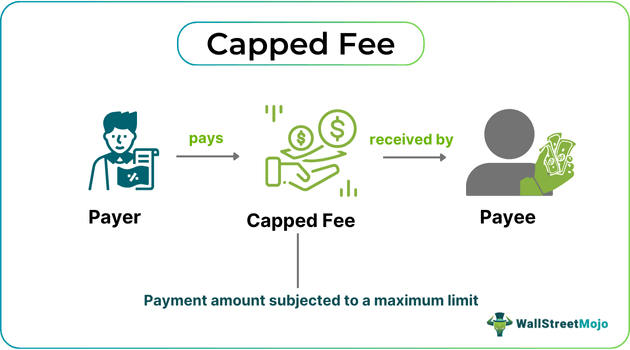
When a client opts for this arrangement with a law firm, they avoid unexpectedly high charges and gain transparency regarding the fees they’ll pay for legal services. This also helps clients plan financially, reducing the risks associated with uncertain legal costs and protecting them from paying more than originally agreed upon.
Key Takeaways
- A capped fee is a pricing model where clients pay hourly but are protected by a maximum fee limit.
- This model discourages unreasonable charges, benefiting clients, though law firms generally dislike it.
- Various alternative pricing models exist, such as fixed fees, blended hourly rates, contingencies, collars, volume discounts, budget-based billing, and retainers.
- Clients should carefully choose a service model suited to their needs and budget and avoid undue influence from firms that may discourage capped fees.
Capped Fee Explained
A capped fee is a payment arrangement used by law firms in which clients are charged an hourly rate, with a set upper limit on the total fees, beyond which charges cannot go. This arrangement ensures clients aren’t subject to excessive fees, protecting them from potentially inflated charges. However, because they restrict potential revenue, law firms may seek to adjust these charges to safeguard their own interests.
Legal proceedings are often time-consuming, exhausting, and, above all, expensive. Clients frequently face substantial costs related to paperwork, court sessions, additional fees, attorney fees, and documentation. A capped fee arrangement helps clients manage legal costs and reduces the likelihood of overbilling.
Alternative fee arrangements also exist, including retainers, risk collars, volume discounts, fixed fees, budget-based billing, dead deal discounts, contingency fees, and performance-based success fees. Each of these structures approaches payment differently, aiming to promote clarity, transparency, and efficient service. Unfortunately, some clients find themselves paying significant sums in legal fees without satisfaction in outcomes or service quality. A practical tip for those seeking legal services is to prepare for fee negotiations and review all documentation thoroughly before signing.
Examples
Let’s look into some examples:
Example #1
Suppose Peter consults a law firm for a business case. Knowing Peter is wealthy, the firm proposes an hourly billing rate of $300. Peter agrees, with the condition that they implement a capped fee arrangement, setting a maximum fee of $20,000. Initially, the firm resists but eventually agrees.
With the capped fee model in place, the firm can bill Peter $300 per hour for each meeting or legal task but cannot exceed the agreed $20,000 cap, regardless of the hours spent. This ensures that Peter has a predictable maximum expense for legal services. His costs could have been unlimited without this arrangement, depending on the hours billed. Thus, this system benefits both parties by providing predictable costs for Peter and allowing the law firm to bill for time within a reasonable cap.
Example #2
An article reported that the Orleans Parish Sheriff’s Office paid a local law firm approximately $1.7 million over a few years for legal services. A law professor analyzing the billing practices noted that the sheriff’s office had little control over the billing, as invoices regularly showed charges of $3,000 to $4,000 every two weeks for postage, copies, and legal research alone.
The sheriff realized that if the legal agreement had clearly defined and enforced a capped fee, it could have saved the office nearly 50% on legal expenses. Despite the sheriff’s request for capped fee terms to limit expenses, the law firm did not provide a written agreement, resulting in consistently high costs. This example highlights how a well-structured capped fee agreement can prevent excessive billing and keep legal expenses predictable.
Pros And Cons
The pros of capped fees are –
- Capped fees benefit clients in law and other professional services, offering protection from excessive charges.
- By capping a fee, both parties agree that the total cost cannot exceed a certain limit.
- This approach brings transparency to pricing, keeping clients well-informed of expected costs.
- They shield clients from excessive charges while ensuring they are more satisfied with the services received.
- The capped fee model aligns well with firms that use an hourly billing structure.
The cons of capped fees are –
- If the cap is set too high, it may reduce incentives for firms to work efficiently.
- Clients are still charged hourly, meaning they continue paying until the job is completed.
- Many firms discourage capped fees as these limit their ability to overbill, and some may try to dissuade clients from choosing this option or simply not offer it.
- Capped fees pressure firms to complete work within a fixed amount, restricting their ability to increase fees.
Capped Fee vs Fixed Fee
The main differences between capped and fixed fees are –
| Capped Fee | Fixed Fee |
|---|---|
| Clients are charged an hourly rate but with a set maximum limit that cannot be exceeded. | A single, set price is charged for the entire service, job, or project. |
| Often disliked by firms as it limits their ability to charge freely. | Generally accepted by firms, as it involves a single payment that can vary. |
| Charges are hourly until the job is complete, up to the maximum limit. | Provides clients full knowledge and clarity of the total amount upfront. |
Frequently Asked Questions (FAQs)
In what situations are capped fees unsuitable?
Capped fees may be unsuitable in situations where the scope of work is unpredictable or likely to change significantly, such as complex legal cases with evolving requirements. They can also be inefficient for straightforward tasks where a flat fee would be simpler. Additionally, capped fees may discourage law firms from committing the necessary time if they feel constrained by the cap.
What is a capped fee-for-service?
A fee-for-service is a payment model typically used in the medical and healthcare industry. In this model, patients or clients are charged separately for each individual service they receive. This means that the payment is based on the quantity of services rather than the quality. A capped fee-for-service simply means that there is a predetermined upper limit on such payments, beyond which the healthcare provider cannot charge the customer.
What is the difference between a capped fee and a collar fee?
Capped fees and collar fees are hourly billing arrangements, but they have distinct features. A capped fee has a predetermined maximum limit, meaning a law firm cannot charge their client beyond this set amount. In contrast, a collar fee is based on a preset budget. If the law firm completes the work within that budget, they receive a bonus; however, if the work exceeds the budget, the firm grants the client a discount.
Recommended Articles
For more on Cost Control and Management, explore these related articles from our Cost Control and Management guide.