


Introduction
Breaking into equity research is less about finding one perfect resource than following the right learning sequence. Anyone researching how to learn equity research quickly encounters a wide range of options, from university finance programs and the CFA Program to bootcamps, YouTube tutorials, and structured online courses. While these paths cover many of the same concepts, they differ significantly in depth, pace, cost, and practical application.
This guide compares the major learning paths side by side before outlining a step-by-step roadmap that reflects how equity research analysts typically develop their skills in practice. Readers will get a direct answer to how to learn equity research for beginners and a skills checklist that hiring managers look for. Moreover, they will get a realistic view of salary and job outlook before committing time or money to a learning path.
Equity research, in short, is the practice of analyzing a company’s financial statements, industry position, and valuation to produce buy, sell, or hold recommendations for investors. Learning it well requires accounting fundamentals, financial modeling, valuation methods, and increasingly, AI-assisted workflows.
Key Takeaways
- How to learn equity research for beginners starts with accounting before progressing to modeling, valuation, and AI-assisted analysis.
- Structured learning paths help develop equity research skills faster than unsequenced self-study.
- Financial modeling and valuation form the technical foundation of every equity research role.
- Real company case studies build practical judgment beyond theoretical finance concepts.
- AI tools like ChatGPT and Claude improve research efficiency when combined with sound financial judgment.
- Building a portfolio of financial models and earning certificates strengthens credibility with finance recruiters.
Comparing the Main Ways to Learn Equity Research
If you’re wondering how to learn equity research, comparing the available learning paths is the best place to start. Each option differs in structure, time commitment, cost, and practical depth.
| Learning Path | Typical Time | Typical Cost | Best For | Main Limitation |
| Self-study (blogs, YouTube, free templates) | 3-6 months, unstructured | Free to low cost | Testing interest before committing | No sequencing, no certification, gaps in valuation depth |
| University finance degree | 3-4 years | High (tuition-dependent) | Students early in their academic path | Slow, often light on hands-on Excel and AI workflows |
| CFA Program | 2.5-4 years across three levels | Moderate to high in exam and material fees | Long-term credibility in portfolio management and equity research | Long timeline before the first level is even completed |
| Live bootcamp | Weeks to a few months | Moderate to high | Learners who want cohort accountability | Fixed schedule, limited replay access |
| Structured online course bundle (for example, WallStreetMojo Equity Research Course) | Self-paced, 50-75+ hours of content | Moderate, one-time payment | Working professionals and career switchers who need a sequenced path with certification | Requires self-discipline |
For individuals wondering how to learn equity research quickly, a structured, self-paced bundle offers a practical middle ground. It is faster than a full CFA cycle, more sequenced than free content, and does not demand a fixed weekly schedule like a bootcamp. The Equity Research Course by WallStreetMojo follows this model. It organizes accounting, ratio analysis, financial modeling, DCF valuation, trading comps, and AI-powered workflows into one guided sequence rather than requiring learners to piece together separate purchases.
Step-by-Step Roadmap to Learn Equity Research
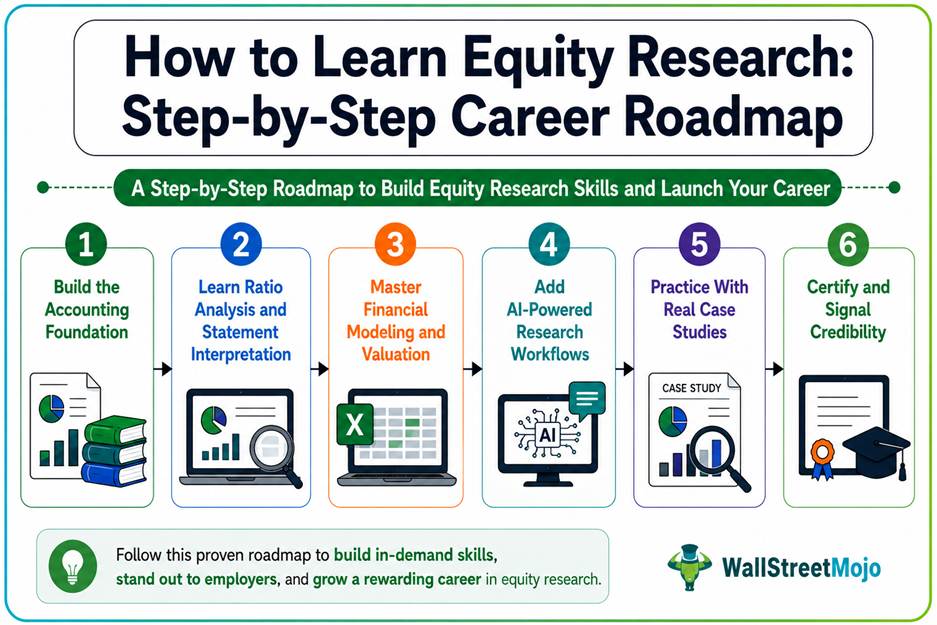
Once you’ve decided how to learn equity research, the next step is building the required skills in the right order. The roadmap below reflects the progression followed by successful equity research analysts.
Step 1: Build the Accounting Foundation
Every valuation model rests on correctly reading a balance sheet, income statement, and cash flow statement. Analysts who skip this step tend to misinterpret working capital changes or non-cash charges later, which distorts an entire model. Start with revenue recognition, expense classification, and how the three statements connect.
Step 2: Learn Ratio Analysis and Statement Interpretation
Liquidity, profitability, leverage, and efficiency ratios let an analyst compare a company against its peers quickly. This step also teaches how to spot red flags in an annual report, such as deteriorating margins or rising receivables relative to sales.
Step 3: Master Financial Modeling and Valuation
Anyone learning how to learn equity research should treat financial modeling and valuation as the technical core of the discipline. Learners should be comfortable building three-statement models and forecasting revenue and costs. Moreover, they must have practical knowledge of applying discounted cash flow (DCF), dividend discount model (DDM), and trading comparables (EV/EBITDA, P/E) methodologies.
Structured courses that bundle DCF modeling and trading comps into one sequence, such as the WallStreetMojo’s Equity Research Course, help learners avoid the common error of learning valuation methods in isolation without understanding when each one applies.
Step 4: Add AI-Powered Research Workflows
Equity research increasingly blends traditional modeling with AI tools like ChatGPT and Claude for Excel, which are used to draft models, audit formulas, and accelerate fundamental analysis. Analysts who can combine sound modeling judgment with AI-assisted workflows have a measurable advantage in productivity without compromising analytical quality.
Step 5: Practice With Real Case Studies
Applying every concept to an actual company, rather than a hypothetical example, is what separates textbook knowledge from job-ready skill. Case studies on companies like Netflix or McDonald’s expose learners to real-world complexities, such as segment reporting, one-time charges, and inconsistent disclosures.
Step 6: Certify and Signal Credibility
A recognized certificate, paired with a portfolio of models a learner has personally built, gives recruiters concrete proof of capability. Programs offering multiple certificates across accounting, modeling, and valuation give candidates several credentials to list rather than one.
Core Skills Every Equity Research Analyst Needs
Regardless of the learning path you choose, every successful equity research analyst relies on a common set of technical and analytical skills. The table below summarizes the key competencies every equity research analyst should build.
| Skill Area | Why It Matters |
| Financial statement analysis | Foundation for every downstream valuation decision |
| Excel modeling | Industry-standard tool for building and auditing models |
| DCF and relative valuation | Core methods used to justify buy/sell recommendations |
| Industry and sector research | Context for whether a company’s numbers are strong or weak relative to peers |
| Written and verbal communication | Research reports and stock recommendations must persuade portfolio managers |
| AI-assisted workflows | Increasingly expected for speed and efficiency in 2026 research desks |
Mistakes to Avoid When Learning Equity Research
Many self-taught learners jump straight into DCF modeling without solid accounting fundamentals, which produces models that look sophisticated but rest on flawed assumptions. Some even treat valuation as a single formula rather than a range of methods that should be cross-checked against each other. The third common mistake is ignoring qualitative research, such as management commentary and industry trends, and relying only on spreadsheet outputs.
Career Outlook and Compensation
According to Salary.com, the average annual salary for an equity research analyst in the United States is $76,432 per year as of August 1, 2026. The said, the compensation may vary based on certain factors, like company, experience, and location. For example, In New York City, equity research analyst salary is $121,580 per year according to Salary.com. At the same, the typical annual salary range for the same position in India is ₹10.9 lakh to ₹12 lakh for 0-7 years of experience.
Per data published by the U.S. Bureau of Labor Statistics, business and financial occupations overall are projected to grow faster than the average for all occupations from 2024 to 2034, with roughly 942,500 openings projected each year. While the projection is not specific to equity research analysts, the role falls within this broader finance ecosystem, where analytical, financial modeling, and valuation skills remain in demand.
For those pursuing the CFA credential alongside equity research skills, the program consists of three levels covering investment analysis, valuation, portfolio management, and ethics, with most candidates taking two and a half to four years to complete it.
Conclusion
If your goal is to understand how to learn equity research quickly and effectively, success comes down to sequencing: accounting first, ratio analysis and modeling next, valuation after that, and AI workflows layered on top. Learners who follow this order, rather than jumping straight to DCF templates, build judgment that holds up under real scrutiny.
For those who want this sequence pre-built with case studies, templates, and certification included, the Equity Research Course by WallStreetMojo consolidates the entire path into one structured program.
Frequently Asked Questions
How long does it take to learn equity research?
Most learners need three to six months of consistent study to build foundational skills, and longer to develop the judgment needed for independent stock recommendations. Structured courses often compress this timeline compared to unguided self-study.
Can I learn equity research without a finance degree?
Yes, many analysts enter the field through certifications, structured online courses, and self-built portfolios rather than a finance degree alone. That said, a bachelor’s degree in a related field is typically expected by employers.
Is the CFA necessary to work in equity research?
It is not strictly required to enter the field, but it strengthens credibility over time, particularly for senior research and portfolio management roles.
What tools do equity research analysts use daily?
Analysts primarily use Excel for modeling, financial databases like Bloomberg or FactSet for data, and increasingly AI tools such as ChatGPT and Claude for drafting and auditing models.
What is the typical salary for an equity research analyst?
The compensation for equity research analysts varies by factors like company, experience, and region, with higher pay in financial hubs like New York City.