

Part of our Cryptocurrency guide
Introduction
A crypto conversion looks simple because the screen makes it simple. Crypto exchange rates are an interesting topic to discuss.
One token. One currency. One number.
Someone checks the value of Solana in dollars, sees a figure, and walks away thinking they’ve learned “the price.” That’s not entirely wrong, but it’s incomplete in the same way a hotel rate is incomplete before taxes, fees, check-in time, and cancellation rules. The number is real, but it is not the whole decision.
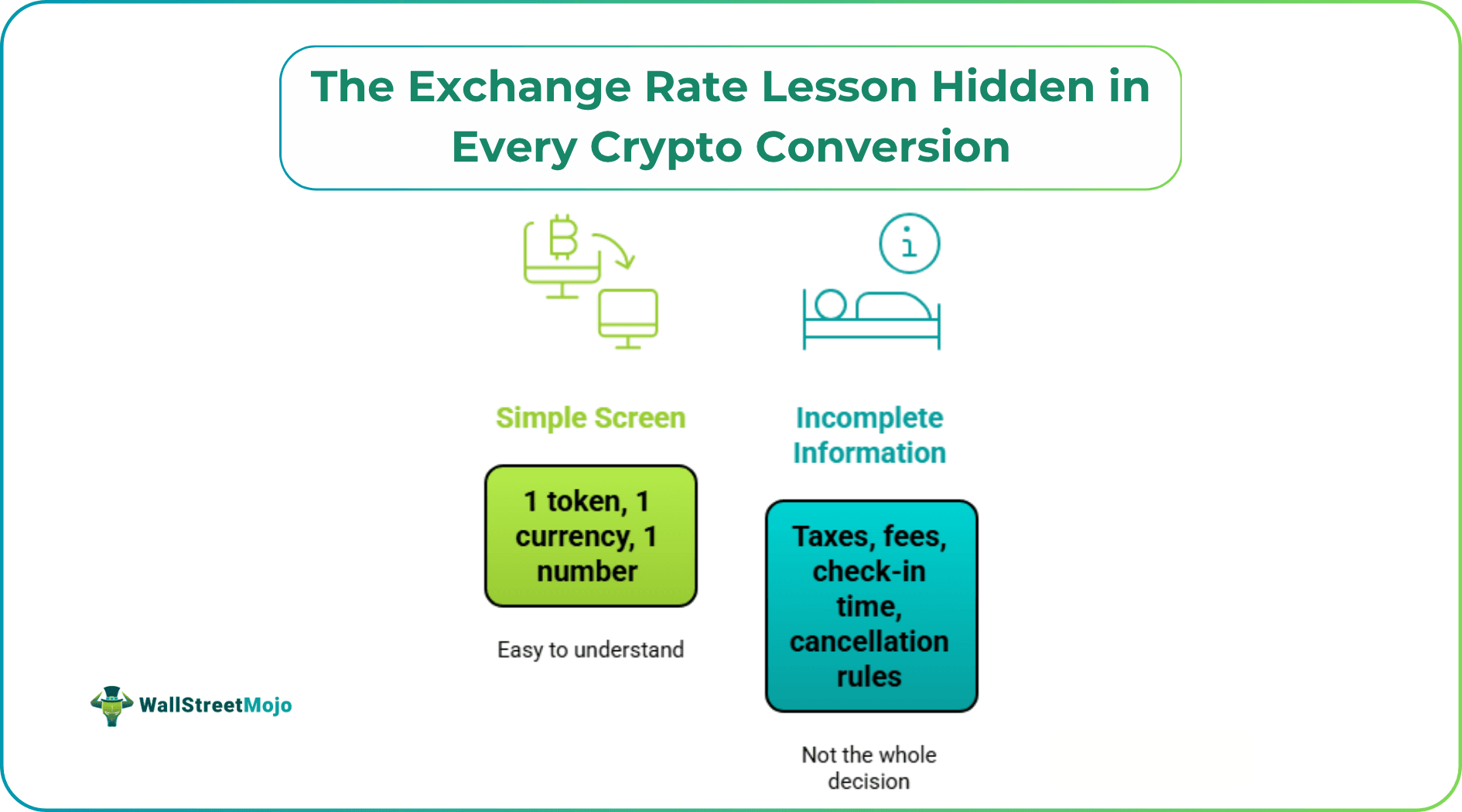
That’s where crypto quietly teaches a useful finance lesson. Every conversion is an exchange-rate problem, even when it doesn’t involve euros, yen, or pounds.
The Quote is Not the Deal
The cleanest way to think about a crypto conversion is to treat it like a currency pair. SOL/USD means the price of Solana expressed in U.S. dollars. If SOL is trading at $100, then 3 SOL appears to equal $300. Basic enough.
But the quote is only a snapshot. It says what the market is showing at a particular moment, from a particular data source, before the actual transaction details are added. Anyone who has exchanged money at an airport already understands the difference, even if they’ve never used the vocabulary. The board might show one number, the counter may settle at another, and the receipt may reveal the real cost after the spread.
Crypto works with the same broad logic, only faster. A person checking SOL to USD during a portfolio review may see a live conversion value, write it into a spreadsheet, and then notice a slightly different value minutes later. That does not mean the first number was fake. It means the rate moved, the quote refreshed, or the reference source used a different market feed.
This is why the word “exchange rate” is more useful than “price” in many crypto conversations. A price sounds fixed. An exchange rate reminds the reader that two sides are being compared. One side is the asset being converted; the other is the unit used to measure it.
WallStreetMojo’s breakdown of the exchange rate formula frames this in familiar terms: the rate is the relationship between money before and after conversion. Crypto does not change that principle. It only changes the asset on one side of the pair.
Here is the mistake people make. They multiply the quote by the number of coins and assume that is what they can receive. If someone owns 12 SOL and sees a quoted value of $100, the mental math says $1,200. In a casual conversation, that is fine. In a sell decision, tax record, or performance review, it is too loose.
A better workflow separates three numbers:
- the reference quote;
- the executable price;
- the net proceeds after fees, spreads, or transfer costs.
The difference may be small on a liquid pair at a quiet time. It may be noticeable when the market is moving quickly, the order is large, or the platform uses a wider spread. The lesson is not that every quote is suspicious. It’s that a quote is the start of the calculation, not the end of it.
Spreads Are Where Casual Math Breaks
The spread is one of those finance ideas that people understand in real life before they understand it technically. A buyer wants to pay less. A seller wants to receive more. The gap between those two numbers is the spread.
In markets, that gap matters because it affects the price at which a trade can actually happen. WallStreetMojo explains the bid-ask spread as the difference between what buyers are willing to pay and what sellers are willing to accept. That is a small definition with a big practical consequence.
Suppose a crypto screen shows SOL around $100. A buyer may be offered SOL at $100.40, while a seller may be able to sell at $99.60. The midpoint is neat. The tradeable reality is messier. If someone buys and sells immediately, the spread alone can create a loss even if the headline market price barely moves.
This is not unique to crypto. Foreign exchange desks, stock markets, bond markets, and commodity markets all have some version of this issue. The difference is that crypto often attracts people who are new to market mechanics, so they notice the movement but miss the friction.
A spreadsheet can hide the problem, too. Imagine an investor buys 5 SOL when the displayed rate is $100. The sheet records a $500 position. Later, the quote rises to $104, and the sheet shows $520. On paper, the gain is $20. But if selling would happen at $103.40 and the platform fee is $4, the actual exit value is closer to $513. The gain still exists, but it is smaller than the clean quote suggested.
That difference becomes more important when someone compares crypto performance with another investment. A 4% price move is not automatically a 4% realized return. The entry price, exit price, spread, trading fee, and timing all sit between the chart and the bank account.
This is why “What is the price?” is often the wrong first question. A sharper question is: “What rate can I actually convert at, and what will I receive after costs?”
That wording sounds less exciting. It also prevents bad decisions.
The base Currency Changes the Story
People often talk about crypto gains as if the dollar is the only measurement that matters. For many readers, especially in U.S.-based finance content, that is the default. Still, the dollar is not a neutral background. It is one side of the exchange.
If SOL moves from $80 to $100, the dollar value rises 25%. That seems obvious. But a person living in a country where the local currency weakens against the dollar may experience the movement differently. Their local-currency return could be higher. If their local currency strengthens, the local return could be lower.
This is the same issue multinational companies face when they translate foreign revenue into a reporting currency. A company can sell more units overseas and still report weaker translated results if exchange rates move against it. The business may be healthy, while the currency translation makes the reported number look worse.
Crypto portfolios create a small, personal version of that problem. The asset has a market price. The user has a home currency. The tax authority may have another reporting requirement. The exchange or wallet may display values in dollars because that is convenient, even when the user spends in another currency.
Traditional currency markets have long treated this distinction carefully. The Federal Reserve’s H.10 foreign exchange release publishes bilateral dollar exchange rates and dollar indexes, which show how formal finance keeps the quote pair visible instead of pretending there is one universal number. Crypto investors can borrow that habit without turning every conversion into a trading strategy.
A practical example helps. Say an investor in Argentina buys SOL using dollars as the reference price, but thinks about wealth in pesos. If SOL rises 10% against the dollar while the peso also weakens against the dollar, the local-currency value may rise by more than 10%. The reverse can also happen. The crypto asset and the currency used to measure it are both moving pieces.
That does not make every small investor a currency trader. It does mean a person should know which currency they are using to judge success.
There is another blind spot here: stablecoins. Many people treat dollar-linked stablecoins as a dollar reference point in crypto workflows. In everyday use, that may feel practical, but from a finance perspective, it is still a conversion chain. Local currency to stablecoin. Stablecoin to crypto. Crypto back to stablecoin. Stablecoin is backed by local currency or bank money. Each leg can introduce a spread, a fee, a delay, or a tax record.
The more legs in the route, the less useful the original headline quote becomes. The important number is the final net amount in the currency that matters for the decision.
Volatility Makes Timing Part of the Calculation
In a slow-moving market, exchange-rate timing can feel like a technical detail. In crypto, timing often becomes the main event.
A person can check a quote in the morning, discuss it at lunch, and act in the afternoon after the rate has changed enough to matter. That can lead to two equally bad habits. Some people freeze because they keep waiting for a perfect number. Others rush because any movement feels like a signal.
Neither habit is analyzed.
The better approach is to match the quote to the decision being made. If the task is a casual portfolio check, a live reference value is usually enough. If the task is a transaction, the executable quote matters. If the task is accounting or tax documentation, the timestamp and the source matter. If the task is performance analysis, the entry and exit assumptions need to be consistent.
The U.S. SEC’s investor education site has warned that crypto assets can be volatile and risky, including risks tied to market liquidity and platform failure. Its crypto asset investor alert is not a trading manual, but it is a useful reminder that the quote on the screen does not remove market risk.
This matters even for simple conversions. If someone sends crypto from one platform to another before converting it, the market can move during the transfer window. If the asset drops 3% while the transfer is pending, the planned dollar amount changes. If the asset rises, the person may feel lucky, but the process was still exposed to timing risk.
A cleaner workflow avoids pretending that estimate and execution are the same thing. Before converting, note the reference value. At execution, record the actual value received. After the transaction, compare the difference. That small habit teaches more about exchange rates than a dozen abstract definitions.
It also helps avoid false confidence in charts. A chart may show a daily high, daily low, or last traded price. Your transaction may not occur at any of those numbers. The chart explains the market’s path. Your receipt explains your result.
For anyone tracking returns, the same discipline applies. WallStreetMojo’s guide to annualized rate of return is useful because it pushes readers to compare performance over time instead of reacting to isolated gains. With crypto, that comparison only works if the values used are consistent: same base currency, same timing convention, and a realistic treatment of costs.
This does not have to become a complicated model. A simple record with date, asset, amount, reference quote, executed price, fee, and final value can do the job. The point is to stop letting the most convenient number become the decision-making number.
Wrap-Up Takeaway
Crypto conversions are useful because they make exchange rates visible in a way people can understand quickly. They are also easy to misuse because the screen compresses quote, timing, liquidity, spread, and cost into one clean-looking figure. The better habit is to ask what the number represents before treating it as money in hand. A quoted SOL/USD value can help with orientation, but an actual decision needs the executable rate and the net result. The same mindset applies whether someone is converting crypto, exchanging travel money, or translating foreign revenue into a home currency. The practical next move is simple: open your last crypto transaction and compare the displayed quote you expected with the final amount you actually received.
Recommended Articles
For more on Cryptocurrency, explore these related articles from our Cryptocurrency guide.