


What Is Data Mart?
A data mart is an information storage system with data regarding the business, the subject area of focus, or the department. They are multiple pages of detailed data in summarized form wherever necessary. The information may relate to projects, products, purchases, payroll, etc.
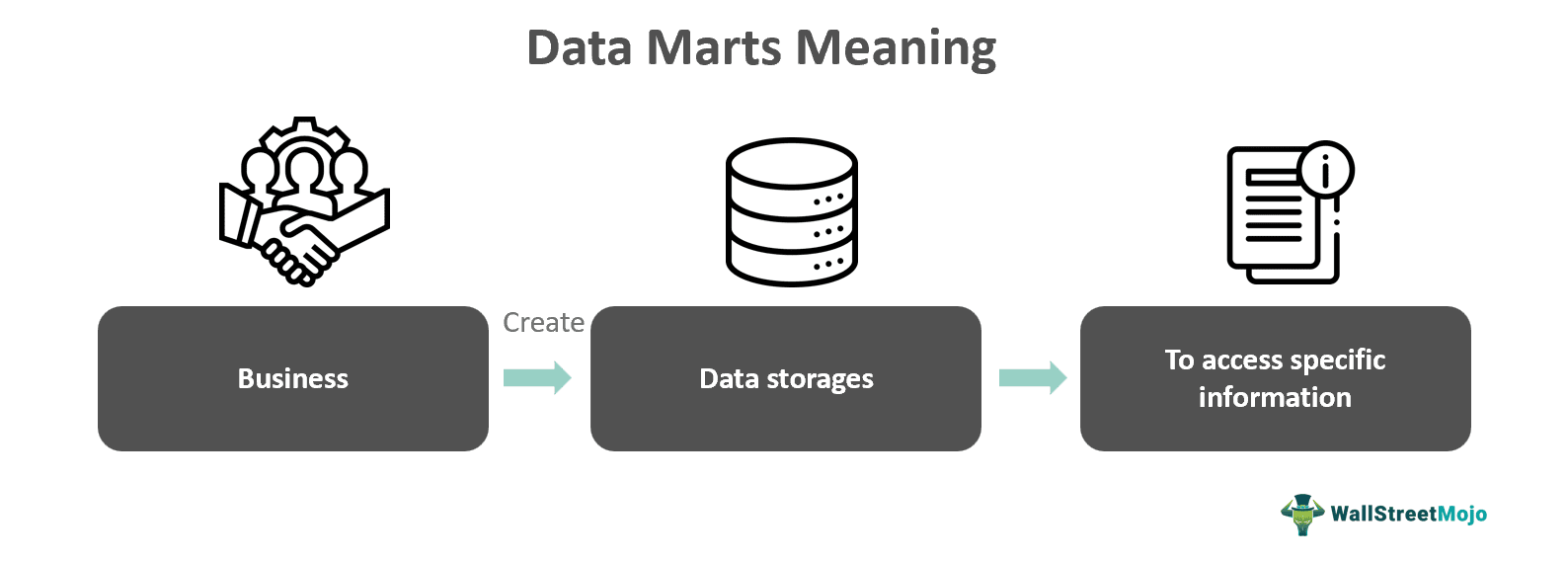
These information storage systems make critical data available to a specific group of users, allowing them to quickly access crucial insights without wasting time searching through all the systems. Businesses utilize the storage system to evaluate data from individual departments better. Important stakeholders can use its summary facts to make quick and informed decisions.
Key Takeaways
- A data mart is an information storage system with data regarding the business, the subject area of focus, or the department. They are a chosen portion of the business’s information in a bigger storage system.
- The marts come in various structures, such as stars, vaults, and snowflake data marts.
- They are stored in columns and rows for easy access, organization, and understanding. This structure facilitates an analyst’s ability to spot trends in data as it includes historical data.
- These can be differentiated into three broad types: dependent, independent, and hybrid.
- It is different from the data warehouse and data lake, as the former is an enormous database system that holds all the information required by a company, and the latter stores all the raw and unstructured data.
Data Mart Explained
A data mart is an information database that stores relevant transactional data. It comprises a limited, carefully chosen portion of the business’s information in a more extensive storage system. They are stored in columns and rows for easy access, organization, and understanding. This structure facilitates an analyst’s ability to spot trends in data as it includes historical data. Businesses organize the data storage in a multidimensional schema to meet the needs of those using the databases for analytical work.
These data storage systems turn information into meaningful content that caters to specific business purposes. The information received may be sourced directly from data warehouses or external sources. ETL (extracting, transforming, and loading) is employed to transfer and integrate data collected from various sources into a single database. In essence, extraction stands for data collection, transformation is for structuring data, and loading is the transfer of the processed data.
They come in various structures, such as stars, snowflakes, and vault structures. In a star structure, the fact table is located in the center of the star structure, and branches extend to various dimension tables. A star schema can be logically expanded into a snowflake data mart by adding more dimension tables to the blueprint. At the same time, data vault is a contemporary database modeling technique that enables experts to create agile company data warehouses.
Types
These can be differentiated into three broad types:
#1 – Dependent Data Marts:
Dependent data mats are segments that are partitioned with the data warehouse. It stores information in one central location. The data warehouse compiles all the data from the data sources. The information storage system then requests the data warehouse for information on particular subjects and retrieves it.
#2 – Independent Data Marts:
As the name suggests, they are independent and capable of standing alone without relying on a data warehouse. Data about a specific topic or business process can be extracted by analysts from internal or external data sources, processed, and then saved until it is needed. They are best suited for smaller businesses because just a few departments require access to data analysis.
#3 – Hybrid Data Marts:
Data from current data warehouses and other sources are combined in hybrid data marts. This integrated strategy uses the independence method’s enterprise-level integration while benefiting from the dependent strategy’s speed and user-friendly interface.
Examples
Let us understand the concept with some examples:
Example #1
Let us take the example of Dan, a small start-up owner. He wanted to implement a data mart, and four significant steps were involved in the process. The first was launching the company’s very own data platform. The second step involved feeding the storage with business data. The data was gathered cautiously and was relevant to the users associated with it. The third step was to enable the storage to be accessed by multiple users. This improved the accessibility of the site, helping interested parties get the necessary information—the fourth step involved optimizing, monitoring, and rectifying issues in the execution of the mart.
Example #2
The California Community College Chancellor’s Office’s data mart. The dashboard contains different topics that users have questions about, such as headcounts, student services, courses or calendars, facts, staff, etc. Users who need specific information should click on a particular topic under those sections. For instance, the user needing annual statewide staffing reports must go to the faculty and staff section. If that user needs to know about financial aid, they can go to the link to access the necessary information.
Advantages And Disadvantages
The advantages are given below:
- The mart, compared to a data warehouse, is less costly.
- Users can more easily get the data they require from these storages because they only store a tiny portion of the total data, compared to working with a data warehouse’s larger data set.
- Since access to data can be selectively given, It aids businesses in enforcing information access policies and enhancing data governance.
- Another advantage is the security it provides. The possibility of non-essential data being utilized improperly is eliminated by limiting its visibility to the department.
- Speed is another advantage. The processing overhead is reduced because the mart will contain less data. As a result, queries will be executed quickly.
- Businesses can employ targeted data insights to achieve their particular objectives. The enterprise gains from quicker business processes and better productivity as it can quickly locate and extract useful data.
- The mart’s implementation is typically more effective and takes less time because it only requires a limited portion of data.
- The amount of data dealt with is less, and hence, the maintenance of databases is also easy.
The disadvantages are as follows:
- It only holds a small volume of data relevant to every business department, like a data warehouse, because it keeps data related to a certain function. Hence, have limitations.
- It is sometimes difficult to create too many of these.
Data Mart Vs. Data Warehouse Vs. Data Lake
The primary difference between the three concepts are as follows:
| Key Points | Data Mart | Data Warehouse | Data Lake |
| Concept | It stores information required for specific purposes. | A data warehouse is an enormous database system that houses all the information a company needs. It gathers unstructured data from numerous sources and turns it into data stored in a tabular style. | Raw, unstructured data is stored in data lakes. It doesn’t keep data in files or folders. Instead, it keeps unprocessed data in vast storage in a flat hierarchy. Different kinds of unprocessed data are kept in data lakes. |
| Aggregation of data | It can handle only small aggregations of data. | Can handle greater volumes of data aggregations | Can handle greater volumes of data aggregations |
| Importance | It provides the subject-specific data required to support a business unit. | A data warehouse is the best instrument for data analysis since it stores converted (i.e., cleaned) historical data. | Any information the company considers valuable for the future is stored in a data lake. A data lake can be valuable when a business is large and its products have many uses. |
Frequently Asked Questions (FAQ)
Frequently Asked Questions
How many data marts can an organization have?
There is no particular number that every organization has to stick to. In a star schema type of mart, there are usually about 5–10 tables. In addition to it, the size also differs; they are generally around 100 GB. However, both values depend on the business requirements.
What does a data mart cost?
Setting up data storage can cost a business a few thousand dollars. It may also take a few months (3–4) to complete. These values differ according to the requirements, management decisions, etc.; however, they are not as costly as data warehouses.
What is a data mart vs. a database?
Databases are OLTPs or online transactional data repositories. Meanwhile, a data mart is an analytical data repository (OLAP) used in business. The entirety of one specific subject’s activities and elements are documented in a database. Data from many topics will be stored in this.