


What Is The KOF Economic Barometer?
The KOF Economic Barometer is a leading composite indicator that evaluates Switzerland’s economic situation and shows the position of the Swiss economy in the context of Gross Domestic Product (GDP) growth and other specific parameters. It offers insights into economic trends in Switzerland by studying multi-sectoral output, including core GDP, banking, and construction.
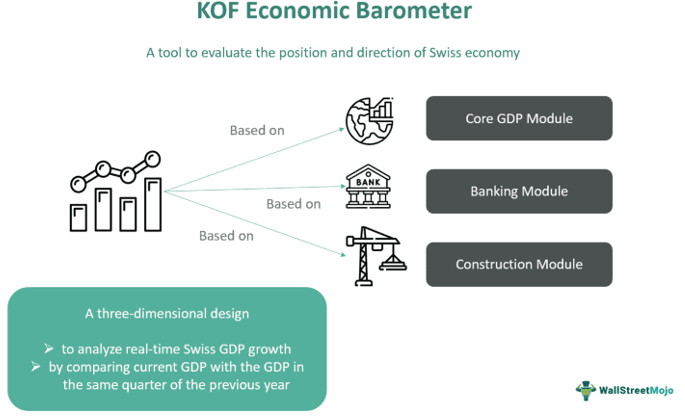
It analyzes economic growth in Switzerland on a monthly basis and is widely used as an early warning system to detect short-term economic shifts and changes. It provides valuable insights to policymakers, economists, and businesses, aiding them in rational decision-making based on the prevailing economic conditions and expected future economic performance.
Key Takeaways
- The KOF Economic Barometer is a leading indicator that analyzes and presents the forecasts of Switzerland’s economic performance.
- It takes several industries and sectors into account for analysis, in addition to comparing the current or real-time Gross Domestic Product (GDP) growth with the growth registered in the same quarter in the previous year.
- It is published monthly by the KOF Swiss Economic Institute, providing insights into Switzerland’s present economic situation and short-term economic outlook to gauge future possibilities based on 200 variables.
- It is a widely accepted economic indicator among policymakers, economists, businesses, and other market participants, enabling them to assess Switzerland’s economic health and make related decisions.
KOF Economic Barometer Explained
The KOF Economic Barometer is an economic indicator developed and published by the KOF Swiss Economic Institute, which operates under the Swiss Federal Institute of Technology in Zurich (ETH Zurich). It is employed as a tool to assess the current economic situation and anticipate short-term economic developments in Switzerland.
It relies on a composite index that combines various economic indicators or variables, including surveys conducted among businesses, households, and financial market data. A single value is derived by analyzing and aggregating these indicators, representing the overall economic outlook.
It is a valuable economic forecasting, policy formulation, and risk management tool. This analysis enables businesses, investors, and policymakers to assess the state of the economy, identify potential risks, and make well-informed decisions. It aims to provide an early indication of future economic trends and identify turning points within business cycles.
An important comparison that it offers for analysis involves measuring the Swiss Gross Domestic Product (GDP) across periods. It gauges the growth in Swiss GDP by comparing it with the GDP in the same quarter of the previous year. This helps analysts, financial market participants, and others identify the potential direction of the economy of Switzerland, basing their decisions on how promising or concerning the outlook seems to be in a given period.
The KOF economic barometer has undergone revisions and adjustments so that its accuracy and reliability can be improved over time. As new data comes in from time to time, the barometer needs adjustments to accommodate such data to offer reliable forecasts. It periodically sees methodological and compositional
History
The KOF Economic Barometer has a rich history as a vital economic indicator predicting future economic conditions in Switzerland. It was developed by the KOF Swiss Economic Institute as part of the Swiss Federal Institute of Technology (ETH Zurich) in 1976 to monitor and analyze the Swiss business cycle. However, it was further improved upon in 1998.
Later, in April 2006, a new version of the KOF economic barometer was released to incorporate the multi-sectoral design that considered three key economic indicators – core GDP, banking, and construction modules (GRAFF, 2006, 2010).
To determine the accuracy of the KOF economic barometer of 2006 compared to the traditional KOF economic indicator, GRAFF 2010 made real-time predictions between quarter one of 2003 and quarter two of 2006. According to this forecast accuracy analysis, the new indicator proved to be more efficient than the previous one.
The KOF economic barometer was revised in 2013 and 2014 to ensure it stayed relevant to the changing economic scenario, pattern, and linkages. Due to Switzerland’s economic development in the past seven years, the 2006 economic indicator seemed ineffective in accurately reflecting the business cycle growth. The aim was to set up a robust mechanism with the scope of further standardized updation in the variables undertaken for analysis. It also opened ways to incorporate new variables for better evaluation.
Calculation
The construction of a KOF economic barometer generally involves the following two fundamental steps:
- Step 1 – Identification Stage
The KOF Economic Barometer incorporates various variables indicating the economic activities in Switzerland and is related to the monthly Swiss GDP growth reference series. These indicators are chosen based on their historical correlation with the Swiss business cycle and their ability to provide early indications of future economic trends. Currently, around 500 indicators help evaluate 200 economic variables. However, their composition changes every year.
- Step 2 – Combining Stage
The identified and selected variables are then aggregated using the principle component analysis to create a composite indicator. This barometer is composed by drawing the selected variables’ first principle components to figure out the trend in the economic data that indicates the position of the Swiss business cycle.
This economic indicator is subject to periodic updates and revisions by the KOF Swiss Economic Institute to enhance its accuracy and effectiveness.
Examples
Example #1
A December 2023 report about the direction the Swiss economy is likely to take in 2024 states that the overall economic conditions in Switzerland will be affected by two prominent factors: slow growth witnessed in the Eurozone and the increasing interest rates around the world. The Gross Domestic Product (GDP) growth projection stands at 1.1%, which is lower than the 2023 figure of 1.3%.
The KOF economic barometer showed positive signs for certain sectors and industries based on past data and industry performance. It projects a good year for the travel and tourism sector in Switzerland, along with some positive developments and growth for the country’s pharma sector.
It outlines the industries that may not deliver promising results, with the machinery, electrical equipment, and metals industry (MEM industry) set to see a decline despite noteworthy growth in the previous years. As for the Swiss financial sector, the troubles caused due to the Credit Suisse fiasco are not likely to go away anytime soon.
This illustrates the comprehensiveness of the KOF indicator, which enables relevant entities to make key decisions about their business operations in Switzerland.
Example #2
In June 2023, the KOF economic barometer was once again below average, with 90.8 points even in the second half of 2023, as seen in a press release issued by the KOF Swiss Economic Institute. It dropped by 0.6 points from May 2023. Although the manufacturing and construction sectors indicated a slight rise, the foreign demand and private consumption indicators reflected a marked decline.
It offered a sector-wise analysis of each industrial sector that contributed to the said decline while highlighting the sectors that performed well. Such input is crucial at multiple levels while making business, commercial, and policy decisions.
Frequently Asked Questions (FAQs)
Frequently Asked Questions
Why is the KOF Economic Barometer important for businesses and investors?
The KOF Economic Barometer aids market participants in identifying the present and future economic trends in Swiss markets. Thus, it enables them to analyze the potential risks and opportunities pertaining to commercial/business operations. Based on the KOF input, they can make crucial decisions and develop strategies for resource allocations and investments.
How often is the KOF Economic Barometer updated?
It is updated and released by the KOF Swiss Economic Institute at the end of every month.
What does a low KOF Economic Barometer value mean?
If the KOF Economic Barometer is low, it reflects negative economic trends (stagnation or contraction) in Switzerland in the short run. In other words, it indicates a decline in business activities, consumer spending, and employment levels.
What is the role of the KOF Economic Barometer in decision-making?
The KOF Economic Barometer analyzes the Gross Domestic Product (GDP) growth, inflation, and unemployment levels across Switzerland to offer Swiss market participants, including businesses, investors, consumers, economists, and policymakers, solid input about where the economy is headed, enabling decision-making.