


What Is Model Risk Management (MRM)?
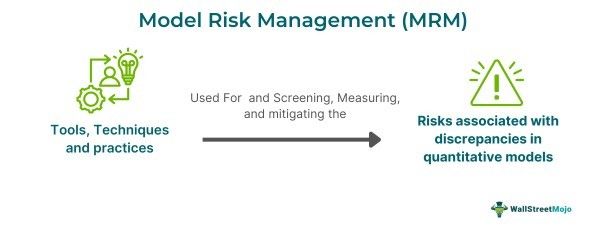
Model risk management (MRM) refers to identifying, measuring, and mitigating the potential uncertainties associated with using inefficient or wrong models or their misuse for critical decision-making. Such practices, tools, and techniques are critical for financial institutions and organizations that majorly function upon quantitative models.
Many financial institutions and related businesses, like banks, credit unions, finance companies, insurance companies, etc., leverage the behavioral, credit, and market models for decision-making. These quantitative models are widely used for credit scoring, data analytics, identification of credit card frauds, investment decision-making, insurance premium evaluation, etc. Therefore, their accuracy and efficiency are paramount for these organizations.
Key Takeaways
- Model risk management (MRM) is a mechanism companies use to analyze, evaluate, and mitigate the potential chances of failure of a particular quantitative model about errors, misuse, or discrepancies.
- The various model risks it addresses include specification, implementation, and application risks.
- The primary principles of MRM include model identification and risk classification, governance, development and usage, independent validation, and risk mitigation.
- Effective model risk management ensures superior operational efficiency, regulatory compliance, effective auditing, corporate sustainability, loss mitigation, and robust model development.
How Does Model Risk Management Work?
Model risk management (MRM) is a structured process of identifying, monitoring, measuring, and mitigating the various uncertainties related to the errors, discrepancies, or misuse of quantitative models. Some businesses function through risk-taking. Such firms include insurance companies, credit unions, banks, and other financial institutions. Thus, these organizations set up the model risk management framework to employ tools, techniques, and practices that determine the reliability, sufficiency, and accuracy of the various quantitative models used for making investment decisions, credit scoring of customers, insurance premium calculation, and performing other financial operations.
There are three kinds of model risk that companies encounter when such modeling practices primarily drive their crucial decisions and operations. These are:
- Specification Risk: It is essential to outline every detail and requirement of the models, including their design, use, inventory, data pulling, cost, etc., to avoid any uncertainties related to model specifications.
- Application Risk: Such type of danger arises when a model seems irrelevant, unreliable or makes false interpretations.
- Implementation Risk: The ease of use, computational speed, technicality, and other features a model possesses can lead to potential implementation risks.
All the above risks can be gauged and mitigated through MRM.
Principles
Now, emphasizing the banking industry, certain principles that govern the model risk management in banking are:
- Model Identification and Risk Classification: The companies should have clarity on the models they require, their inventory, and the type of potential model risk and its management.
- Governance: The senior management and board should develop a robust MRM framework by defining their model risk appetite, appointing personnel to oversee the MRM functions, and undertaking MRM policy decisions to ensure best practices.
- Development and Usage: The organizations need to develop a standard process for model selection, implementation, and performance measurement. There should be provisions for regular testing and frequent updations to ensure that any errors or pitfalls are identified, recorded, and rectified on time.
- Independent Validation: The companies should have a separate body or personnel for performing model validation to ensure that these quant models are relevant at all times. They should also suggest any improvements or redevelopment required to upgrade these models over time.
- Risk Mitigation: The organizations should frame model risk-mitigant policies and procedures to address any underperformance or inaccurate results driven from a model to make necessary adjustments to it.
Examples
Model risks can considerably affect a business’s profitability and sustainability. Let us understand the need for MRM through the following examples:
Example #1
Suppose a finance company uses multiple third-party credit scoring models to allocate credit scores to potential borrowers based on their credit history, financial status, assets, age, employment or income, and other such factors. The MRM team used an AI-leveraged tool to find whether these models were accurate for credit analysis. However, the scores provided by the two models were significantly different than the other models. While one model failed to consider all the factors for credit scoring, the other model couldn’t process more than five previous credit transactions. Therefore, these models were replaced with more reliable ones.
Example #2
ValidMind, a company specializing in AI and model risk management for the financial sector, has secured $8.1 million in seed funding. This round was led by Point72 Ventures and supported by Third Prime, New York Life Ventures, AI Fund, Notion Capital, FJ Labs, Angel Invest, and Gaingels. Thus, the total funds raised by ValidMind amounts to $11.1 million. The investment aims to enhance ValidMind’s market presence and solidify its role in financial services, especially as AI and machine learning adoption fosters.
Moreover, since 43% of financial executives predict AI’s critical role by 2025, it has become crucial to manage AI-related risks. Also, the SR 11-7 (U.S.), SS1-23 (U.K.), the EU’s AI Act, and the U.S. AI Bill of Rights exert regulatory pressures to push financial institutions further to seek comprehensive solutions for model risk management.
In the meanwhile, ValidMind’s platform addresses these needs by automating model documentation and governance, which enhances efficiency, reduces time-to-market, and ensures compliance. Indeed, the new funding will support these initiatives and help ValidMind improve its services. Additionally, Murat Doganaksoy, the former Model Risk Officer at First Republic Bank, has joined ValidMind’s Advisory Board, thus contributing his 20+ years of expertise in model risk management to assist in product development and strategic planning for the company.
Best Practices
Financial institutions need to examine the viability of their financial models to confirm that they are on the right track. Some of the MRM best practices used by these businesses include:
- Every model should be structured with a clear purpose and specific roles and responsibilities.
- Examine models for their reliability, effectiveness, data availability, computational speed, and potential pitfalls.
- The developers should frequently develop test cases such as prototypes, external benchmarks, stress testing, etc.
- There should be separate validation and review of the test cases formed by the developers to ensure efficiency.
- The overall development process of the quant models and the related documents should be independently audited for assurance.
- Perform regression testing, I.e., automating the unit and functional tests throughout the model’s lifetime to ensure a robust build.
- Maintain all the documentation, codes, automated build scripts, and tests in a revision control system for easy accessibility.
- Use review tools to acquire feedback from the model reviewers for improving the models.
- Leverage project tracking tools for handling issues, bugs, and features of these models.
- Ensure constant monitoring and improvement in the models for risk mitigation.
Benefits
MRM has gained significance since financial organizations majorly depend upon these quantitative models for predictions, analysis, and decision-making. Let us now discuss some of its advantages:
- Gauge Model Risks: The model risk management framework identifies, monitors, and measures the potential uncertainties and inefficiencies of a quantitative model for a comprehensive overview of model risk insights.
- Determine Model Accuracy: It helps the organization frequently review the financial models for any potential errors, misuse, discrepancies, or outdated information and make modifications accordingly to ensure that the existing models are accurate and efficient.
- Achieve Operational Efficiency: The enterprise model risk management is essential for the smooth functioning of a company whose significant operations and decisions are based upon such models.
- Effectively Leverage Technology: The mechanism of the financial models is structured based on software and databases. Therefore, it is critical to manage the risks associated with it for efficient use of the technology.
- Fulfil Stakeholders’ Expectations: The firms can limit their losses by structuring their model risk management framework, thereby meeting the expectations of their directors, shareholders, employees, customers, and other stakeholders.
- Ensure Regulatory Compliance: The companies adhere to government regulations and audit requirements by managing the model risk efficiently.
- Attain Business Sustainability: The use of accurate models is the foundation of a firm’s success when it requires quantitative modeling for business decision-making, thus making it sustainable in the long run.
Frequently Asked Questions (FAQs)
Frequently Asked Questions
What does model risk management do?
The MRM efforts ensure that the models used in business are accurate, reliable, useful, and efficient in all senses.
What is a model in model risk management?
In MRM, a model refers to a quantitative tool or mathematical framework that enables the conversion of raw input data into final results or outcomes. These outputs serve as a basis for critical decision-making.
Why is model risk management in banking important?
Financial institutions like banks prominently rely upon the data acquired from the quant models for decision-making related to loans, credit card issuance, and other functions. Therefore, they adopt MRM as a constant process.
What are the stages of model risk management?
The model risk management involves the following critical phases: – Analyzing the model requirements, – Developing a suitable model, – Deploying or implementing the model into practice, – Testing the model for reliability and accuracy, – Bringing the model into use, – Validating the model’s efficiency through frequent audits – Remedifications and redevelopment of models