


What Is Market Abuse?
Market abuse is an unfair practice or behavior whereby an individual or group manipulates or misuses certain information to make undue personal gains or works to the disadvantage of other financial market participants, such as traders and investors. It includes market manipulation, insider trading, and unlawful disclosure.
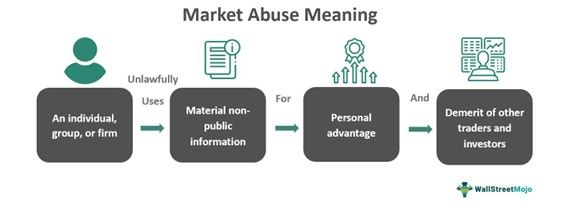
The people responsible for market abuse disobey fair market regulations, shattering investors’ confidence in the financial markets. Thus, ethical investors suffer the ultimate loss by trading on unreal security prices. Therefore, it becomes essential to identify, discourage, and punish such unfair practices to maintain market integrity and ensure fair market competition.
Key Takeaways
- Market abuse is the deceitful act of an individual, group, or firm to wrongfully use material non-public information to gain an illegitimate advantage or for the demerit of the other market players.
- The three prominent market abuse categories include unlawful disclosure, insider trading, and market manipulation.
- The MAR compliance team employs various market surveillance algorithms and constantly monitors and tracks unusual trade activities to detect these unfair practices.
- The companies should follow the market abuse policies, monitor the personal trading of their employees, identify and mitigate the associated risks, and comply with the regulatory requirements to prevent such cases.
Market Abuse Explained
Market abuse is an unfair practice in the financial market where a person, firm, or group illegitimately uses material non-public information for their benefit or the disadvantage or loss of other traders and investors. Such unfair actions can make the markets incompetent for honest market participants while negatively affecting their confidence levels in the financial markets. These deceitful actions include wash trading, spoofing, marking the open, marking the fix, marking the close, front running, pools, pump-and-dump, cornering the market, ramping, layering, etc.
The financial market often encounters unreal price fluctuations in investments and securities due to the various market speculators and manipulators who act against the MAR. The market abuse regulation (MAR) applies to all kinds of financial instruments, including stocks, debt assets, and derivatives across the different financial markets globally. Subsequently, the EU market abuse regulation was developed on July 03, 2016. Moreover, the compliance team emphasized the enforcement of the market abuse directive (MAD) across Europe’s financial markets. Later, the UK market abuse regulation overruled the EU MAR on December 31, 2020.
Types
According to the market abuse regulation (MAR), seven different kinds of behavior are identified as unfair in the financial markets. These are as follows:
- Insider Dealing: Insider trading is one of the most common types of unfair practices where the manipulators have their hands on non-public corporate information and use it illegally.
- Unlawful Disclosure: In this form of abuse, insider information is leaked to the people or groups that are unauthorized to access such non-public disclosures.
- Misuse of Information: Sometimes, the individual with access to non-public information may use it illegally to make personal gains.
- Manipulating Devices: In this form of market manipulation, the culprits may interfere with the orders to trade or bids through fictitious devices. The regulators need to ensure compliance to maintain market integrity.
- Manipulating Transactions: Such practices involve furnishing any deceitful or misleading information on the securities’ demand, supply or price. Such practices as wash trading require strict regulatory compliance.
- Dissemination: In this misconduct, the sensitive information is illegally shared with deceitful intent.
- Distortion and Misleading Behavior: This category comprises all the other false practices that don’t fall under the above categories but adversely affect market sentiments.
Examples
We often encounter various cases of market abuse that decrease investors’ confidence. Let us discuss a few of these instances below:
Example #1
Suppose Mr. Truman is the CEO of ABC Insurance Co. He has access to all the confidential information about the company’s venturing and future projects. Mrs. Clement is Mr. Truman’s sister, and she is a stock market investor. Mr. Truman unlawfully discloses the upcoming merger of ABC Insurance Co. with XYZ Fincorp Ltd. to expand its vertical. This information is then illegitimately used by Mrs. Clement, who buys and holds the XYZ Fincorp Ltd. stocks in bulk. Thus, such an unfair trade practice is punishable by law.
Example #2
On June 17, 2024, Trafigura agreed to settle its litigation with the US Commodity Futures Trading Commission (CFTC) for $55 million on the allegations of fraud and market manipulation. The alleged misconduct commenced from 2014 to 2020 when the company traded gasoline using insider information, manipulated a fuel oil benchmark, and obstructed whistleblower communications.
Although Trafigura denied the allegations, it has worked on its compliance program after the incident. However, this settlement has increased the legal challenges for Trafigura, including an alleged bribery fine amounting to $127 million in Brazil. The CFTC claimed that Trafigura obtained the confidential information unlawfully to manipulate fuel oil prices in 2017 and deterred the whistleblower communication through the enforcement of the restrictive non-disclosure agreements (NDAs). Hence, Trafigura agreed to change its NDAs to incorporate employees to report illegal activities to authorities.
Source – https://www.ft.com/content/d30f7715-0c8a-42fa-a492-4c64800c55bc
How To Detect?
The identification of market abuse is essential for the compliance authorities to make the markets better and ensure that there is no scope for any such unfair activities. Such practices can be detected by using the following measures:
- Trade Surveillance Algorithms: Layering or spoofing, wash trading, and marking the open, close, and fix can be easily identified through trade surveillance technology and other algorithms that are meant to identify the trader’s unfair activities in these contexts.
- Tracking Unusual Trades: The compliance teams can observe the actions of the traders who may have the MNPI and leverage such information to benefit their firms through insider trading practices.
How To Deal With It?
The companies can gauge and prevent unfair trade practices like market abuse with the help of the following best practices:
- The firms should follow the market abuse regulations, compliance laws, and policies to avoid such practices.
- The businesses should discover all the potential risks pertaining to the market abuse and establish the risk mitigation mechanism for it.
- The companies should adopt the best practices for bookkeeping and workflow management.
- The organizations should clearly contemplate all the regulatory requirements for disclosure of information, insider lists, suspicious orders, insider duties and responsibilities, etc.
- Firms should keep a close eye on the personal trading activities of their employees.
Frequently Asked Questions (FAQs)
Frequently Asked Questions
Is market abuse a criminal offense?
Since all types of market abuse are unethical and can negatively impact the investors’ confidence in the financial markets, most of these unfair practices are subjected to criminal proceedings like insider trading.
Who must comply with market abuse requirements?
According to the MAR, the companies registered with the financial markets must comply with market abuse surveillance, supervision, laws, and controls to ensure market integrity and avoid such deceitful acts.
Can the general public be prosecuted for market abuse?
Under the market abuse regulations, alleged individuals, groups, and companies, whether the general public, private entities, or government agencies, are subject to market abuse prosecutions.
What penalties can the FCA impose for market abuse?
The UK’s FCA market abuse regulation subjects the offenders to order injunctions, prohibitions, and unlimited fines. However, the parties alleged of market manipulations and insider dealings are charged with criminal proceedings, including unlimited penalty charges and up to 10 years of custodial sentences.