


What Is North Sea Brent Crude?
North Sea Brent crude is a specific type of light-sweet, blended crude oil obtained from the North Sea. Its low density makes it light, and its low sulfur content makes it sweet. Moreover, it is a preferred reference point for determining the price of other crude oils globally.
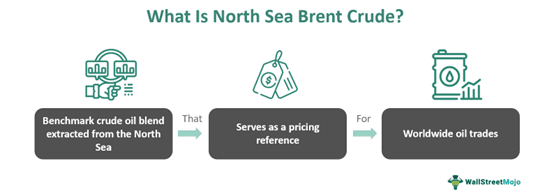
According to the standard scale of the American Petroleum Institute, Brent crude has high gravity. The name of this crude oil is derived from the Brent oil field, situated in the North Sea, close to the Shetland coast in Scotland. Also, it is listed on the Intercontinental Exchange (ICE) for virtual exchange and is one of the most commonly traded commodities in the world.
Key Takeaways
- North Sea Brent Crude is a superior quality crude oil produced at the Brent oil and gas field located in the northeast of the Shetland coast of Scotland. It is a light (low density) and sweet (low in sulfur) crude oil.
- It serves as a benchmark or base for setting the prices of other crude oils across the world. More than two-thirds of the world’s oil refineries depend on Brent price.
- Although the Brent field was decommissioned in 2017, the Brent crude is bought and sold as a futures contract on the Intercontinental Exchange (ICE), London.
North Sea Brent Crude Explained
North Sea Brent crude is famous for its low sulfur content, making it an attractive option for refineries worldwide. Compared to heavier crude oils, it is simpler to refine, which enables quicker processing at lower costs. Brent crude oil futures contract is a popular Intercontinental Exchange (ICE) stock. It is an international oil benchmark for ascertaining the value of more than two-thirds of the world’s other crude oils. The Organization of the Petroleum Exporting Countries (OPEC) even recognizes it as an international reference point for oil prices.
Also, its price is governed by factors such as global supply and demand, geopolitical events, and weather conditions. Moreover, the price fluctuation of Brent crude indicates the global economic condition since its price is closely related to the price of other commodities and the strength of major currencies.
The discovery of North Sea Brent crude oil dates back to the late 1960s when the North Sea experienced exploration and drilling activities. In 1971, Shell located the Brent oilfield, which was marked as one of the most significant oil discoveries in history. The oil production at Brent first started in 1976. The first cargo of Brent crude was exported from the Sullom Voe terminal in the Shetland Islands in 1979, and the price was set at $14.55 per barrel.
Then, there was no looking back; in the 1980s, the Brent oilfield produced at its highest capacity, I.e., 500,000 barrels per day. However, the capacity declined in the 1990s, and the field was decommissioned in 2017. However, it is still a significant benchmark for crude oils.
Price Chart
The ICE Brent crude oil is currently trading at slightly over $84 per barrel. It has seen a decline for the second consecutive week, possibly influenced by a global economic slowdown and indications of a contraction in global supply, impacting energy demand. Brent crude has experienced a 4% decrease this week, potentially reflecting concerns about economic inflation. Market observers are closely monitoring the actions of central banks like the Federal Reserve and the European Central Bank, with expectations of tighter monetary policies, including possible interest rate hikes in May 2023.
Additionally, a recent report from the Energy Information Administration (EIA) revealed a significant decline in US crude oil inventory by 5.054 million barrels, surpassing previous estimates of a 1.486 million-barrel decrease. Furthermore, OPEC+ has announced plans to reduce oil output further starting in May, which could exacerbate the contraction of the global oil supply.
Examples
Let’s understand the concept with the help of some real-world and hypothetical examples.
Example #1
In a hypothetical scenario, let’s consider the impact of a disruption in North Sea Brent Crude production. Due to unforeseen maintenance issues at several key oil platforms in the North Sea, the production of Brent crude is experiencing a significant drop. This disruption leads to a shortage of this particular grade of crude oil in the market, causing its price to spike.
Refineries that rely heavily on Brent crude for their operations are forced to seek alternative sources or adjust their refining processes, potentially leading to higher production costs and affecting their profit margins. As a result, the spike in Brent crude prices may also influence broader energy markets, impacting the prices of gasoline, diesel, and other refined petroleum products. Additionally, traders and investors closely monitor the situation, adjusting their strategies in response to the changing dynamics of the Brent crude market.
Example #2
On June 10, 2022, Brent crude oil prices experienced a notable decline of $3, equivalent to 2.4%, dropping to $120.07 per barrel. This decrease coincided with a broader downturn in the US stock market. The drop in oil prices followed the announcement of new COVID-19 lockdown measures in Shanghai and Beijing, China, which raised concerns about reduced global oil demand due to restricted travel activities. Additionally, fears of inflationary pressures impacting consumer spending and the possibility of reduced oil production in Norway due to a potential workers’ strike contributed to downward pressure on Brent crude prices.
Frequently Asked Questions (FAQs)
Frequently Asked Questions
Is North Sea Brent Crude still produced?
Yes, North Sea Brent Crude is still produced, although production levels have declined over the years. The Brent oil field, one of the primary sources of this crude oil, was decommissioned in 2017 due to declining reserves. However, other fields in the North Sea region continue to yield Brent crude oil.
How does North Sea Brent Crude compare to other crude oils?
North Sea Brent Crude is known for its relatively low sulfur content and light, sweet characteristics, making it desirable for refining into various petroleum products. Compared to heavier crude oils, such as those from tar sands or heavy crude blends, Brent crude is easier and cheaper to refine, resulting in higher yields of valuable products like gasoline and diesel. Additionally, its geographical location in the North Sea region provides logistical advantages for transportation to European and global markets.
Is North Sea Brent Crude environmentally friendly?
While North Sea Brent Crude is known for its relatively low sulfur content compared to heavier crude oils, its environmental impact depends on factors such as its production methods, transportation, and refining processes. Efforts are continually made to minimize the environmental impact of oil extraction and refining activities.